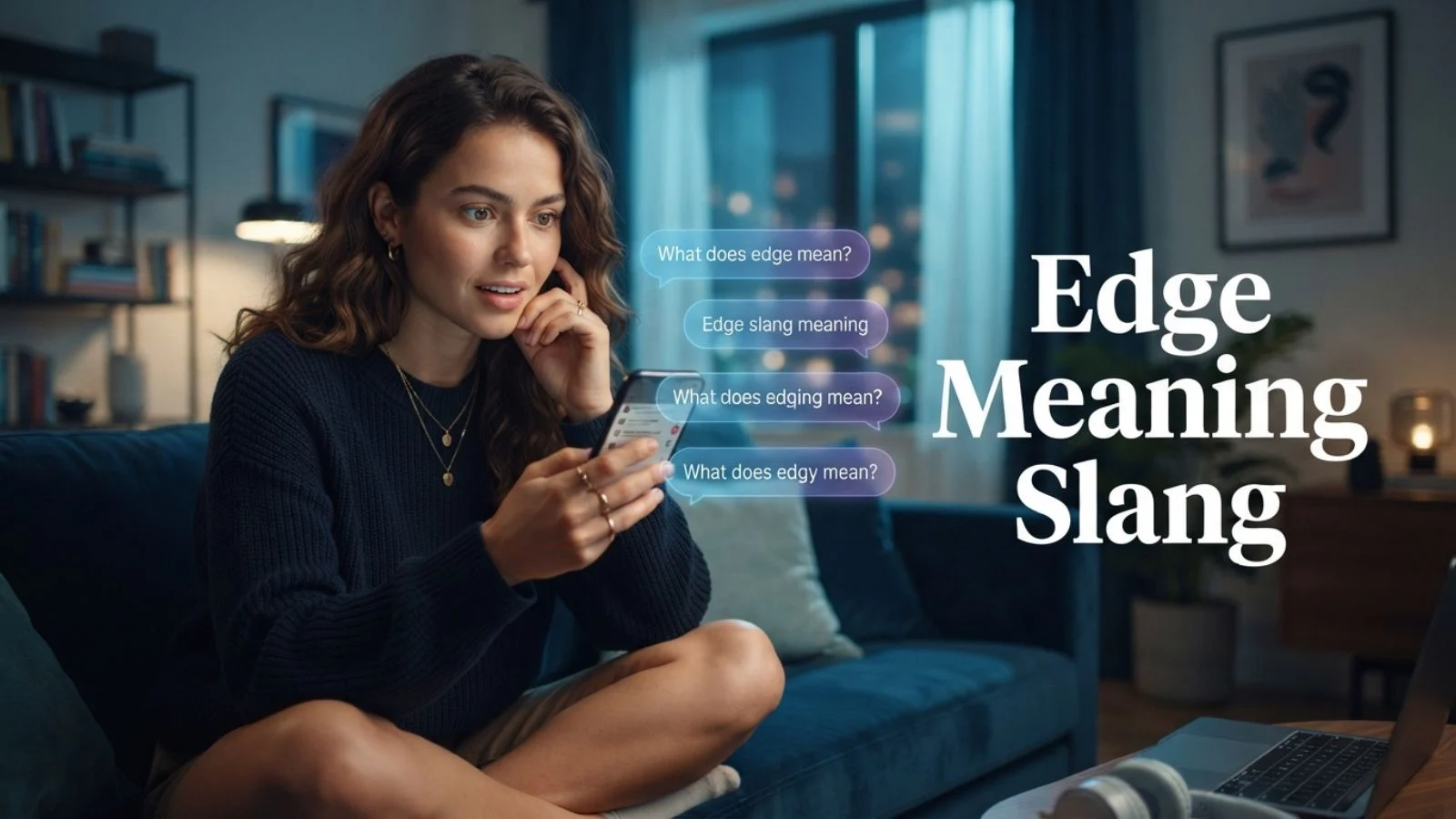
Have you ever seen the word “edge” in a TikTok comment, text message, meme, or gaming chat and wondered what it actually means? You’re not alone.
The phrase “Edge Meaning Slang” can be confusing because its meaning changes depending on the conversation and platform. In everyday English, “edge” can mean an advantage, while “on edge” describes someone who feels nervous or tense.
Online, however, “edge” and “edging” can also have different slang meanings, including adult references and jokes.
Social media users may also use the word when talking about suspense, teasing, or provocative behaviour.
In this guide, we’ll break down the different meanings of edge slang in simple language. You’ll learn what it means in texting, TikTok, gaming, memes, and everyday conversations, plus how to recognize the intended meaning from context.
What Does “Edge” Mean in Slang?
The word “edge” can have several meanings in slang, and the correct meaning usually depends on the context. Unlike many slang words with one popular definition, “edge” has developed different uses across texting, social media, gaming, memes, and everyday conversations.
In one common use, edge is connected to “edging,” an adult slang term. Online communities may shorten “edging” to “edge,” especially in jokes, comments, or memes. Because of this, seeing “edge” in an internet conversation can sometimes suggest an adult meaning.
However, not every use of “edge” is sexual. For example, someone might say, “Our team has the edge,” meaning their team has an advantage over the competition. Similarly, the phrase “on edge” means feeling nervous, tense, or worried.
On social media, “edge” can also appear when someone is deliberately building suspense or delaying a reveal. A creator who keeps teasing an announcement without revealing it may be jokingly accused of “edging” their audience.
Another related word is “edgy.” When someone calls a joke, person, character, or style “edgy,” they usually mean it is dark, provocative, rebellious, or designed to shock.
So, when you see “edge meaning slang,” remember that there isn’t one fixed definition. Always check the surrounding words, platform, and tone before deciding what someone means.
What Does “Edging” Mean in Slang?
“Edging” is one of the most common internet-related meanings connected with the word “edge.” The term originally has an adult meaning, referring to deliberately delaying sexual climax. Because of that association, you may see “edge,” “edging,” or “edger” used in memes, jokes, comments, and online conversations with a suggestive meaning.
However, internet users also use “edging” in a broader, non-sexual way. For example, someone might say, “Stop edging us and show the video already!” In this situation, the speaker is joking that another person is deliberately delaying a reveal or keeping the audience waiting.
This newer, playful usage is especially common in online communities where words can quickly develop exaggerated or humorous meanings. The surrounding conversation is therefore important when interpreting the term.
For example, if someone says “I’m edging the announcement,” they may simply mean they are teasing people and delaying the announcement. But if the conversation contains clearly adult references, the original sexual meaning may be intended.
It is also worth remembering that “edge” and “edging” are not automatically inappropriate words in every situation. Their meaning depends heavily on context, tone, and the people involved.
If you encounter the term in a conversation and are unsure what the person means, look at the words around it before jumping to a conclusion. This is particularly important on TikTok, Discord, Reddit, and meme pages, where slang is often used jokingly or with multiple meanings.
What Does “Edge” Mean in Text Messages?
When someone uses “edge” in a text message, the meaning can change significantly depending on the conversation. Unlike a word such as “LOL,” which usually has one clear meaning, edge slang can refer to an advantage, suspense, an internet joke, or an adult reference.
For example, if someone texts, “Our team has the edge,” they simply mean their team has an advantage. This is a normal use and has nothing to do with internet slang.
On the other hand, a message such as “Stop edging me and tell me already!” may use the word in a playful, non-sexual way. Here, the person means that someone is deliberately delaying an answer, reveal, or piece of information.
Context becomes especially important when “edge” appears by itself. A friend sending just “edge 💀” could be making a meme reference, while someone discussing an adult topic may intend the sexual meaning associated with “edging.”
The tone of the conversation can also provide clues. Look at the messages before and after the word, the emojis being used, and the subject being discussed. This can help you understand whether the person means advantage, suspense, humor, or something more suggestive.
If you’re unsure, there is nothing wrong with asking, “What do you mean by edge?” A simple clarification is better than assuming the wrong meaning.
What Does “Edge” Mean on TikTok?
On TikTok, “edge” can have several meanings, which is why the slang may seem confusing when you first see it in comments or captions. The intended meaning usually depends on the video, conversation, and other words surrounding it.
One common internet use comes from “edging,” an adult slang term. TikTok users may sometimes mention “edge” or “edging” as part of memes, jokes, or trending conversations. However, not every TikTok reference has an adult meaning.
Another popular use is connected to suspense and anticipation. A creator might repeatedly tease a video, reveal, story, or announcement without showing the result. Viewers may jokingly say the creator is “edging us”, meaning they are making everyone wait for the payoff.
For example, a creator might post, “The answer is coming in Part 2,” after creating lots of suspense. A commenter could respond, “Bro is edging us 😭.” Here, the phrase is being used humorously to describe delayed information.
TikTok also has a strong meme culture, so words can be intentionally used with double meanings. This means you should not automatically assume that “edge” has one specific definition whenever you encounter it.
The best way to understand edge meanings on TikTok is to look at the video’s topic, comments, caption, and overall tone. If the content is about an announcement or reveal, it may refer to suspense. If the conversation is clearly adult, the meaning can be different.
What Does “Edge” Mean on Instagram, Discord, Reddit & X?
The slang “edge” can appear across Instagram, Discord, Reddit, and X, but its meaning depends on the community and conversation. Online slang often spreads between platforms, so the same word may carry different meanings in different situations.
On Instagram, “edge” may appear in comments, memes, captions, or jokes. A comment such as “Stop edging us” can mean that someone is deliberately delaying a reveal, announcement, or expected content. In other contexts, it may refer to the adult meaning associated with “edging.”
On Discord, meaning depends heavily on the server. Gaming communities may use “edge” to mean having an advantage, while meme-focused communities may use it as internet slang or humor. Always consider the topic being discussed before interpreting it.
On Reddit, “edge” is particularly context-dependent because different communities have their own vocabulary and inside jokes. A gaming subreddit, meme community, and adult subreddit may use the same word in completely different ways.
On X, users may use “edge” in memes, reactions, arguments, or posts about trending topics. “Edgy” may also appear when describing humor or opinions considered provocative, dark, or deliberately shocking.
The important point is that edge does not have one universal social-media meaning. If you encounter the word online, check the surrounding conversation first. Look at the post’s subject, the comments, and whether people are discussing gaming, suspense, humor, personality, or adult topics. Context usually makes the intended meaning much easier to understand.
What Does “Edge” Mean in Gaming?
In gaming, “edge” usually has a completely normal meaning: having an advantage over another player or team. Gamers commonly use the phrase when discussing better equipment, stronger strategies, superior skills, or any factor that could improve their chances of winning.
For example, a player might say, “This weapon gives me an edge,” meaning the weapon provides a useful advantage. Similarly, “Our team has the edge” means the speaker believes their team has a better chance of winning.
The word can also appear in gaming memes and casual chat with other internet meanings. For instance, players may jokingly say someone is “edging the lobby” when they keep delaying an action or making other players wait. In this situation, the meaning comes from online meme culture rather than the traditional gaming definition.
It is important not to automatically interpret every gaming use of “edge” as adult slang. Gaming conversations frequently use the word in its ordinary sense of advantage or superiority.
Common Gaming Examples
- “We have the edge this round.” Your team has an advantage.
- “Better gear gives him an edge.” Better equipment improves his chances.
- “She has the edge because she knows the map.” Her knowledge provides an advantage.
- “That strategy gives us an edge.” The strategy puts the team in a stronger position.
What Does “Edge” Mean When Describing a Person?
When “edge” is used to describe a person, it is often connected to the word “edgy.” In this context, it usually describes someone who acts, dresses, speaks, or behaves in a way that seems dark, rebellious, provocative, or intentionally shocking.
For example, someone might say, “He’s trying to be edgy,” when a person makes controversial jokes or deliberately says something shocking to get a reaction. The word can be neutral, playful, or insulting depending on the speaker’s tone.
What Does “Edgy” Mean?
Edgy can describe a person, personality, joke, fashion style, character, or piece of content that pushes normal boundaries. It is often associated with dark humor, unusual opinions, rebellious behavior, or provocative themes.
For example:
- “That character is really edgy.” The character has a dark or rebellious personality.
- “He keeps making edgy jokes.” His jokes are provocative or designed to shock people.
- “Her style is edgy.” Her fashion looks bold, unconventional, or rebellious.
Is “Edgy” a Compliment?
It depends on the context. Someone may use “edgy” positively to describe a bold fashion style or creative personality. However, it can also be criticism when someone believes a person is trying too hard to appear shocking or rebellious.
You may also encounter the term “edgelord” online. It is generally used mockingly for someone who repeatedly tries to appear extreme, offensive, or provocative.
What Does “Edge” Mean in “On Edge”?
The phrase “on edge” is another important meaning to understand because it is often confused with internet slang. In everyday English, “on edge” means feeling nervous, tense, worried, or uncomfortable. It does not usually refer to the adult slang meaning associated with “edging.”
For example, if someone says, “I’ve been on edge all day,” they mean they have been feeling anxious, restless, or unusually tense. Similarly, “The scary movie left me on edge” means the movie created a strong feeling of tension or nervous anticipation.
The phrase can also describe a situation where people are waiting for something uncertain to happen. For example:
“Everyone was on edge waiting for the final results.”
Here, “on edge” suggests that everyone feels nervous because they do not know what will happen next.
Common Examples of “On Edge”
- “She’s been on edge since the meeting.” She feels tense or worried.
- “The sudden noise put me on edge.” The noise made the person feel uneasy.
- “Fans were on edge during the final minutes.” Fans were nervous and excited about the outcome.
- “I’m feeling a little on edge today.” The person feels tense or unsettled.
This meaning is much older and more established than many modern internet uses of edge slang. Therefore, when you see “on edge” in a message, conversation, article, or social-media post, it normally means nervous or tense.
What Does “Have an Edge” Mean?
When someone says they “have an edge,” they usually mean they have an advantage over someone else. This is one of the most common and completely normal meanings of the word “edge.” Unlike some internet slang uses, this expression does not automatically have a sexual or suggestive meaning.
The phrase is often used in sports, gaming, business, school, and competitions. The advantage can come from better skills, experience, equipment, knowledge, preparation, or strategy.
For example, someone might say:
- “Our team has the edge.” Our team has an advantage.
- “Experience gives her an edge.” Her experience helps her perform better.
- “This strategy gives us an edge.” The strategy provides a competitive advantage.
- “The home team has the edge tonight.” The home team is considered more likely to succeed.
You may also hear “competitive edge.” This simply means something that helps a person, company, or team perform better than competitors.
For example, a business might say, “Fast delivery gives us a competitive edge.” The company is saying that its faster service gives it an advantage over other businesses.
The surrounding words usually make this meaning easy to recognize. If the conversation involves winning, competition, performance, skills, or strategy, “edge” most likely means advantage.
Edge vs. Edging vs. Edgy vs. On Edge
Although edge, edging, edgy, and on edge look similar, they do not always mean the same thing. Understanding the difference is important because these terms appear in texting, social media, gaming, memes, and everyday conversations.
Edge is the basic word and can mean an advantage, a boundary, depending on internet context a shortened reference to “edging.” For example, “Our team has an edge” means the team has an advantage.
Edging is a form of internet slang with an adult meaning, but it can also be used jokingly to describe deliberately delaying a reveal or keeping someone waiting. Context is especially important with this term.
Edgy is different. It generally describes something dark, provocative, rebellious, unconventional, or designed to shock. You might hear someone say, “That character is edgy” or “That joke is too edgy.”
On edge is an everyday expression meaning nervous, tense, uneasy, or worried. For example, “I was on edge before the results came out” means the person was feeling nervous while waiting.
Quick Comparison
| Term | Common Meaning |
| Edge | Advantage or context-dependent slang |
| Edging | Adult slang or delaying a reveal |
| Edgy | Dark, provocative, or rebellious |
| On edge | Nervous or tense |
How Context Changes the Meaning of “Edge”
The meaning of “edge” can change completely depending on where and how it is used. This is especially true online, where slang often develops different meanings across TikTok, gaming communities, memes, and private messages. Instead of looking at the word alone, pay attention to the conversation and surrounding words.
If the conversation is about sports, competition, or gaming, “edge” usually means an advantage. For example, “Our team has an edge” means the team has something that gives it a better chance of winning.
If someone is discussing suspense or a delayed reveal, “edging” may be used humorously to describe keeping people waiting. A creator who constantly teases an announcement without revealing it may be told, “Stop edging us!”
In an adult conversation, “edging” can have its established sexual slang meaning. Because of this, context is important before interpreting the word.
When the topic is personality, fashion, humor, or behavior, the word “edgy” usually means dark, provocative, rebellious, or intentionally shocking.
Meanwhile, the phrase “on edge” generally means nervous, tense, or uneasy. This is a common everyday expression rather than a modern internet slang term.
A Simple Context Check
Before deciding what “edge” means, ask:
- What are people talking about?
- Is this a gaming or competitive conversation?
- Is someone delaying a reveal?
- Is the conversation clearly adult?
- Is “edgy” describing a person or style?
- Does the phrase say “on edge”?
These clues can help you understand the intended meaning without making the wrong assumption.
Edge Meaning Slang Examples in Real Conversations
Seeing “edge” in a message can be confusing because the same word may have completely different meanings. The easiest way to understand it is to look at the surrounding conversation. Here are some simple examples showing how edge slang can be used in different situations.
Example 1: Competitive Meaning
Person A: “Who has the better chance of winning?”
Person B: “I think our team has the edge.”
Meaning: Their team has an advantage.
Example 2: Gaming
Player A: “Why did you choose that character?”
Player B: “It gives me an edge in close fights.”
Meaning: The character provides a competitive advantage.
Example 3: Suspense
Person A: “Are you going to tell us what happened?”
Person B: “Wait until tomorrow.”
Person A: “Stop edging us!”
Meaning: The person is jokingly accusing someone of delaying the reveal.
Example 4: Social Media
Comment: “Bro is edging the entire comment section 😂”
Meaning: The creator is keeping viewers waiting or teasing them without giving the expected answer.
Example 5: Edgy Humor
Person A: “What did you think of that joke?”
Person B: “It was pretty edgy.”
Meaning: The joke was provocative, dark, or designed to shock.
Example 6: Nervousness
Person A: “Why are you so quiet?”
Person B: “I’m on edge waiting for the results.”
Meaning: The person feels nervous or tense.
Example 7: Adult Context
Person A: “What does edging mean?”
Person B: “It’s an adult slang term.”
Meaning: Here, the word has its established sexual meaning.
Is “Edge” Slang Appropriate to Use?
Whether “edge” is appropriate depends on the meaning, audience, and situation. The word itself is completely normal English, but some internet uses of “edge” and “edging” can have adult or suggestive meanings. Because of this, it is important to consider the context before using the term.
In everyday conversations, phrases such as “have an edge” and “on edge” are generally safe and widely understood. For example, saying “Our team has an edge” simply means your team has an advantage. Likewise, “I’m on edge” means you feel nervous or tense.
However, internet slang can be more complicated. “Edging” may be used as an adult term, while social-media users sometimes use it jokingly to describe delaying a reveal or keeping an audience waiting. The same word can therefore have very different interpretations.
Where Should You Be Careful?
You may want to avoid slang uses of “edge” when communicating in:
- School or educational settings
- Workplace conversations
- Professional emails
- Family group chats
- Public posts with a broad audience
- Conversations with people you do not know well
If you are talking casually with friends, slang may be perfectly understandable. Still, if there is a chance someone could interpret the word differently, choosing clearer language is usually better.
For example, instead of saying “I’m edging you,” you could say “I’m keeping you waiting” when talking about a delayed reveal.
Is “Edge” a Bad Word?
No, “edge” is not inherently a bad word. It is a normal English word that has been used for a very long time. The confusion comes from the fact that internet users have developed additional meanings for “edge,” “edging,” and related terms.
In everyday English, “edge” can describe the boundary of something. For example, “Sit near the edge of the table” is completely ordinary. It can also mean an advantage, as in “Our team has an edge.”
The phrase “on edge” is also common and means feeling nervous, tense, or uneasy. For example, “I was on edge before the interview” simply describes nervousness.
The situation becomes different with “edging.” Online, this term can have an adult meaning. However, people also sometimes use it as a joke when someone deliberately delays a reveal or keeps an audience waiting. Because of this double meaning, the surrounding context is important.
The related word “edgy” is not automatically offensive either. It generally describes something dark, provocative, rebellious, or designed to shock. Calling a movie or joke “edgy” can be either criticism or a neutral description depending on the speaker.
So, When Should You Be Careful?
If you are using edge to mean an advantage or referring to something being on an edge, there is usually no issue. However, slang involving “edging” can be misunderstood in professional, school, or family settings.
How to Know Which Meaning of “Edge” Someone Means
When you see “edge” in a text, comment, or online conversation, the best way to understand it is to look at the context. Since the word has several meanings, reading it by itself can easily lead to the wrong interpretation.
1. Look at the Topic
The subject of the conversation is your first clue. If people are discussing a competition, “edge” probably means an advantage. If they are talking about suspense or a delayed announcement, it may refer to keeping someone waiting.
2. Check the Words Around It
A few nearby words can completely change the meaning.
For example:
- “We have the edge.” → We have an advantage.
- “I’m on edge.” → I feel nervous.
- “That joke is edgy.” → The joke is provocative or shocking.
- “Stop edging us.” → Stop delaying the reveal or payoff.
3. Consider the Platform
The platform can also provide a useful clue. In gaming communities, edge commonly refers to a competitive advantage. On TikTok or meme pages, it may be used humorously or as internet slang. Different online communities can develop their own meanings.
4. Pay Attention to Tone
Is the person being serious, sarcastic, humorous, or provocative? A laughing emoji or meme-style comment may indicate that the word is being used jokingly.
5. Ask If You’re Unsure
If the meaning still isn’t clear, simply ask, “What do you mean by edge?” There is no need to guess.
Common Misunderstandings About “Edge” Slang
Because “edge” has several meanings, people can easily misunderstand it when they see it online. A word that sounds completely normal in one conversation may have a very different interpretation in another. Knowing the common mistakes can help you understand the intended meaning more accurately.
Assuming “Edge” Always Has a Sexual Meaning
One of the biggest mistakes is assuming that every use of edge or edging refers to adult slang. That is not true. In gaming, sports, and everyday conversations, “edge” often simply means an advantage.
Confusing “Edge” With “Edgy”
These words are related in spelling but have different meanings. Edgy usually describes something dark, provocative, rebellious, or designed to shock. It does not automatically refer to “edging.”
Confusing “On Edge” With Internet Slang
The phrase “on edge” normally means nervous, tense, or uneasy. For example, “I was on edge before the exam” has nothing to do with modern internet slang.
Ignoring the Conversation
Another common mistake is interpreting a word without reading the surrounding messages. A single comment such as “edge” may be difficult to understand, but the previous messages can provide an obvious clue.
Assuming TikTok Has One Fixed Meaning
Slang on TikTok changes quickly, and the same word may be used seriously, humorously, or as part of a meme. The video’s topic and comments can help determine the intended meaning.
Taking Meme Language Literally
Online communities often exaggerate words for humor. Someone saying “Stop edging us” may simply be joking about a delayed announcement rather than using the term literally.
How to Respond When Someone Says “Edge”
If someone uses “edge” in a conversation and you are not sure what they mean, you do not have to guess. Because the word has several slang and everyday meanings, the best response depends on the context.
If the person is talking about gaming, sports, or competition, “edge” probably means an advantage. You can respond naturally with something like, “Yeah, that definitely gives you an advantage.”
If someone says “Stop edging us” while waiting for an announcement or reveal, they may be joking about being kept waiting. A casual response could be, “Okay, okay, I’ll wait!” or “Just tell us already!”
If someone uses “edgy” to describe a joke, movie, character, or personality, you can ask what they found provocative or unusual. For example, “What makes it edgy?”
Sometimes “edge” may have an adult slang meaning. If you are unsure or uncomfortable, the simplest response is “What do you mean by that?” This lets the other person clarify without making assumptions.
Simple Responses You Can Use
- “What do you mean by edge?”
- “Do you mean an advantage?”
- “Are you talking about the meme’s meaning?”
- “What does that mean in this context?”
- “Can you explain?”
Edge Meaning Slang: Common Uses at a Glance
The word “edge” has become popular across internet culture because people use it in several different ways. While some meanings are connected to slang, others are simply normal English expressions. Understanding these differences makes it much easier to interpret the word when you see it online.
The most common meanings can be grouped into a few categories. First, edge can mean an advantage, especially in gaming, sports, and competition. If someone says, “We have the edge,” they usually mean their side has a better position or greater chance of success.
Second, edging is an internet term that can have an adult meaning. It can also appear in jokes about delaying a reveal, announcement, or expected outcome. The surrounding conversation is important for determining which interpretation applies.
Third, edgy describes something that is dark, provocative, rebellious, or deliberately shocking. It can describe a person, joke, movie, character, fashion style, or online post.
Finally, “on edge” is a common phrase meaning nervous, tense, or uneasy. It is not necessarily slang at all.
Quick Reference
| Expression | Common Meaning |
| Edge | Advantage or context-dependent slang |
| Edging | Adult slang or delaying something |
| Edgy | Provocative, dark, or rebellious |
| On edge | Nervous or tense |
| Have an edge | Have an advantage |
| Competitive edge | Something that creates an advantage |
Edge Meaning Slang on Social Media: What It Really Means
The meaning of “edge” on social media depends heavily on the post, community, and tone. Platforms such as TikTok, Instagram, Discord, Reddit, and X allow slang to spread quickly, so a word can develop several meanings at the same time.
One common use is related to suspense or anticipation. When someone keeps teasing an announcement, video, answer, or reveal without actually providing it, users may jokingly say they are “edging” the audience. In this context, the phrase means keeping people waiting for the expected payoff.
Another use comes from adult internet slang. “Edging” has an established sexual meaning, so some memes and comments may use the word with that interpretation. However, you should not automatically assume this meaning whenever you see “edge” online.
Social media users may also use “edgy” when describing dark humor, provocative posts, rebellious personalities, or content designed to shock. For example, someone might call a controversial meme “edgy” because it intentionally pushes boundaries.
The word can also have its ordinary meaning. A post saying “This team has the edge” is most likely talking about an advantage, while “I’m on edge” means feeling nervous or tense.
How to Identify the Meaning
Look at:
- The topic of the post
- The words surrounding “edge”
- The platform or community
- The tone of the comment
- Whether the content is a meme or serious discussion
Is “Edge” Slang Appropriate for Everyone?
The slang meaning of “edge” is not appropriate for every audience or situation. While the word itself is completely normal, some uses of “edge” and “edging” can have adult meanings. Other uses are harmless, such as describing an advantage, suspense, or nervousness.
In casual conversations with friends, internet slang may be common and easily understood. However, it is better to be more careful in school, workplace, professional, or family settings. Someone who is unfamiliar with internet slang may interpret the word differently or misunderstand what you intended.
For example, saying “Our team has an edge” is safe because it clearly means an advantage. Likewise, “I’m on edge” simply means that you feel nervous or tense.
The phrase “Stop edging us” can be more complicated. Online, people may use it humorously when someone keeps delaying a reveal or announcement. However, because “edging” also has an adult meaning, some readers may interpret the phrase differently.
When Is “Edge” Usually Safe?
You can generally use the word without concern when discussing:
- A competitive advantage
- The edge of an object
- Being nervous or tense
- A competitive edge
- A sharp or physical boundary
When Should You Be Careful?
Be cautious when using edging-related slang in:
- Professional communication
- School assignments
- Public-facing content
- Conversations with younger audiences
- Formal messages
- Mixed-age communities
How to Avoid Misunderstanding “Edge” Slang
Because “edge” has several meanings, using it without enough context can sometimes confuse the person reading your message. This is especially true online, where slang, memes, and shortened expressions can have meanings that are different from traditional English.
The easiest way to avoid confusion is to be specific about what you mean. If you are talking about an advantage, use words such as “advantage” or “competitive edge.” For example, instead of saying, “We have an edge,” you could say, “Our team has a clear advantage.”
If you are talking about suspense, phrases such as “keeping us waiting,” “teasing the reveal,” or “building suspense” make your meaning clearer. This can prevent readers from connecting your message with the adult slang meaning of “edging.”
You should also consider your audience. Slang that works among close friends may not be suitable for a workplace, school, professional website, or public announcement. When communicating with a broad audience, straightforward language is usually the safest choice.
Context Can Make a Big Difference
Compare these examples:
- “Our team has the edge.” → Competitive advantage.
- “I’m on edge.” → Nervous or tense.
- “That character is edgy.” → Dark, provocative, or rebellious.
- “Stop edging us.” → Could mean delaying a reveal or having an adult interpretation.
Frequently Asked Questions
What does “edge” mean in slang?
“Edge” can have different meanings depending on context. It may refer to having an advantage, creating suspense, or be connected to the internet slang term “edging.” The surrounding conversation usually reveals which meaning is intended.
What does “edge” mean in texting?
In texting, “edge” can mean an advantage, while “edging” may refer to delaying something or, in some contexts, have an adult meaning. Always consider the topic and tone of the conversation.
What does “edge” mean on TikTok?
On TikTok, “edge” and “edging” may appear in memes, jokes, or comments about delaying a reveal. It can also carry an adult meaning, so the video’s context is important.
Is “edge” slang sexual?
Not always. “Edge” is a normal English word, and phrases such as “have an edge” and “on edge” are not inherently sexual. However, “edging” can have an adult slang meaning in certain online contexts.
What does “edgy” mean?
“Edgy” usually describes something dark, provocative, rebellious, or deliberately shocking. It can describe humor, fashion, characters, opinions, or someone’s online personality.
What does “on edge” mean?
“On edge” means feeling nervous, tense, worried, or uneasy. For example, “I was on edge waiting for the results” means the person felt nervous while waiting.
Is “edge” a bad word?
No. “Edge” itself is not a bad word. It is a standard English word, but some related internet slang particularly “edging”can have meanings that are unsuitable for certain audiences or situations.
How can I tell which meaning of “edge” someone means?
Look at the surrounding words, conversation topic, platform, and tone. If you’re still unsure, simply ask the person what they mean rather than assuming.
Final Takeaway
The easiest way to remember the Edge Meaning Slang is to look at the context. In gaming, sports, and competition, edge usually means an advantage or something that gives you a better chance of winning.
In phrases such as “on edge,” it means feeling nervous, tense, or worried. And when someone is described as “edgy,” it usually means they are being dark, provocative, rebellious, or intentionally shocking.
Online, “edge” and “edging” can also have slang meanings. In social-media jokes, “edging” may describe delaying a reveal or keeping people waiting. In some contexts, however, edging has an adult meaning, so the surrounding conversation is important.
So remember:
Edge = an advantage or a context-dependent slang term.
Edging = delaying something, or an adult slang term depending on context.
Edgy = dark, provocative, or rebellious.
On edge = nervous, tense, or uneasy.
Once you understand these differences, phrases such as “our team has an edge,” “stop edging us,” “that joke is edgy,” and “I’m on edge” become much easier to understand.