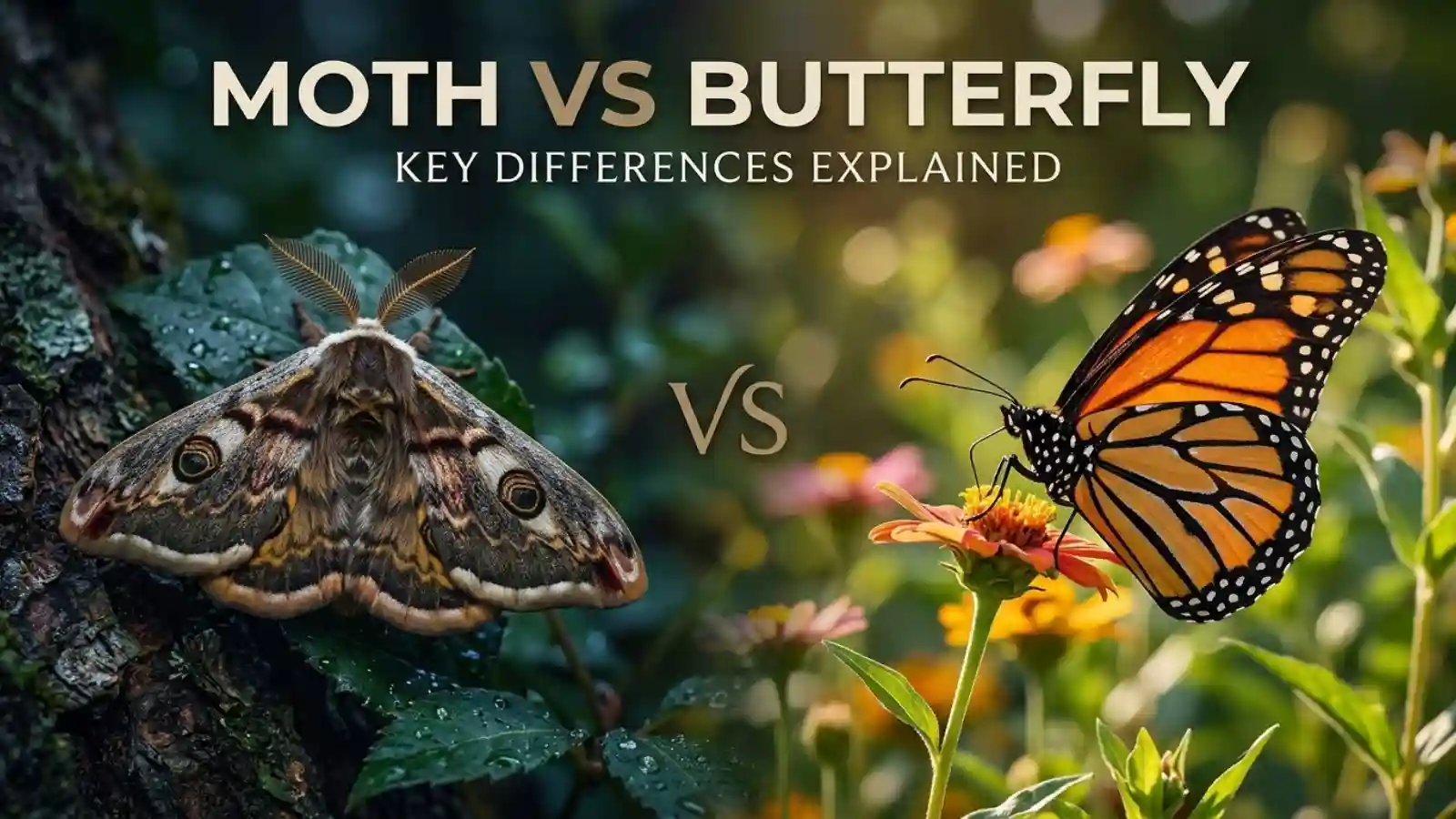
The easiest way to distinguish a moth from a butterfly is to check the antennae. Butterflies usually have thin antennae with club-shaped tips, while moth antennae are often feathery, tapered, or thread-like.
Wing position, activity time, body shape, and color can provide additional clues, but each has exceptions.
Key Takeaways:
- Butterflies usually have clubbed antennae; moth antennae are more varied and often feathery.
- Butterflies are mostly active during the day, while many moths are active at night.
- Butterflies commonly rest with their wings raised, while moths often rest with wings flat or tented.
- Both belong to the insect order Lepidoptera and undergo complete metamorphosis.
- Color alone is not a reliable way to identify a moth or butterfly.
Moth vs Butterfly: Quick Comparison
Moths and butterflies are close relatives. Both are winged insects in the order Lepidoptera, a name referring to the tiny scales covering their wings and bodies.
The biggest challenge is that there is no single simple rule that works perfectly for every species. Some moths are colorful and active during the day, while some butterflies can have darker colors.
Still, several features make identification much easier.
| Feature | Butterfly | Moth |
| Antennae | Usually club-shaped at the tips | Often feathery, tapered, or thread-like |
| Activity | Mostly daytime | Mostly nighttime |
| Resting wings | Often held upright | Often flat, folded, or tent-like |
| Body | Usually slimmer | Often thicker or fuzzier |
| Colors | Often bright, but not always | Often muted, but many are colorful |
| Pupa | Usually exposed chrysalis | Often protected by a cocoon |
| Group | Lepidoptera | Lepidoptera |
These are useful identification clues, rather than absolute rules.
How to Tell a Moth From a Butterfly
If you see a winged insect and want to identify it quickly, start with the antennae and then use the other features as supporting clues.
1. Check the Antennae
Antennae are usually the best first clue.
Most butterflies have relatively thin antennae ending in a noticeable club or knob. Moth antennae have much more variety. They can be thread-like, tapered, saw-edged, comb-like, or feathery, and generally do not have the same clubbed tip found on butterflies.
Feathery antennae are especially useful for recognizing many moths. In some male moths, the enlarged antennae help detect chemical signals from potential mates.
If you can get a clear view of the antennae, you can often make a good identification without relying on color.
2. Look at the Resting Wings
Wing position is another helpful clue.
Butterflies commonly rest with their wings held vertically above their backs. Moths often rest with their wings spread, folded flat, or arranged in a roof-like position over the body.
However, do not reject an identification simply because the wings do not match the usual pattern. Different species have different resting behaviors.
This clue works best when combined with antenna shape and body structure.
3. Consider When It Is Active
The time of day can also help.
Most butterflies are diurnal, meaning they are primarily active during daylight. Moths are generally more active at night and are often associated with artificial lights.
But this is not a perfect test.
Some moths are active during the day, including several highly visible species. Some butterflies may be active around dawn or dusk. That means seeing an insect during the daytime does not automatically make it a butterfly.
4. Check the Body Shape
Body shape can provide another useful clue.
Butterflies generally have slimmer bodies, while many moths have thicker, fuzzier-looking bodies. Moths often appear more heavily covered with scales, which can give them a soft or furry appearance.
This difference is especially noticeable when comparing a typical butterfly with a typical moth.
Still, there are exceptions. Some butterflies have relatively robust bodies, and some moths have slender bodies. Use body shape as supporting evidence rather than your only test.
5. Look at the Colors
Color is one of the least dependable ways to tell them apart.
Butterflies are often associated with bright blues, oranges, yellows, and other noticeable colors. Many moths have brown, gray, tan, or muted patterns that help them blend into their surroundings.
But colorful moths are common, and some butterflies are surprisingly plain.
The Australian Museum specifically notes that brightly colored day-flying moths exist, while some butterflies have dark or relatively dull patterns.
So, if you see a brightly colored insect, do not assume it is a butterfly. Check the antennae first.
Moth vs Butterfly Life Cycle
Moths and butterflies share a similar basic life cycle. Both undergo complete metamorphosis, passing through four major stages:
- Egg
- Larva or caterpillar
- Pupa
- Adult
The caterpillar stage is primarily focused on eating and growing. Eventually, the larva becomes a pupa and undergoes major physical changes before emerging as an adult insect.
Do Both Have Caterpillars?
Yes. Both moths and butterflies have caterpillar-like larvae.
Their caterpillars can look dramatically different, however. Some are smooth and brightly colored, while others are hairy, spiny, camouflaged, or covered with distinctive markings.
A caterpillar that looks unusual is not automatically a moth caterpillar or a butterfly caterpillar. Identification usually requires additional features or a species-level guide.
Cocoon vs Chrysalis
One common misconception is that every pupa is a cocoon.
Butterflies generally form a chrysalis, which is the exposed pupal stage. Many moths create a cocoon, a protective covering often made partly or largely from silk.
However, this is another area where simple rules can cause confusion. Not every moth species makes a traditional silk cocoon.
What Do Moths and Butterflies Have in Common?
Despite their differences, moths and butterflies have a lot in common.
Both have wings covered in tiny scales. These scales help create the patterns and colors visible on their wings. Both also have six legs, compound eyes, antennae, and a complete life cycle involving egg, larva, pupa, and adult stages.
They also play important roles in ecosystems.
Butterflies are well-known pollinators, but moths can also visit flowers and transfer pollen. Their caterpillars and adults also serve as food for many other animals.
In other words, moths are not simply the “less colorful” version of butterflies. They represent an enormous and diverse part of the Lepidoptera group.
Common Myths About Moths and Butterflies
Myth: All moths are brown.
False. Many moths have striking colors and patterns, including species that are active during daylight.
Myth: All butterflies fly during the day.
Mostly, but not every species follows the same schedule. Activity patterns vary.
Myth: Every moth spins a cocoon.
Not necessarily. Moth pupae can be protected in different ways.
Myth: You can identify a butterfly or moth by color alone.
Color can help, but antennae, wing posture, behavior, and body structure are usually more useful.
The reason these myths persist is simple: the typical butterfly and typical moth do look very different. Nature, however, contains many exceptions.
Are Moths or Butterflies More Common?
There are far more moth species than butterfly species.
The Smithsonian National Museum of Natural History estimates roughly 135,000 moth species and almost 20,000 butterfly species worldwide.
The exact number of recognized species can change as scientists describe new species and revise classifications, but the overall pattern is clear: moths are much more diverse.
That also explains why moths can look so different from one another. A tiny household moth, a large luna moth, and a brightly colored day-flying moth may seem unrelated at first glance, but they belong to the same broad group.
Which One Did You See?
If you are trying to identify an insect in your yard, garden, home, or on a hike, use this simple checklist:
Step 1: Look at the antennae.
Clubbed tips strongly suggest a butterfly.
Step 2: Check the wings while the insect is resting.
Raised wings often suggest a butterfly; flat or tented wings often suggest a moth.
Step 3: Consider the time.
Daytime activity favors butterflies, while nighttime activity favors moths.
Step 4: Look at the body.
A thick, fuzzy body can suggest a moth.
Step 5: Do not rely on color alone.
Use several clues together.
This approach is more reliable than following any single visual rule.
Frequently Asked Questions
What is the main difference between a moth and a butterfly?
The most useful visible difference is usually the antennae. Butterflies generally have antennae with clubbed tips, while moth antennae are more varied and often feathery or tapered. Activity time and resting wing position can also help, but these features have exceptions.
Are moths and butterflies related?
Yes. Both belong to the order Lepidoptera and share important characteristics, including scaled wings and complete metamorphosis. Butterflies and moths are therefore close relatives rather than completely separate types of insects.
Do moths turn into butterflies?
No. A moth larva develops into an adult moth, while a butterfly larva develops into an adult butterfly. Both go through egg, larva, pupa, and adult stages, but they remain the same type of insect throughout the life cycle.
Are all moths active at night?
No. Most moths are nocturnal or active around low-light periods, but many moth species are active during the day. Day-flying moths can even have bright colors and may be mistaken for butterflies.
Final Takeaway:
The Moth vs Butterfly question is easier to answer when you focus on several clues instead of one.
Start with the antennae: clubbed tips usually point to a butterfly, while feathery or tapered antennae commonly point to a moth. Then check wing position, activity time, body shape, and overall appearance.
The most important point is that nature does not always follow simple rules. Colorful moths, day-flying moths, and unusual-looking butterflies all exist. When in doubt, combine multiple characteristics for a more confident identification.