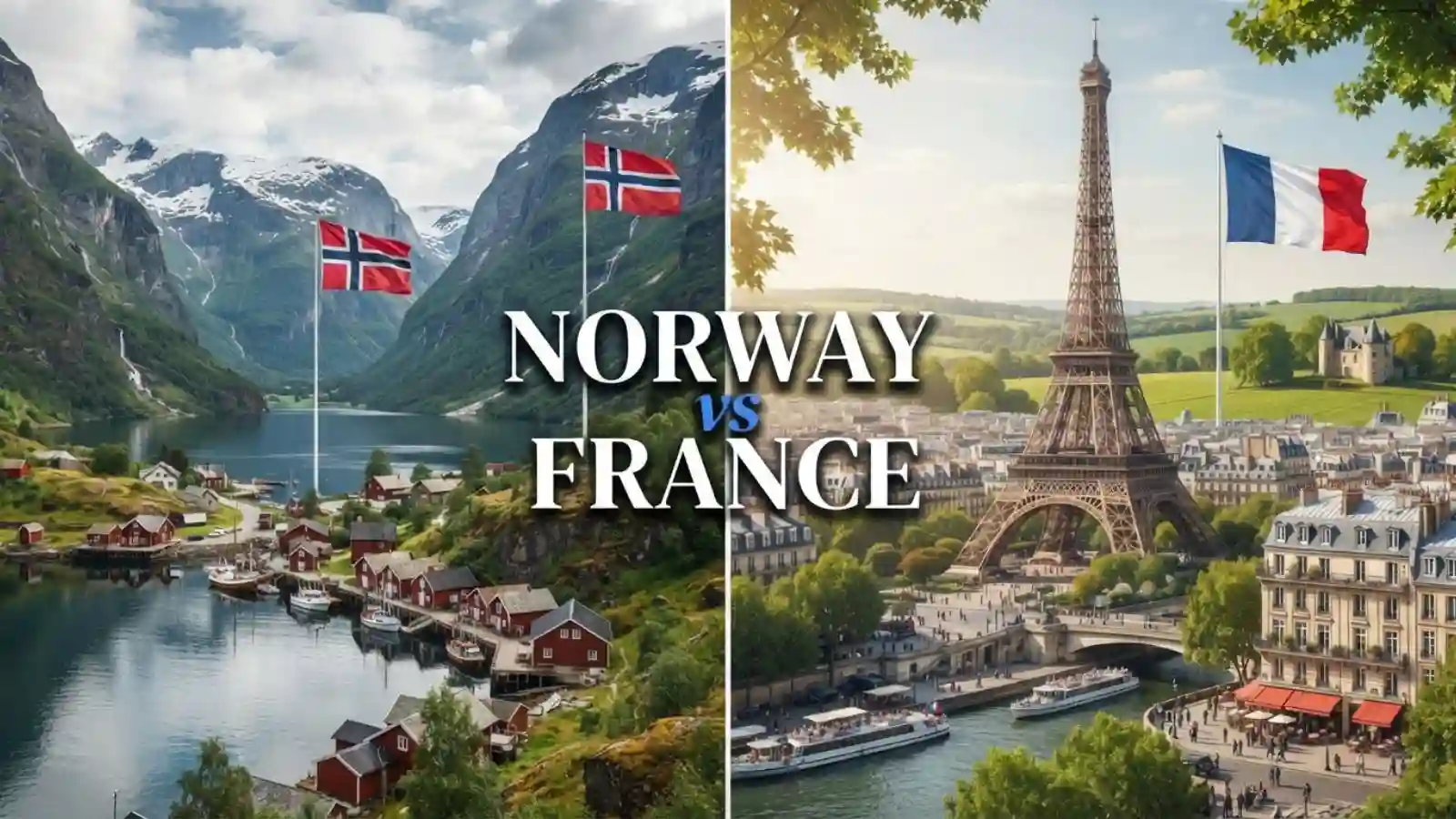
Norway vs France is a comparison between two wealthy European countries with very different geography, population, culture, and economies.
France is much larger by population and has a bigger overall economy, while Norway has substantially higher GDP per person.
France is generally cheaper, while Norway is known for dramatic natural scenery and a higher-income economy. Their football teams also met at the 2026 FIFA World Cup.
Key Takeaways:
- France has a population of about 68.7 million, compared with about 5.6 million in Norway.
- France has the larger overall economy, while Norway has much higher GDP per capita.
- Norway is generally more expensive than France for everyday living.
- Norway is famous for fjords, mountains, and outdoor adventures, while France offers major cities, beaches, wine regions, mountains, and historic landmarks.
- France defeated Norway 4–1 at the 2026 FIFA World Cup.
Norway vs France: At a Glance
Norway and France are both high-income European countries, but they offer very different experiences.
France is a large Western European country with a population of more than 68 million. Norway is a much smaller Northern European country with just over 5.5 million people.
| Category | Norway | France |
| Capital | Oslo | Paris |
| Population | About 5.6 million | About 68.7 million |
| Currency | Norwegian krone (NOK) | Euro (€) |
| Official/main language | Norwegian | French |
| Region | Northern Europe | Western Europe |
| GDP | About $484 billion in 2024 | About $3.16 trillion in 2024 |
| GDP per capita | About $86,785 | About $46,103 |
| EU member | No | Yes |
| Schengen Area | Yes | Yes |
The economic figures above use World Bank data, with 2024 being the latest comparable year in that dataset.
Population, Size, and Geography
Population
France is dramatically more populous than Norway. World Bank data puts France’s 2024 population at about 68.55 million, compared with 5.57 million for Norway.
That difference affects the feel of each country.
France has numerous large urban areas and a much denser population. Paris, Lyon, Marseille, Toulouse, Bordeaux, and other cities create a broad urban network.
Norway is much less densely populated. Much of its identity comes from mountains, forests, coastline, islands, and fjords rather than large metropolitan areas.
Land Area and Geography
France is also larger by commonly used land-area comparisons, although Norway’s geography makes the comparison less straightforward because of its long, mountainous shape and extensive coastline.
Norway stretches far along northern Europe and is particularly famous for its fjords and mountainous landscapes.
France has a greater geographic variety of its own. It includes Atlantic and Mediterranean coastlines, the Alps, the Pyrenees, agricultural regions, forests, and major river valleys.
For dramatic wilderness, Norway has a major advantage. For overall geographic variety and urban destinations, France has the broader selection.
Economy and Cost of Living
GDP and Income
France has a much larger economy in absolute terms.
World Bank figures show France’s 2024 GDP at about $3.16 trillion, compared with about $483.6 billion for Norway.
However, the picture changes when GDP is measured per person.
Norway’s 2024 GDP per capita was approximately $86,785, compared with around $46,103 in France.
So, France has the larger economy overall because its population is much bigger, while Norway produces substantially more economic output per person.
Norway’s economy also has an important connection to energy and natural resources, alongside sectors such as shipping, fisheries, technology, and services. France has a much more diversified large economy spanning manufacturing, services, tourism, aerospace, luxury goods, agriculture, technology, and other industries.
Which Is More Expensive?
For everyday expenses, Norway is generally more expensive than France.
A September 2026 comparison from Expatistan estimates Norway’s overall cost of living at roughly 26% higher than France, although it warns that its crowdsourced price data is not perfectly comprehensive.
Food, housing, personal services, and entertainment can be particularly expensive in Norway.
France can therefore be more attractive for travelers or residents who want to control everyday expenses. However, costs vary considerably by location. Paris, for example, can be expensive compared with many smaller French cities.
Lifestyle and Quality of Life
Climate and Daily Life
Norway generally has cooler weather and long, dark winters in many parts of the country. Northern areas experience particularly dramatic seasonal changes in daylight.
France has a much broader range of climates. Northern and western areas can be cool and maritime, while southern regions enjoy warmer Mediterranean conditions.
Lifestyle is another major difference.
Norwegian life is strongly associated with outdoor activities, nature, hiking, skiing, and relatively low population density.
French life is more strongly associated with urban culture, cafés, cuisine, arts, architecture, fashion, and regional traditions.
Neither is automatically better. Someone who loves hiking and quiet landscapes may prefer Norway, while someone who wants museums, historic cities, restaurants, and varied regional cultures may prefer France.
Language, Currency, and EU Status
Norway uses the Norwegian krone (NOK), while France uses the euro.
France is a member of the European Union. Norway is not an EU member, although it has extensive economic and political cooperation with the EU.
Both countries participate in the Schengen Area, which is an important distinction for travelers.
Norway vs France for Travel
Why Visit Norway?
Norway is particularly appealing if your priority is nature.
Popular experiences include fjord cruises, scenic road trips, hiking, skiing, northern landscapes, and visits to cities such as Oslo and Bergen.
The country is also well suited to travelers who prefer outdoor experiences over traditional sightseeing.
Norway’s scenery is arguably its biggest tourism advantage: steep mountains, waterfalls, deep fjords, forests, and coastal landscapes create experiences that are difficult to replicate elsewhere.
Why Visit France?
France offers a much broader mix of travel styles.
You can visit Paris for museums and landmarks, explore the French Riviera, ski in the Alps, visit wine regions, relax along Atlantic beaches, or explore historic towns and villages.
Food is another major attraction, with strong regional differences throughout the country.
For a first-time European traveler who wants cities, history, culture, food, beaches, and mountains in one country, France provides exceptional variety.
Choose Norway for: fjords, mountains, hiking, skiing, nature, and quieter landscapes.
Choose France for: history, food, art, cities, beaches, architecture, and cultural variety.
Norway vs France Football: 2026 World Cup
The phrase Norway vs France also has a major football meaning in 2026.
Norway and France met during the 2026 FIFA World Cup group stage on June 27, 2026, with the match played at Gillette Stadium in Massachusetts. France won 4–1.
Norway scored through Thelo Aasgaard, while Ousmane Dembélé scored a hat-trick for France and Désiré Doué added another goal late in the match.
That result makes France the clear winner of this particular head-to-head encounter.
However, football results should be kept separate from the broader country comparison. A football victory does not mean France is “better” than Norway in areas such as income, quality of life, tourism, or geography.
Which Is Better: Norway or France?
The better country depends on what you want.
Norway may be better for you if you value:
- Nature and outdoor activities
- Mountains and fjords
- Lower population density
- High income per person
- Winter sports
- A quieter lifestyle
France may be better if you value:
- Major cities and cultural attractions
- Food and regional cuisine
- Historic architecture
- Beaches and Mediterranean destinations
- A larger and more diverse economy
- Generally lower everyday costs
From an economic perspective, Norway has the higher GDP per capita, while France has the much larger total economy.
For travel, the choice is even more personal. Norway is a strong pick for scenery and outdoor adventure, while France offers a wider combination of culture, food, history, cities, and landscapes.
Frequently Asked Questions
Is Norway richer than France?
On a GDP-per-capita basis, yes. World Bank data shows Norway at about $86,785 per person in 2024 compared with approximately $46,103 in France. However, France has the larger total economy because it has a much larger population.
Is Norway more expensive than France?
Generally, yes. A September 2026 Expatistan comparison estimated Norway’s overall cost of living at about 26% higher than France, with especially noticeable differences in food, housing, personal care, and entertainment. Crowdsourced price comparisons can vary, so individual cities and lifestyles matter.
Which country is bigger, Norway or France?
France has the larger population and is also larger by commonly used land-area comparisons. France has about 68.7 million people, while Norway has about 5.6 million.
Who won Norway vs France in 2026?
France won the 2026 FIFA World Cup group-stage match 4–1 against Norway. Ousmane Dembélé scored three goals for France, while Thelo Aasgaard scored Norway’s goal.
Conclusion:
Norway vs France is less about finding one universal winner and more about understanding two very different European countries.
France has a much larger population, economy, and cultural footprint, while Norway stands out for its high GDP per capita, dramatic natural environment, and lower population density.
France is generally cheaper, while Norway offers an especially strong appeal for nature-focused travelers.
If you’re comparing them for a trip, choose Norway for fjords and outdoor adventure or France for culture, cuisine, history, and variety. If you’re comparing their football teams, France won their 2026 World Cup meeting 4–1.

I’m Maya Angelou, the creator behind EmojiAura.com, where I explore emoji meanings, social media trends, and fun digital expressions. I’m passionate about helping people understand the real meaning behind emojis and use them creatively in chats, captions, posts, and everyday online conversations.