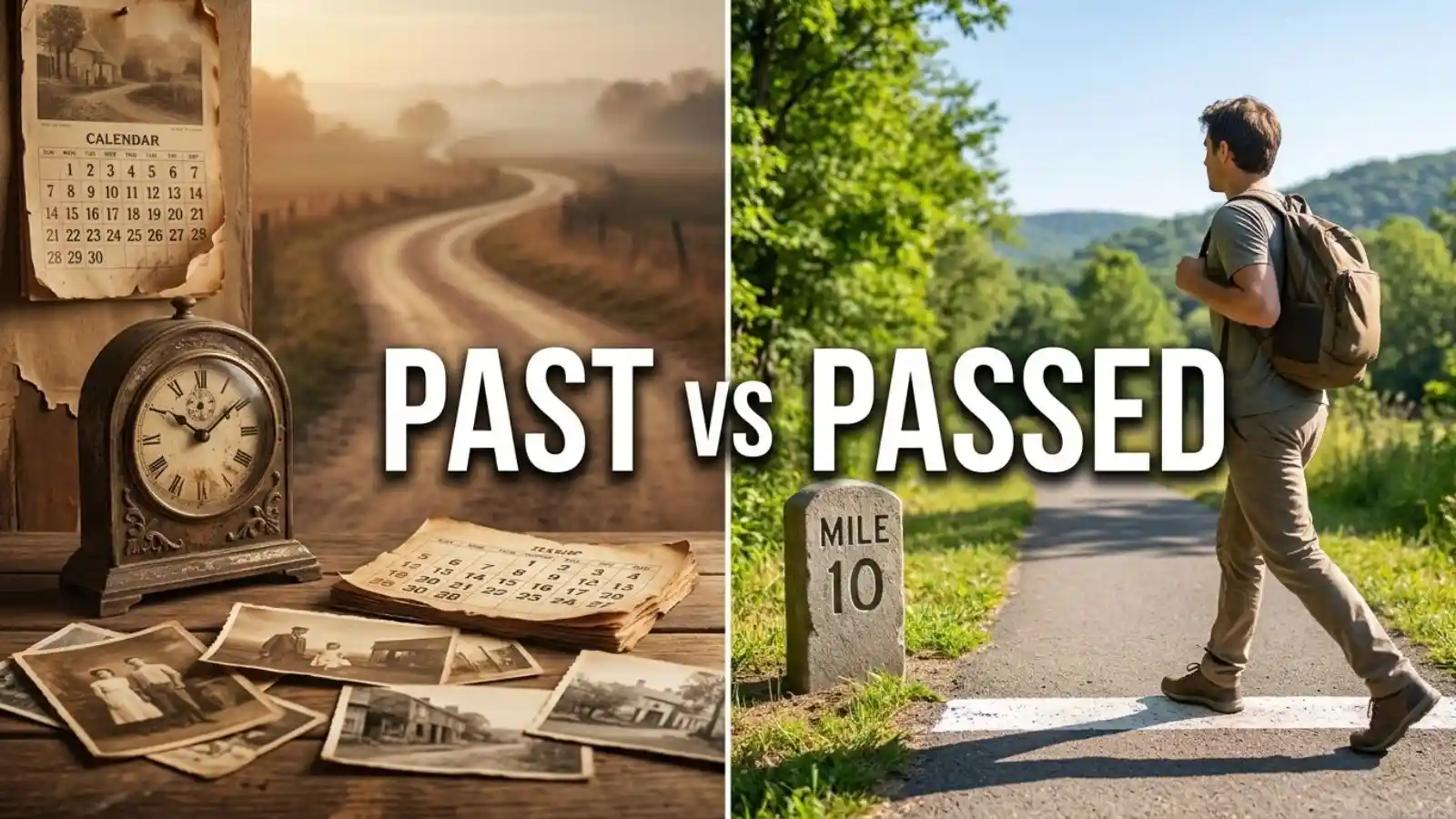
Past vs passed are different words that sound alike but have different grammatical jobs. Passed is a form of the verb pass, while past is used as a noun, adjective, preposition, or adverb.
Use passed for an action involving passing, and past for time, position, or something beyond a point.
Key Takeaways:
- Passed is the past tense and past participle of pass.
- Past can refer to earlier time or something beyond a point.
- She passed the test correctly.
- She walked past the store.
- If you can replace the word with an action such as went by, moved beyond, or handed over, passing may be the right choice.
Past vs Passed: What’s the Difference?
The confusion between past and passed comes from pronunciation. In many varieties of American English, the two words sound the same, but they are spelled differently and perform different jobs in a sentence. They are therefore classic homophones.
The simplest rule is grammatical:
Passed is a verb. Past is not a verb.
For example:
- Maria passed the exam.
- We walked past the library.
- The past can teach us useful lessons.
- Three hours passed quickly.
The first and fourth examples use passed as the verb pass. The second uses past to show position, while the third uses past as a noun.
This grammar-based approach is more reliable than simply remembering past means time and passed means movement, because both words can appear in sentences involving time or movement.
What Does Past Mean?
Past generally refers to a time before the present or to something beyond a particular point.
It can work as several parts of speech, including a noun, adjective, preposition, and adverb.
Examples:
- We should learn from the past.
- She has changed a lot over the past year.
- We drove past the school.
- The runner moved past quickly.
Into the past, the word names a period of time. In the past year, it describes the year. In the past, it showed a position or direction.
What Does Passed Mean?
Passed is the past tense and past participle of the verb pass. The verb pass has several meanings, including moving beyond something, handing something to someone, succeeding in a test, or allowing time to go by.
Examples include:
- She passed her driving test.
- The car passed the truck.
- He passed me the salt.
- Two hours passed before they arrived.
- Her grandfather passed away last year.
The key point is that passed describes the action of passing.
Past vs Passed: Side-by-Side Comparison
| Feature | Past | Passed |
| Main grammatical role | Noun, adjective, preposition, adverb | Verb |
| Refers to earlier time | Yes | Sometimes, through the verb pass |
| Shows an action | No | Yes |
| Example | the past year | Time passed quickly |
| Example with movement | Walk past the store | The car passed the store |
| Example with success | — | She passed the exam |
A useful way to think about the difference is this:
Past describes time, position, or something beyond a point. Passed describes the action of passing.
When to Use Past
Past as a Noun
Use past as a noun when you are talking about an earlier period or something that happened before now.
Examples:
- We cannot change the past.
- He often thinks about his past.
- The past is an important part of history.
- She learned from her past.
Here, the past names a period or collection of previous events.
Past as an Adjective
Use past before a noun when you mean something that happened or existed previously.
Examples:
- The past year has been difficult.
- He talked about his past mistakes.
- She is a past president of the organization.
- We reviewed the past results.
Past as a Preposition or Adverb
The past can also show movement beyond a person, place, time, or point.
Examples:
- We walked past the restaurant.
- The dog ran past me.
- Drive past the gas station and turn left.
- It is already past midnight.
Notice an important pattern:
We walked past the house.
Not:
We walked passed the house.
The verb is already walked. The word past tells us where the movement went.
When to Use Passed
Passed for Movement
Use passed when pass is the action taking place.
Examples:
- The car passed our house.
- She passed me on the highway.
- The train passed through the tunnel.
- He passed the ball to his teammate.
Compare:
- We walked past the house.
- We passed the house on our way home.
Both sentences are correct, but their grammar is different.
In the first, walking is the verb and past indicates position.
In the second, passed is the verb.
Passed for Success or Completion
Use passed when someone succeeds in an examination, test, or similar requirement.
Examples:
- I passed my driver’s test.
- She passed the final exam.
- He passed the certification test.
- They passed the inspection.
You should not write that I past the test. The action is pass, so its past-tense form is passed.
Passed for Giving or Transferring Something
Passed can also mean handed or transferred something.
Examples:
- She passed me the remote.
- He passed the note to his friend.
- Please pass the salt.
- The teacher passed out the worksheets.
The same verb can describe physical movement, transfer, success, or the passage of time.
Passed in Common Expressions
One familiar expression has passed away, which is a polite way of saying that someone died.
Example:
- Her grandfather passed away peacefully.
You may also see time passed, the storm passed, and the opportunity passed. In each case, passed is functioning as a verb.
Past vs Passed: Common Confusing Phrases
Walked Past vs Walked Passed
The correct phrase is:
I walked past the store.
Why? Walked is already the past-tense verb. Past acts as a preposition or adverb showing movement beyond the store.
The same pattern appears in:
- ran past
- drove past
- moved past
- walked past
- flew past
Current grammar resources consistently identify walked past as the correct construction.
Past Bedtime vs Passed Bedtime
The correct phrase is:
It is past bedtime.
Here, the past means beyond a particular time.
Examples:
- It is past midnight.
- The children are past their bedtime.
- We are past the deadline.
Passed bedtime would normally be incorrect when you mean that the current time has gone beyond bedtime.
Past Due vs Passed Due
The correct phrase is:
The payment is past due.
Here, past means beyond the required date.
Examples:
- Your bill is past due.
- The account became past due last month.
- The payment is now past due.
Past the Point vs Passed the Point
Both forms can be correct depending on the sentence.
We are past the point of arguing.
Here, past means beyond a particular stage.
But:
The runner passed the point where the road turns.
Here, passed is the verb describing the runner’s action.
Passed the Test vs Past the Test
The correct expression is:
She passed the test.
That means she succeeded.
By contrast, the past cannot replace the verb in that sentence.
Easy Tricks to Remember Past vs Passed
The easiest test is to ask:
Is this word the action of pass?
If yes, use passed.
- She passed the exam.
- The car passed me.
- Time passed quickly.
- He passed the ball.
If the word describes time, position, or something beyond a point, use past tense.
- the past year
- in the past
- walk past the bank
- past midnight
Another useful trick is the test.
Try replacing the word with went by or another form of pass.
Three hours passed.
→ Three hours went by.
That works, so passing is correct.
We walked past the store.
→ We walked by the store.
That does not work grammatically, so the past is correct.
Common Mistakes to Avoid
Here are some frequent errors:
| Incorrect | Correct | Why |
| I walked passed the bank. | I walked past the bank. | Walked is already the verb. |
| She passed the exam. | She passed the exam. | Passed is the verb pass in the past tense. |
| It is passed midnight. | It is past midnight. | The past means beyond that time. |
| The passed year was busy. | The past year was busy. | The past describes an earlier period. |
| Two hours past quickly. | Two hours passed quickly. | Passed is the verb. |
| The bill is passed due. | The bill is past due. | Past means beyond the due date. |
The most reliable solution is to look at the word’s job in the sentence, rather than how it sounds.
Past vs Passed Examples
Try these examples to reinforce the difference:
- We drove past the old theater.
- The driver passed the old theater.
- I remember the past very clearly.
- Three months passed quickly.
- She passed her English exam.
- The children ran past the playground.
- It is past ten o’clock.
- He passed the ball to his brother.
- We have moved past that problem.
- The storm passed during the night.
The pattern becomes easier to see when you compare similar sentences. The past often tells you where, when, or beyond what point. Passed tells you that the action of the pass happened.
Frequently Asked Questions
Are past and past homophones?
Yes. Past and passed are homophones because they have the same or very similar pronunciation but different spellings and meanings. Their grammatical roles are different: past is a form of the verb pass, while past can function as a noun, adjective, preposition, or adverb.
Is walked past or walked passed correct?
Walking past is correct. The word walked already serves as the past-tense verb. The past then shows movement beyond a person or place: We walked past the store. You would use passed when pass itself is the verb: We passed the store.
Is it past bedtime or passed bedtime?
Past bedtime is correct when you mean that the current time is beyond bedtime. For example, The kids should be asleep because it is past bedtime. Here, the past indicates that a particular time has been exceeded.
Is it the past 10 years or passed 10 years?
When referring to the previous period of ten years, use the past: Over the past 10 years, technology has changed quickly. Use passed when it functions as the verb pass, as in Ten years passed before they met again.
Conclusion:
The difference between Past vs Passed becomes much easier once you focus on grammar instead of pronunciation.
Passed is a form of the verb pass. Use it for actions such as moving beyond something, succeeding in a test, transferring an object, or describing time going by.
Past is used for earlier time, position, or something beyond a particular point. It can act as a noun, adjective, preposition, or adverb.
When you’re unsure, ask one simple question:
Is this the action of pass?
If it is, choose passed. If it is describing time, position, or something beyond a point, choose the past.
That quick grammar check will solve most past vs passed mistakes.