Affected usually means influenced, changed, or impacted by something. Effected means brought something about, caused it to happen, or accomplished it. For example, “The storm affected our plans” means the storm changed the plans, while “The manager effected several changes” means the manager brought those changes about.
Key Takeaways
- Affected usually means influenced, changed, or impacted.
- Effected means brought about, caused, or accomplished.
- Use affected when something experiences an influence.
- Use effected when someone or something causes a specific change to happen.
- If you can replace the word with influenced or changed, choose affected. If you can replace it with brought about or accomplished, effected may be correct.
Affected vs Effected: The Main Difference
The difference between affected vs effected becomes easier when you focus on what the sentence is trying to say.
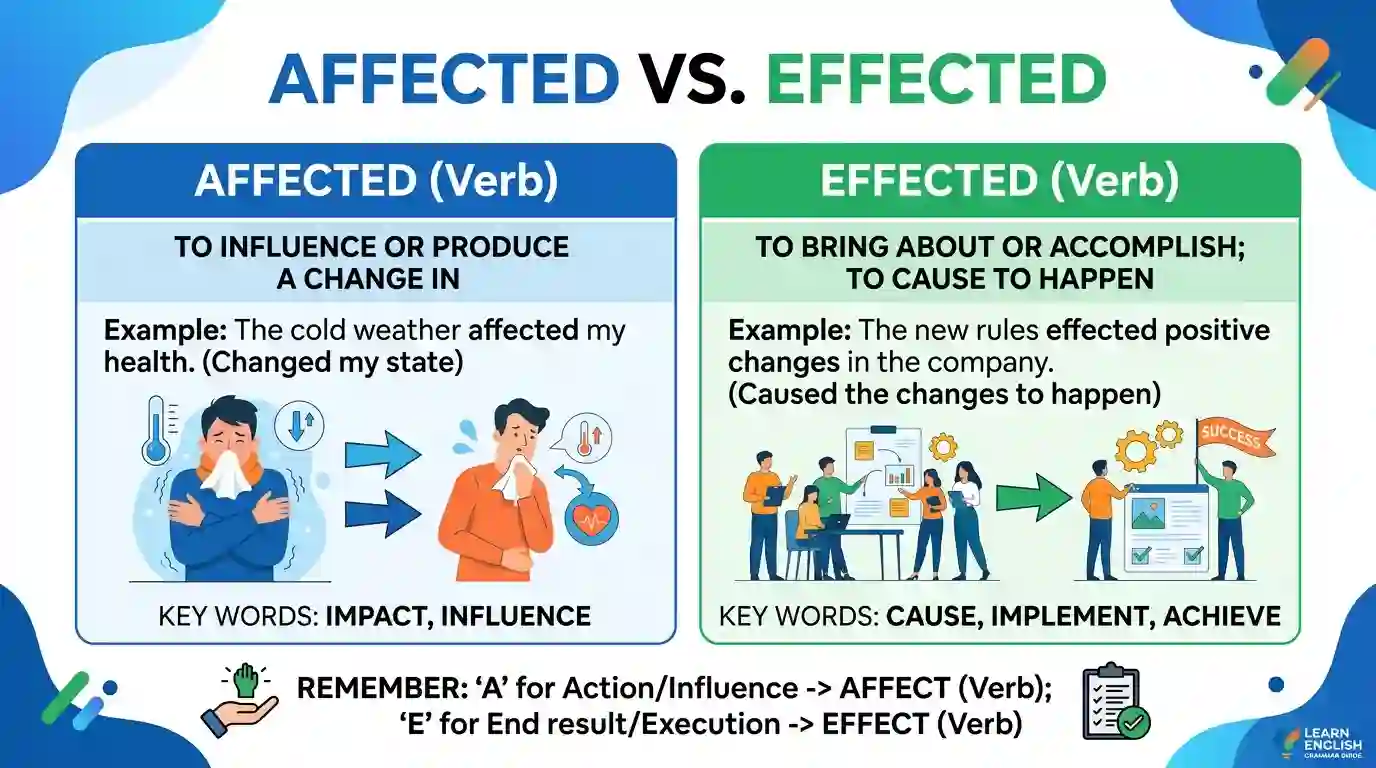
Affected is the past tense of affect, which usually means “to influence” or “to cause a change in.” Something that is affected experiences an influence or change.
The heavy rain affected our travel plans.
The rain influenced the plans. It did not create the plans.
Effected is the past tense of effect when effect is being used as a verb. In this less common use, effect means “to bring about,” “to cause,” or “to accomplish.”
The new manager effected several changes.
Here, the manager did not merely influence the changes. The manager brought those changes about.
This distinction is also reflected in major English usage references. Affected is the normal past form of the common verb affect, while effected comes from the less common verb sense of effect.
Affected vs Effected Comparison
| Word | Meaning | Typical Use | Example |
|---|---|---|---|
| Affected | Influenced, changed, or impacted | Something experiences an influence | The delay affected our schedule. |
| Effected | Brought about, caused, or accomplished | Someone or something creates a change | The director effected major reforms. |
A useful way to think about the difference is:
Affected = something was changed.
Effected = something was made to happen.
That distinction is more reliable than simply memorizing that one is a verb and the other is not, because both words can function as verbs in different contexts.
When to Use Affected
Use affected when you mean that something or someone was influenced, changed, or impacted.
It is by far the more common choice in everyday writing.
Examples of Affected
- The storm affected several flights.
- Lack of sleep affected her concentration.
- The news affected him deeply.
- Higher prices affected household spending.
- The new schedule affected everyone on the team.
- The power outage affected businesses across the city.
- The teacher’s feedback affected how she approached the assignment.
A quick test is to replace affected with influenced.
The storm affected our plans.
becomes:
The storm influenced our plans.
The basic meaning remains the same, so affected is correct.
You can also try changed:
The new rule affected the way employees worked.
The new rule changed the way employees worked.
Again, the meaning works.
When to Use Effected
Use effected when you mean brought about, caused, produced, or accomplished something.
This use is less common and often appears in formal, professional, legal, academic, or policy-related writing.
For example:
The new director effected several policy changes.
This means the director brought the policy changes into existence.
Another example:
The agreement effected a peaceful transition.
The agreement caused or brought about the transition.
More examples include:
- The committee effected major reforms.
- The new leadership effected important changes.
- The negotiations effected a peaceful settlement.
- The organization effected improvements in its hiring process.
- The legislation effected significant changes in the industry.
Notice that effected often appears with words such as change, changes, reform, reforms, improvement, transition, settlement, or transformation.
That does not mean these words automatically require effected. Context still determines the correct choice.
A Simple Trick to Choose Between Affected and Effected
When you are unsure, use the replacement test.
Choose “affected” if you can use:
- influenced
- changed
- impacted
- altered
Example:
The cold weather affected the crops.
Try:
The cold weather changed the crops.
The idea works, so affected is appropriate.
Choose “effected” if you can use:
- brought about
- caused
- accomplished
- made happen
Example:
The new policy effected significant changes.
Try:
The new policy brought about significant changes.
The meaning works, so effected is appropriate.
There is an important difference in perspective:
Affected focuses on what experienced the change.
Effected focuses on what caused or brought the change about.
Common Mistakes With Affected and Effected
“Affected Me” vs “Effected Me”
When you mean influenced me, use affected.
The criticism affected me more than I expected.
Here, the criticism influenced your feelings or response.
Effected me would normally be incorrect if you simply mean “influenced me.”
The verb effect means to bring something about, so it does not normally replace affect in this everyday construction.
“Affected by” vs “Effected by”
Affected by is the normal phrase when something has been influenced by another thing.
The town was affected by severe flooding.
Her performance was affected by stress.
Thousands of customers were affected by the outage.
In these sentences, something experienced an impact.
Effected by is possible in specialized contexts when effect has its verb meaning, but it is not the normal replacement for affected by. If you mean “influenced by,” use affected by.
“Affect Change” vs “Effect Change”
This is one of the trickiest examples.
Affect change means influence change.
Social media can affect change in public attitudes.
Effect change means bring about change.
The organization hopes to effect change through education.
The second construction is especially useful when the subject is actively bringing a desired change into existence.
So:
affect change = influence change
effect change = cause or bring about change
The phrase effect change is an established use of effect as a verb.
Affected vs Effected Examples
| Sentence | Correct Word | Why |
|---|---|---|
| The storm ___ our plans. | affected | The storm influenced the plans. |
| The new CEO ___ several reforms. | effected | The CEO brought the reforms about. |
| Lack of sleep ___ my concentration. | affected | Lack of sleep influenced concentration. |
| The agreement ___ a peaceful transition. | effected | The agreement brought about the transition. |
| The outage ___ thousands of customers. | affected | Customers experienced the impact. |
| The board ___ major changes. | effected | The board caused the changes to happen. |
| The criticism ___ her confidence. | affected | Her confidence was influenced. |
| The negotiations ___ a settlement. | effected | The negotiations produced the settlement. |
The table reveals an important pattern. With affected, the object is often something that already exists and experiences an impact. With effected, the object is often a change, result, or new condition that is brought about.
How Affected and Effected Relate to Affect and Effect
Understanding affect vs effect makes the past-tense forms much easier.
In ordinary usage:
- Affect = to influence or change
- Effect = a result or consequence
- Affected = influenced or changed
- Effected = brought about or accomplished
For example:
The heat affected the plants.
Here, affected means influenced.
The heat had an effect on the plants.
Here, effect is a noun meaning result or impact.
Now consider:
The company effected major changes.
Here, effected is a verb meaning brought about.
This is why the familiar rule “affect is a verb, effect is a noun” is useful for beginners but incomplete. Effect can also be a verb, while affect has a specialized noun use in psychology referring to observable emotional expression.
For normal everyday writing, however, the simplest rule remains highly useful:
Affect = influence.
Effect = result.
Then remember the special verb:
Effect = bring about.
Frequently Asked Questions
Is effected a real word?
Yes. Effected is a correct word. It is the past tense and past participle of the verb effect, meaning to bring about, cause, or accomplish something. For example, “The new policy effected significant changes” means the policy brought those changes about. It is less common than affected, so it may look unusual in everyday writing.
Is it affected or effected by something?
Usually, it is affected by when you mean influenced or impacted by something.
The community was affected by the storm.
Here, the community experienced the storm’s impact.
If you are unsure, replace the word with influenced. If that works, choose affected.
Is “effected change” correct?
Yes. Effected change is correct when effected means brought about or caused.
The new leadership effected change throughout the organization.
It means the leadership made the change happen.
By contrast, affected change would mean influenced an existing change or process.
How can I remember affected vs effected?
Use this simple memory rule:
Affected = influenced or changed.
Effected = brought about or accomplished.
Then use the replacement test:
- Can you say influenced? Choose affected.
- Can you say brought about? Choose effected.
This works better than relying only on the first letters because it focuses on the actual meaning of the sentence.
Conclusion
The difference between affected vs effected is mainly about the type of action you want to describe.
Use affected when something was influenced, changed, or impacted:
The bad weather affected our plans.
Use effected when someone or something brought about, caused, or accomplished a change:
The new policy effected major changes.
When in doubt, test the word with a simpler replacement. If influenced or changed fits, choose affected. If brought about or accomplished fits, choose effected.
Once you focus on whether the sentence describes experiencing a change or bringing a change about, this commonly confused pair becomes much easier to use correctly.

I’m Maya Angelou, the creator behind EmojiAura.com, where I explore emoji meanings, social media trends, and fun digital expressions. I’m passionate about helping people understand the real meaning behind emojis and use them creatively in chats, captions, posts, and everyday online conversations.