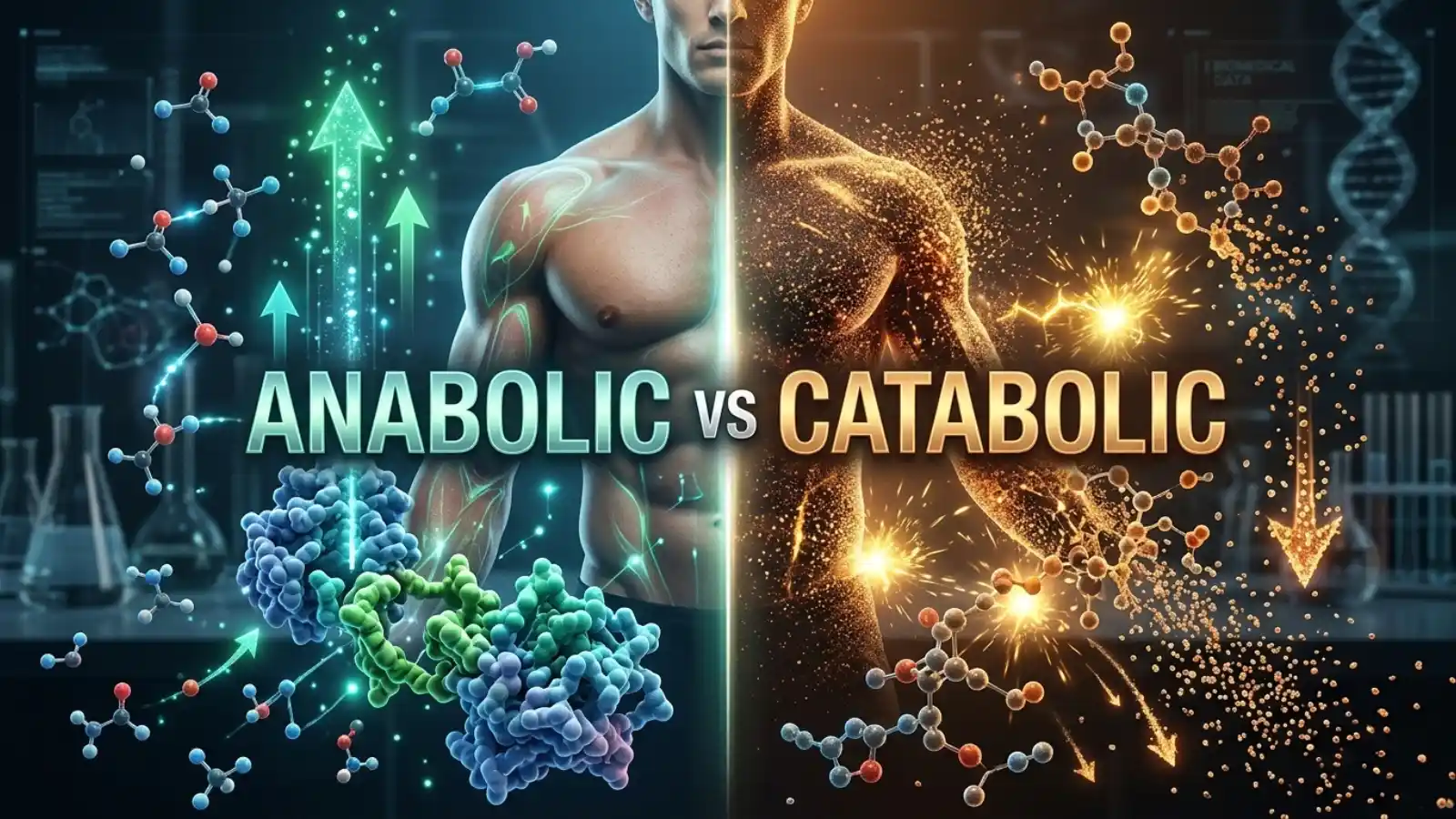
Anabolic vs catabolic describes two major sides of metabolism. Anabolic processes build larger molecules or tissues from smaller components and require energy.
While catabolic processes break larger molecules into smaller components and often release usable energy.
Both are essential: catabolism supplies energy and building blocks, while anabolism uses them for growth, repair, and storage.
Key Takeaways:
- Anabolism builds larger molecules from smaller ones.
- Catabolism breaks down larger molecules and helps release energy.
- Both processes are normal and necessary parts of metabolism.
- Muscle gain depends on the long-term balance between protein synthesis and protein breakdown.
- Exercise, food intake, fasting, hormones, and illness can all influence this balance.
What Does Anabolic Mean?
Anabolic refers to a building or constructive metabolic process. During anabolism, the body uses smaller molecules or building blocks to create larger and more complex molecules.
For example, amino acids can be joined together to make proteins. Glucose can be stored as glycogen, while fatty acids can be incorporated into triglycerides. These reactions generally require energy, often supplied through ATP.
Anabolism is important for more than muscle growth. Your body uses anabolic processes to make and repair tissues, store nutrients, build cellular components, and support normal growth.
Examples of Anabolic Processes
Common examples include:
- Building proteins from amino acids
- Creating glycogen from glucose
- Making triglycerides from fatty acids and glycerol
- Producing new cellular components
- Repairing and building tissue
This is why you will often see the word anabolic associated with growth, recovery, and tissue building.
What Does Catabolic Mean?
Catabolic refers to a breakdown or destructive metabolic process. During catabolism, larger molecules are broken into smaller molecules, and the process often makes energy available for cellular activities.
For example, glycogen can be broken down to provide glucose, while stored fats can be broken into components that can be used as fuel.
Catabolism is not automatically harmful. Your body needs catabolic reactions every day because cells constantly need usable energy.
Examples of Catabolic Processes
Examples include:
- Breaking glycogen down into glucose
- Breaking fats down for energy
- Breaking proteins into amino acids
- Cellular respiration
- Digesting nutrients into smaller usable components
In simple terms, catabolism makes resources available, while anabolism uses resources to build things.
Anabolic vs Catabolic: Key Differences
The easiest way to remember the difference is build versus break down.
| Feature | Anabolic | Catabolic |
| Main action | Builds larger molecules | Breaks larger molecules down |
| Direction | Smaller → larger | Larger → smaller |
| Energy | Requires energy | Often releases usable energy |
| Main role | Growth, repair, storage | Fuel production and resource mobilization |
| Examples | Protein synthesis, glycogen formation | Glycogen breakdown, fat breakdown |
| Muscle connection | Supports muscle building and repair | Can contribute to muscle breakdown when sustained |
| Common hormonal association | Insulin, growth hormone, IGF-related signaling | Glucagon, cortisol, epinephrine |
These categories describe broad metabolic directions rather than two completely separate conditions. Your body continuously regulates both types of reactions.
How Anabolic and Catabolic Processes Work Together
Anabolism and catabolism are closely connected.
Catabolic reactions can release energy and produce smaller molecules that serve as raw materials. Anabolic reactions then use energy and those building blocks to create larger molecules.
A simple example is the relationship between glycogen and glucose. When the body needs available fuel, glycogen can be broken down. When nutrients and energy are available, glucose can be stored as glycogen. Hormones such as insulin and glucagon help regulate these opposing directions.
This means your metabolism is not permanently “anabolic” or permanently “catabolic.” The balance changes according to factors such as food intake, physical activity, fasting, and the body’s energy demands.
Anabolic vs Catabolic for Muscle Growth
The terms become especially important in fitness.
Muscle tissue is constantly undergoing protein synthesis and protein breakdown. Muscle growth occurs over time when the overall balance favors synthesis.
If muscle protein synthesis exceeds muscle protein breakdown over time, the result can be a positive muscle protein balance. If breakdown consistently exceeds synthesis, muscle loss can occur.
Resistance exercise stimulates muscle protein synthesis, but exercise does not mean every moment is purely anabolic. Research shows that resistance exercise can increase both protein synthesis and breakdown, particularly when no food is consumed. Nutrient intake can help shift the net balance toward protein gain.
That is an important distinction: one workout does not simply switch your entire body from catabolic to anabolic. What matters for muscle growth is the overall pattern of training, nutrition, recovery, and protein turnover.
Is Exercise Anabolic or Catabolic?
Exercise can involve both anabolic and catabolic processes.
During demanding exercise, your body breaks down stored fuels such as glycogen and fat to provide energy. That is catabolic activity.
After resistance training, however, muscle protein synthesis increases, creating an opportunity for repair and adaptation. When adequate nutrients are available, the post-exercise response can support a more positive muscle protein balance.
This is why labeling an entire workout as simply “anabolic” or “catabolic” can be misleading.
For example, running uses metabolic pathways that mobilize fuel during exercise, while resistance training creates a strong stimulus for later muscle remodeling. Both activities can involve multiple metabolic pathways at the same time.
How Hormones Affect Anabolic and Catabolic Processes
Hormones act as important regulators of metabolism.
Insulin is strongly associated with anabolic metabolism. It promotes nutrient uptake and storage and plays an important role in carbohydrate, fat, and protein metabolism. Glucagon, by contrast, helps mobilize stored fuels, particularly when blood glucose needs to be maintained between meals or during energy demand.
Other hormones are also commonly described as anabolic or catabolic:
- Testosterone: supports processes involved in muscle and tissue growth.
- Growth hormone: contributes to growth and tissue-related processes.
- IGF-1: participates in growth and anabolic signaling.
- Cortisol: helps mobilize energy during stress and has catabolic effects.
- Epinephrine: helps rapidly mobilize energy during the fight-or-flight response.
- Glucagon: promotes the availability of stored energy.
However, hormones rarely fit into a simple “good hormone” or “bad hormone” category. Their effects depend on the tissue, timing, concentration, and physiological situation.
Is Fasting Anabolic or Catabolic?
Fasting generally shifts the body’s overall energy strategy toward catabolic activity because the body has less incoming energy and must increasingly mobilize stored fuel.
After food is absorbed, insulin helps promote nutrient storage and use. As the post-absorptive period continues, glucagon and other signals help the body access stored energy. Glycogen can be mobilized, and fat can become an important fuel source.
That does not mean fasting automatically causes immediate muscle loss. The effects depend on the length and severity of the energy deficit, nutritional status, activity level, and other factors.
For people focused on preserving or gaining muscle, prolonged energy restriction can make maintaining positive muscle protein balance more difficult, particularly when combined with inadequate protein intake or inactivity.
Which Is Better: Anabolic or Catabolic?
Neither is inherently better.
Your body needs catabolism to obtain usable energy and raw materials, and it needs anabolism to build, repair, and store resources.
The goal is not to eliminate catabolism. Instead, healthy metabolism requires appropriate regulation and balance.
For muscle growth, you generally want conditions that support muscle protein synthesis and recovery over time. Resistance training, adequate nutrition, sufficient protein, and recovery all contribute to that process. Research shows that combining resistance exercise with protein availability stimulates muscle protein synthesis more effectively than either stimulus alone in many settings.
For fat loss, meanwhile, mobilizing stored energy is necessary. That involves catabolic pathways. The important point is that fat loss and muscle preservation are not exactly the same metabolic goal.
Anabolic Does Not Mean Anabolic Steroids
One common misunderstanding comes from the popular use of the word “anabolic.”
In biology, anabolic simply means building or synthesizing larger molecules. It does not automatically refer to anabolic steroids or performance-enhancing drugs.
Anabolic steroids are a specific class of synthetic compounds related to androgen hormones. The broader biological term “anabolic” existed independently of that fitness-related usage.
So when a biology textbook says “anabolic reaction,” it is describing a metabolic process not recommending or referring to steroid use.
Frequently Asked Questions
Is anabolic good or bad?
Anabolic processes are normal and essential. They help the body build proteins, repair tissues, store nutrients, and support growth. Anabolism is not automatically “good,” though, because metabolism requires both building and breakdown. Your body needs catabolic processes as well to produce energy and supply materials for other reactions.
Is catabolic good or bad?
Catabolic processes are also necessary. They break down nutrients and stored molecules so the body can access energy and smaller building blocks. Catabolism becomes a concern in situations where excessive or prolonged breakdown, particularly of body tissues, exceeds the body’s ability to rebuild them. The overall context matters more than the word itself.
Does anabolic mean muscle growth?
Not necessarily. Anabolic means building larger or more complex molecules from smaller ones. Muscle growth is one example of an anabolic outcome, but anabolism also includes processes such as protein synthesis, glycogen storage, and production of other cellular molecules. Muscle growth specifically depends on the long-term balance between muscle protein synthesis and breakdown.
Is exercise anabolic or catabolic?
Exercise can be both. During exercise, the body uses catabolic pathways to break down stored fuels and produce energy. Resistance exercise can also stimulate muscle protein synthesis during recovery, supporting anabolic adaptation. Therefore, calling an entire workout purely anabolic or purely catabolic does not accurately describe what happens inside the body.
Final Takeaway:
The simplest way to understand Anabolic vs Catabolic is to remember build versus break down.
Anabolic processes use energy and building blocks to create larger molecules, support tissue repair, and store nutrients. Catabolic processes break molecules down and help make energy available for cellular work.
The two processes are not enemies. They are interconnected parts of metabolism, and the body constantly adjusts their activity based on nutrition, exercise, fasting, hormones, and energy needs.
For muscle growth, what matters most is the long-term balance between muscle protein synthesis and breakdown, not whether your body is permanently in one “state.”