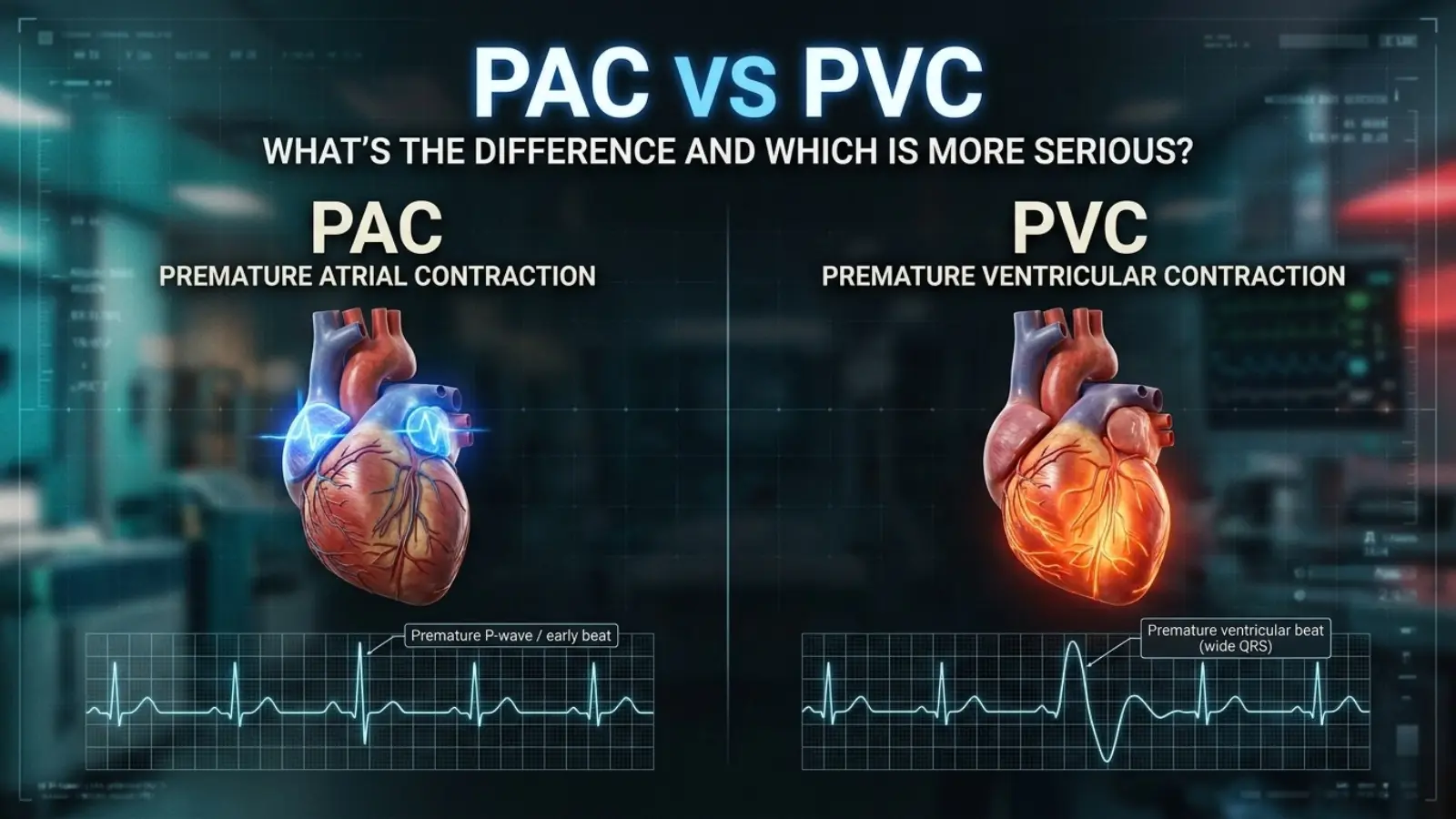
PAC vs PVC refers to two types of premature heartbeats. A premature atrial contraction (PAC) starts in the heart’s upper chambers, while a premature ventricular contraction (PVC) starts in the lower chambers.
Both can feel like a skipped beat, flutter, or extra thump and are often harmless, but frequent episodes may require medical evaluation.
Key Takeaways:
- PACs begin in the atria, the heart’s upper chambers.
- PVCs begin in the ventricles, the heart’s lower chambers.
- Both can cause palpitations, skipped-beat sensations, or a strong heartbeat.
- Occasional PACs and PVCs are common and often do not require treatment.
- Frequent or bothersome premature beats should be discussed with a healthcare professional.
What Is a PAC?
A premature atrial contraction (PAC) is an extra heartbeat that starts in one of the heart’s upper chambers, called the atria. Instead of the normal electrical signal beginning at the sinus node, an early signal comes from another location in the atrium.
This causes the heart to beat earlier than expected. A brief pause may follow, and the next normal beat can feel stronger. That is why some people describe a PAC as a skipped beat even though the heart has actually produced an extra beat.
PACs are common and can occur in otherwise healthy people. Many cause no noticeable symptoms at all.
Common PAC Symptoms
When symptoms occur, they may include:
- A fluttering feeling in the chest
- A skipped or extra beat
- A stronger-than-normal heartbeat
- Pounding or racing sensations
- Occasional shortness of breath or anxiety
The sensation alone usually cannot tell you whether you are having a PAC or PVC. An ECG or heart monitor is much more useful for identifying the type of premature beat.
Common PAC Triggers
PACs may be associated with several factors, including:
- Caffeine
- Alcohol
- Tobacco
- Stress
- Poor sleep
- Dehydration
- Electrolyte problems
- Certain medications or stimulants
- Thyroid problems
- Some underlying heart conditions
Sometimes, no clear cause is found.
What Is a PVC?
A premature ventricular contraction (PVC) is an extra heartbeat that begins in one of the heart’s lower chambers, called the ventricles.
Because the electrical signal starts in the ventricles rather than following the heart’s usual pathway, the heartbeat can look different on an ECG. The following normal beat may feel particularly strong, creating the familiar sensation of a “thump” after a pause.
PVCs are also common. Many people with occasional PVCs have no underlying heart disease and may not need treatment.
Common PVC Symptoms
PVCs can cause:
- A skipped-beat sensation
- A strong thump in the chest
- Fluttering or pounding
- Awareness of an irregular heartbeat
- Occasional dizziness or weakness
- Shortness of breath in some people
Some people have PVCs without feeling anything.
Common PVC Triggers
Possible triggers and contributing factors include:
- Caffeine
- Alcohol
- Tobacco
- Stress or anxiety
- Exercise in some people
- Certain medications
- Stimulants
- Electrolyte changes
- Heart disease or previous heart injury
The cause is not always obvious.
PAC vs PVC: Key Differences
The simplest difference is where the premature heartbeat starts.
| Feature | PAC | PVC |
| Full name | Premature atrial contraction | Premature ventricular contraction |
| Origin | Atria | Ventricles |
| Chamber location | Upper chambers | Lower chambers |
| What it is | Early extra heartbeat | Early extra heartbeat |
| Common sensation | Flutter, skip, extra beat | Thump, flutter, skip |
| ECG appearance | Usually an early abnormal P wave followed by a QRS | Usually a wide, unusual QRS without a preceding normal P wave |
| Common evaluation | ECG, monitor, sometimes echo | ECG, monitor, sometimes echo or stress testing |
| Treatment | Often unnecessary | Often unnecessary when occasional and the heart is healthy |
PACs and PVCs can feel very similar, so symptoms alone are not a reliable way to distinguish them.
PAC vs PVC ECG Differences
An ECG/EKG is one of the main ways healthcare professionals distinguish a PAC from a PVC.
A PAC usually begins with an early, abnormal-looking P wave, because the electrical impulse starts in the atria. The ventricles can then activate through the normal conduction system, so the QRS may remain relatively narrow.
A PVC starts in the ventricles. Because the electrical signal does not travel through the usual conduction pathway, the QRS complex is typically wider and looks different from a normal heartbeat.
There are exceptions, including PACs that conduct abnormally, so ECG interpretation should be left to a qualified healthcare professional.
Which Is More Serious: PAC or PVC?
There is no simple rule that says PVCs are always worse than PACs.
For many people with a healthy heart, occasional PACs and PVCs are harmless. The bigger question is how often they occur, whether symptoms are significant, and whether there is an underlying heart condition.
Frequent PACs can be associated with a higher likelihood of developing atrial fibrillation, although having PACs does not mean that you will develop it.
Frequent PVCs can sometimes weaken the heart muscle and contribute to a condition known as PVC-induced cardiomyopathy, particularly when the PVC burden is high.
So instead of asking only “Which is worse?” it is more useful to ask:
How frequent are the premature beats, what is causing them, and is the heart otherwise healthy?
How Are PACs and PVCs Diagnosed?
A healthcare professional may begin with your symptoms, medical history and physical examination.
An ECG/EKG can identify a premature beat when it happens during the recording. However, occasional PACs or PVCs may not occur during a short office ECG.
In that situation, a Holter monitor or another ambulatory heart monitor can record your heart rhythm for a longer period. This can help determine how frequently the premature beats occur and whether they happen in a particular pattern.
Depending on your symptoms and medical history, a healthcare professional may also recommend an echocardiogram, blood tests, or an exercise stress test.
Do PACs and PVCs Need Treatment?
Usually, occasional premature beats do not require specific treatment when there is no underlying heart problem and symptoms are mild.
Treatment becomes more relevant when the beats are frequent, very bothersome, associated with another medical condition, or affecting heart function.
Lifestyle measures may include getting adequate sleep, staying hydrated, managing stress, limiting caffeine or alcohol when they trigger symptoms, and avoiding tobacco and recreational drugs.
If symptoms remain troublesome, a healthcare professional may consider medications such as beta blockers. In selected cases, catheter ablation may be considered, particularly when premature beats are frequent and other approaches are not effective.
Do not start, stop, or change heart medication based only on an article or wearable-device reading.
When Should You See a Doctor?
Occasional palpitations are often not an emergency, but new, persistent, worsening, or frequent premature beats deserve medical attention.
Make an appointment if you repeatedly experience palpitations, notice a significant increase in episodes, or have symptoms that interfere with normal activities. A healthcare professional can determine whether you are having PACs, PVCs, another rhythm problem, or something unrelated.
Seek urgent medical attention if palpitations occur with symptoms such as chest pain or pressure, fainting, severe shortness of breath, significant dizziness, confusion, or severe weakness.
FAQs About PAC vs PVC
Are PACs dangerous?
Most occasional PACs are not: dangerous, particularly in people without significant heart disease. However, frequent PACs may be associated with an increased risk of atrial fibrillation and should be discussed with a healthcare professional when they become persistent or more noticeable.
Are PVCs dangerous?
Occasional PVCs are often harmless in people with healthy hearts. However, frequent PVCs can sometimes affect heart function, and PVCs may be more concerning when someone has underlying heart disease. Evaluation helps determine the significance of the rhythm.
Can you have both PACs and PVCs?
Yes. A person can experience both premature atrial and premature ventricular contractions. Because they can feel similar, an ECG or longer heart monitor may be needed to determine which type is occurring and how frequently.
Can lifestyle changes reduce PACs and PVCs?
They may help, especially when specific triggers are involved. Better sleep, hydration, stress management, and reducing caffeine, alcohol and tobacco can reduce premature beats for some people. However, lifestyle changes cannot replace medical evaluation when symptoms are frequent, worsening, or accompanied by concerning symptoms.
Final Takeaway:
The main difference in PAC vs PVC is the location where the early heartbeat begins. PACs originate in the atria, while PVCs originate in the ventricles.
Both can cause a skipped beat, flutter, or strong thump, and both are often harmless when they occur occasionally.
The important issue is not simply whether a beat is a PAC or PVC. Frequency, symptoms, heart health, and the underlying cause all matter.
If premature beats become frequent or are accompanied by chest pain, fainting, severe shortness of breath, or other serious symptoms, seek medical evaluation promptly.

I’m Maya Angelou, the creator behind EmojiAura.com, where I explore emoji meanings, social media trends, and fun digital expressions. I’m passionate about helping people understand the real meaning behind emojis and use them creatively in chats, captions, posts, and everyday online conversations.