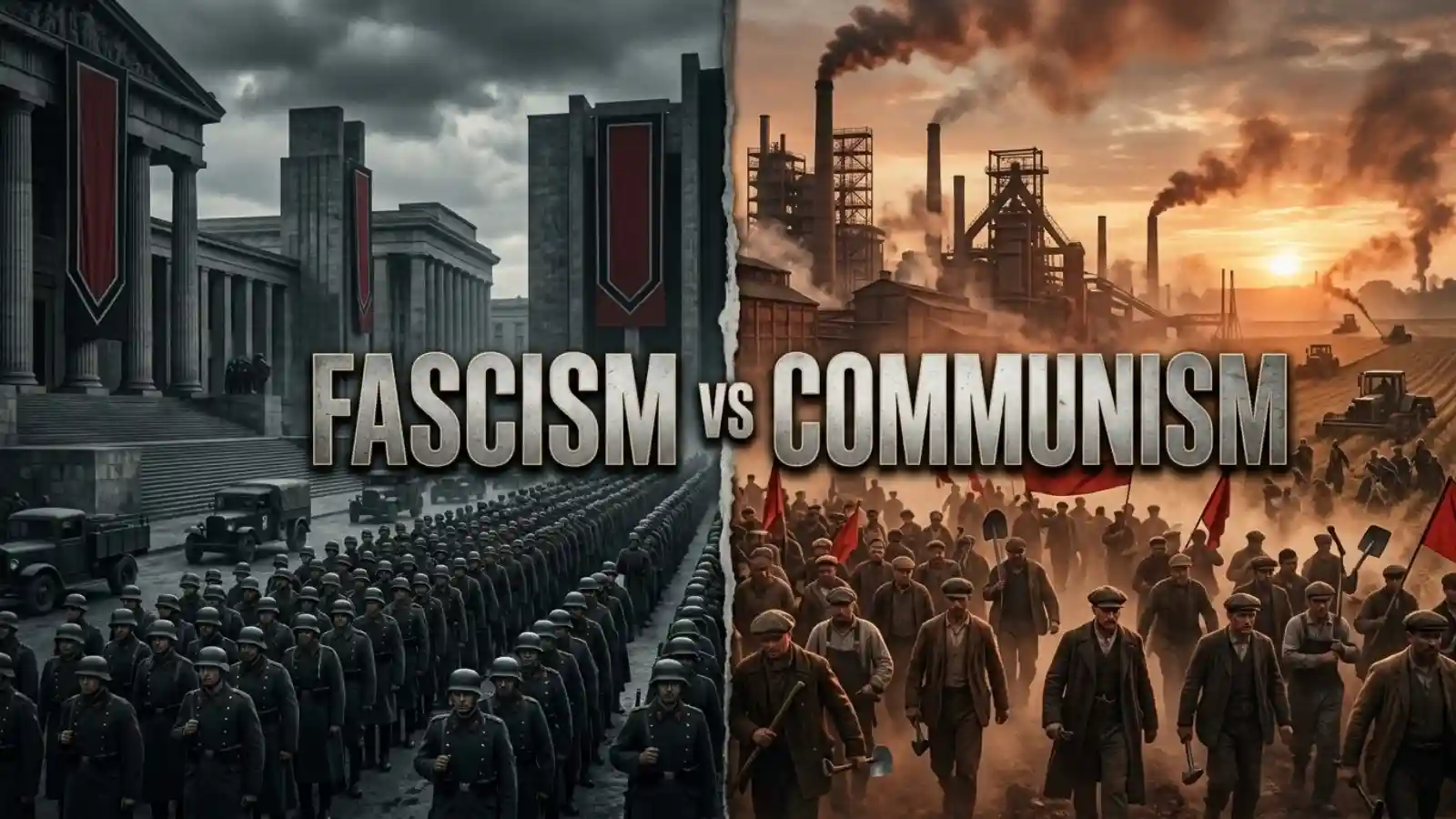
Fascism vs communism involves two very different political ideologies. Fascism emphasizes authoritarian leadership, nationalism, hierarchy, and the interests of the nation.
While communism is based on class struggle, collective ownership, and the goal of a classless society.
Historical regimes associated with both became authoritarian, but their core ideological goals and social visions were fundamentally different.
Key Takeaways:
- Fascism places the nation, national unity, and often racial identity above individual interests.
- Communism focuses on economic class and seeks to eliminate class divisions through collective ownership.
- Fascism generally supports private property under strong state direction, while communist theory seeks collective ownership of the means of production.
- Historical fascist and communist regimes often used one-party rule, political repression, and state violence, but that does not make their ideologies identical.
- Fascists and communists were frequently bitter enemies, particularly in Europe during the 20th century.
What Is Fascism?
Fascism is an authoritarian political ideology that emerged in Europe in the early 20th century. It is commonly associated with extreme nationalism, centralized leadership, militarism, political repression, and the idea that the interests of the nation should come before individual rights.
The U.S. Holocaust Memorial Museum describes fascism as a far-right political philosophy that places the nation above the individual and rejects liberal democracy, political pluralism, communism, and socialism.
Fascist movements were especially successful in Italy under Benito Mussolini and Germany under Adolf Hitler. Nazi Germany represented a particularly radical form of fascism, combining authoritarian nationalism with racism and antisemitism.
Core Beliefs of Fascism
Although fascist movements differed by country, several themes commonly appeared:
- Strong centralized leadership
- Extreme or exclusionary nationalism
- Rejection of liberal democracy
- Suppression of political opposition
- Militarism and glorification of strength
- Emphasis on national unity
- Acceptance of political violence
- Social and political hierarchy
Fascism generally does not seek to eliminate all private businesses or private property. Instead, businesses and economic activity can remain privately owned while being heavily directed toward national goals.
What Is Communism?
Communism is a political and economic philosophy most strongly associated with Karl Marx and Friedrich Engels. It views society through the relationship between economic classes, particularly the conflict between workers and owners of the means of production.
Marx and Engels argued that capitalism created a conflict between the proletariat, or working class, and the bourgeoisie, or capitalist class. Communist theory ultimately seeks a classless society in which productive resources are collectively owned.
The Russian Revolution of 1917 eventually led to the creation of the Soviet Union, the first state to be governed by a communist party.
An important distinction is that communist theory and historical communist governments are not exactly the same thing. The fully classless society described by communist theory has never existed in practice. Historical communist states instead developed powerful centralized governments and state-controlled economies.
Core Beliefs of Communism
Key ideas associated with communist theory include:
- Class struggle
- Collective ownership of productive resources
- Opposition to capitalism
- Reduction or elimination of class divisions
- Economic equality
- International working-class solidarity
- Revolutionary transformation of society
The central focus is therefore different from fascism: communism emphasizes economic class, while fascism emphasizes nation and national unity.
Fascism vs Communism: Key Differences
The easiest way to understand fascism vs communism is to compare what each ideology considers most important.
| Category | Fascism | Communism |
| Central focus | Nation and national community | Economic class |
| Political orientation | Generally far-right | Generally far-left |
| Nationalism | Strong, often central | Traditionally internationalist |
| Social hierarchy | Often embraces hierarchy | Seeks to eliminate class hierarchy |
| Private productive property | Can exist under state direction | Intended to become collectively owned |
| Capitalism | May preserve private business under state control | Seeks to replace capitalism |
| Leadership | Strong authoritarian leader | Communist party leadership in historical states |
| Liberal democracy | Rejected | Rejected by many historical communist regimes |
| Main historical examples | Fascist Italy, Nazi Germany | Soviet Union and other communist states |
The table describes broad ideological and historical patterns. Individual movements and governments differed, so neither category should be treated as completely uniform.
Nationalism vs Internationalism
One of the biggest differences is their approach to national identity.
Fascism treats the nation as the central political community. Fascist movements often promoted national unity, national strength, and the idea that individuals should subordinate their interests to the nation.
Classical communist theory, by contrast, emphasizes class solidarity across national borders. Its central conflict is not one nation against another but workers against the capitalist class.
This difference helps explain why fascist movements were strongly anti-communist.
Class and Social Hierarchy
Communism aims to remove class divisions. Marxist theory argues that society is divided by ownership of productive resources and seeks to eliminate the capitalist class structure.
Fascism takes a very different approach. Rather than making class equality the central goal, fascist systems generally emphasize hierarchy, discipline, and unity within the national community.
That does not mean every fascist movement used identical social structures. However, hierarchy and unequal social roles are much more compatible with fascist ideology than with the communist goal of a classless society.
Private Property and the Economy
Economic organization is another major dividing line.
Communist theory seeks collective ownership of the means of production, such as major industries and productive resources. Historical communist governments frequently placed these sectors under state control.
Fascism does not inherently require the abolition of private businesses. Instead, fascist governments can maintain private ownership while directing economic activity toward state and national objectives.
This means state economic control does not automatically make a system communist. The purpose and ideological justification behind that control matter.
Government and Political Power
Both ideologies have been associated with authoritarian governments in historical practice, but their ideological justifications differ.
Fascist governments generally concentrate political authority around a leader, a ruling party, and the national state. Fascist movements reject political pluralism when they see competing parties and institutions as threats to national unity.
Historical communist states also developed highly centralized political systems, often dominated by a single communist party.
The result can look similar in terms of political repression or limited political competition, even though the underlying ideologies have different goals.
Fascism vs Communism: Similarities
If fascism and communism are so different, why are they often compared?
The answer is that some historical regimes associated with these ideologies shared methods of political control.
Both fascist and communist regimes have historically been associated with:
- One-party political systems
- Restrictions on political opposition
- Propaganda
- State censorship
- Political imprisonment
- Extensive government control
- Political violence
- Rejection of liberal democratic institutions
The OER Project notes these similarities when comparing Stalin’s Soviet Union with fascist regimes. At the same time, it highlights major differences in nationalism, race, and social hierarchy.
Therefore, saying that two systems shared authoritarian methods does not mean their philosophies were identical.
Fascism and Communism in Historical Practice
Fascist Italy and Nazi Germany
Italy under Mussolini became the first major fascist regime. Germany under Hitler later developed a particularly extreme form of fascist rule.
The Nazi government established a one-party dictatorship, suppressed opposition, and used state power to pursue racial persecution and territorial expansion. Communists were among the regime’s earliest political targets.
The Nazi regime’s hostility toward communism was not incidental. Hitler and the Nazi movement presented Marxism and communism as fundamental enemies of their nationalist and racial vision.
The Soviet Union and Communist Rule
The Soviet Union developed under communist party rule following the Russian Revolution. Under Joseph Stalin, the state exercised extensive control over political and economic life, including collectivization and industrial planning.
This historical experience is important because it shows the difference between communist theory and communist governments in practice. The theoretical goal of a classless society differed significantly from the centralized state that developed in the Soviet Union.
Why Were Fascists and Communists Enemies?
Fascists and communists had opposing visions of society.
Fascists generally emphasized national identity, hierarchy, and national unity. Communists emphasized class conflict, economic equality, and international working-class solidarity.
In Germany, this conflict became especially violent. When Hitler came to power in 1933, the Nazis rapidly arrested communists and other political opponents. The first prisoners at Dachau included German Communists.
The hostility was therefore ideological as well as political. Nazi Germany viewed communism as a threat to its nationalist and racial political order.
Fascism vs Communism: Side-by-Side Comparison
A simple way to remember the difference is:
Fascism asks: How can the nation become unified, powerful, and dominant?
Communism asks: How can class divisions and capitalist ownership be eliminated?
That distinction captures the basic divide without pretending that every historical movement followed an identical blueprint.
Fascism is primarily organized around nation, authority, hierarchy, and collective national identity. Communism is primarily organized around class, economic ownership, and the creation of a classless society.
Their historical regimes could both become highly authoritarian, but they arrived at that political structure from different ideological starting points.
Frequently Asked Questions
Is fascism right-wing and communism left-wing?
Fascism is generally classified as a far-right political ideology, particularly because of its ultranationalism, hierarchy, and opposition to communism and liberal democracy. Communism is generally placed on the far-left because it seeks to eliminate capitalist class divisions and establish collective ownership.
Are fascism and communism the same?
No. They are fundamentally different ideologies. Fascism centers on the nation, authoritarian leadership, and hierarchy, while communism centers on class struggle, collective ownership, and the goal of a classless society. Some historical regimes associated with each used authoritarian methods, which explains why they are sometimes compared.
What do fascism and communism have in common?
Historical fascist and communist governments have shared some features, including centralized political power, suppression of opposition, propaganda, and restrictions on liberal democratic institutions. However, their ideological goals were substantially different.
Did fascists oppose communism?
Yes. Major fascist movements were strongly anti-communist. Nazi Germany, for example, targeted German Communists immediately after Hitler came to power and treated communism as a major ideological enemy.
Final Takeaway:
The most important point in Fascism vs Communism is that similarity in political methods does not mean similarity in ideology.
Fascism places the nation, authority, hierarchy, and national unity at the center of political life. Communism begins with class conflict and seeks to replace capitalist ownership with collective ownership and ultimately eliminate class divisions.
Historical governments associated with both ideologies sometimes became highly authoritarian, but they pursued different visions of society.
Understanding that distinction makes it much easier to evaluate fascism and communism accurately rather than treating them as interchangeable political labels.