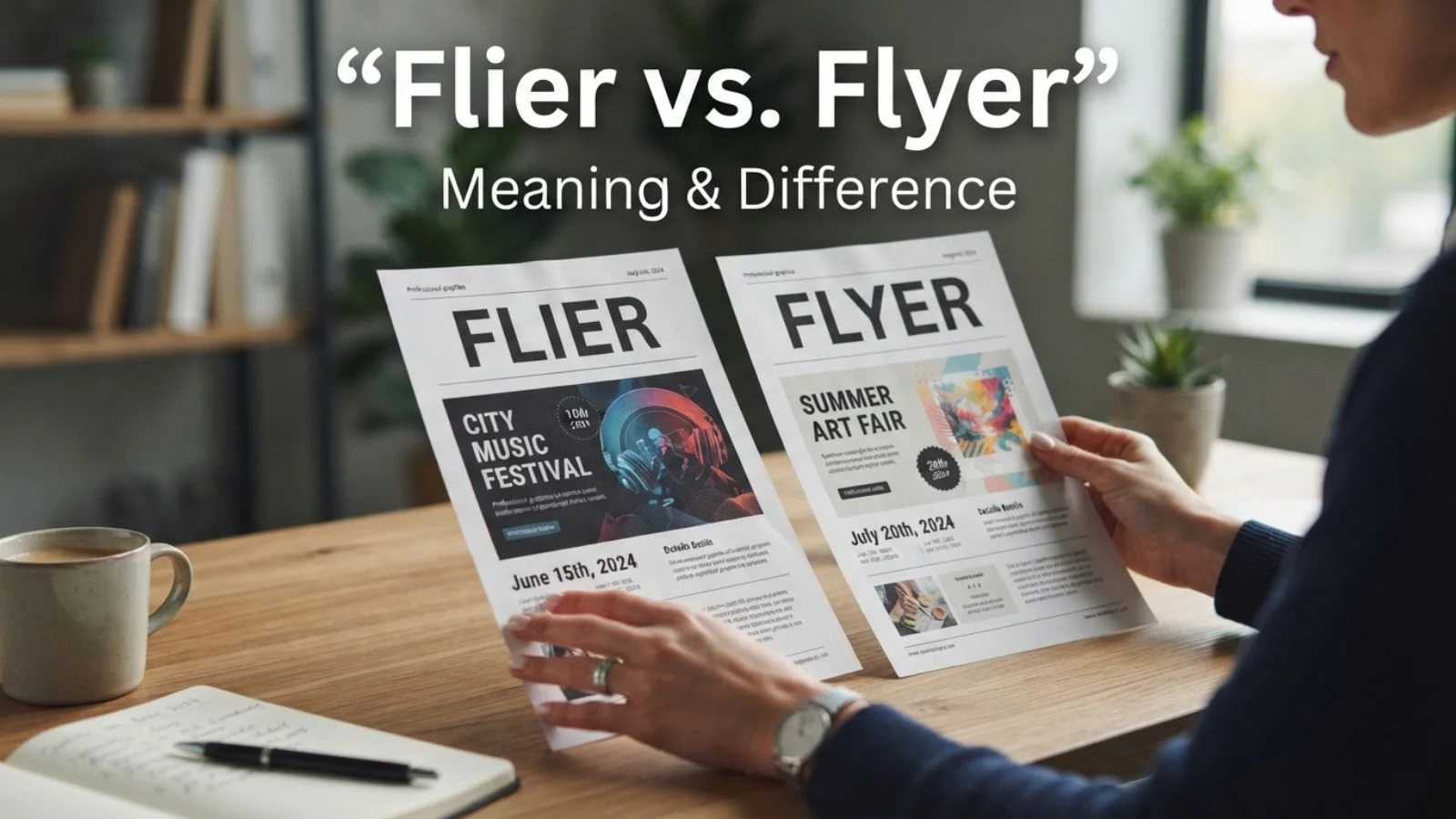
Few word pairs cause as much quiet hesitation as “flier” and “flyer.” You’re drafting an email, designing a handout, or writing about your latest trip, and suddenly you stop: which spelling is right? The frustrating (and freeing) truth is that both are correct.
English simply never settled on one form, and the two spellings have drifted into slightly different roles depending on where you’re writing from and what you’re describing.
In American English, “flier” often refers to a person who flies or someone taking a risk, while “flyer” usually means a printed handout.
In British English, “flyer” covers nearly every sense of the word. Neither version is a typo, and dictionaries list them as interchangeable variants.
This guide breaks down where each spelling comes from, how it’s used today, and how to choose the right one with confidence no matter who you’re writing for.
Etymology and Origins
Both “flier” and “flyer” trace back to the verb “fly,” combined with the agent suffix “-er,” which turns a verb into “one who does the action.” In theory, this should have produced a single, tidy spelling. Instead, English true to form developed two.
The “-er” ending is the standard, more common way to form this kind of noun in English (think “runner,” “worker,” “driver”). The “-ier” variant is rarer and shows up in only a handful of words, most notably “flier,” “cashier” (though from a different root), and a few others where pronunciation or historical spelling habits nudged the “i” into place.
Historically, “flyer” appears to be the older and more consistently used form, showing up in print well before “flier” gained traction. As aviation became a major industry in the early 20th century, American English speakers increasingly adopted “flier” specifically for pilots and passengers, while “flyer” stuck around for handbills, notices, and advertisements, a division that never fully took hold in British English.
Over the decades, American style guides and newspapers helped cement this loose split, while British publishers largely ignored it, treating “flyer” as the default spelling for both people and paper.
Dictionary Definitions
Major dictionaries agree on one key point: “flier” and “flyer” are variants of the same word, not two separate words with fixed, non-overlapping meanings. This is an important distinction, because it means neither spelling is technically “incorrect” in any context dictionaries simply note which one is used more frequently for which sense.
Merriam-Webster, the most widely used American dictionary, lists “flyer” as the primary spelling and “flier” as an equal variant, noting that both can refer to a person or thing that flies, a daring venture, or a printed advertisement. It does not enforce the person/paper split that many American writers assume is a hard rule that division is more of a stylistic convention than a dictionary-backed distinction.
The Oxford English Dictionary, reflecting British usage, favors “flyer” across the board and treats “flier” as the less common variant, primarily seen in American writing.
Collins English Dictionary similarly lists “flyer” as the standard British spelling, with “flier” noted as an American alternative.
What’s notable is that none of these dictionaries assign strict, separate definitions to each spelling. The idea that “flier” always means a person and “flyer” always means paper is a popular writing convention reinforced by style guides and habit rather than an official rule found in dictionary entries themselves.
Flier” Detailed Usage
In American English, “flier” has carved out a fairly specific niche, even though dictionaries treat it as interchangeable with “flyer.” Understanding these common contexts will help you use it naturally and consistently.
Referring to a person who flies. The most traditional use of “flier” describes a pilot, aviator, or passenger. Phrases like “a skilled flier” or “nervous fliers” lean on this sense, evoking the person rather than the object.
Frequent flier programs. This is perhaps the most recognizable use of “flier” in everyday life. Airlines and loyalty programs in the U.S. have historically used “frequent flier” to describe program members and their accumulated miles or points, though many brands now use “flyer” instead, so you’ll see both in the wild.
The idiom “take a flier.” This lesser-known phrase means to take a risk or make a speculative attempt, often in a financial or business context: “The startup took a flier on an unproven technology.” Here, “flier” has nothing to do with flight at all; it’s a standalone idiomatic expression.
Journalistic and formal American writing. Style guides like the AP Stylebook have historically favored “flier” for these person-related and idiomatic senses, which is part of why the spelling persists in American newspapers, aviation writing, and business journalism.
Flyer” Detailed Usage
“Flyer” is the more versatile and widely used spelling globally, covering a broader range of contexts than “flier” especially outside the United States.
Printed advertisements and handouts. This is the spelling’s most common modern use. Whether it’s a paper notice stapled to a community board, a promotional handout at a trade show, or a digital PDF shared online, “flyer” is the default choice: “hand out flyers for the concert” or “design a flyer for the sale.”
Public transportation and brand names. Many transit systems, airlines, and companies bake “flyer” directly into their branding loyalty programs, train services, and travel brands frequently choose this spelling regardless of region, which has helped reinforce it as the more visible, recognizable form.
British English usage. In the UK, Australia, and most other English-speaking countries outside the U.S., “flyer” is the standard spelling for virtually every sense of the word people who fly, promotional materials, and idiomatic expressions alike. There’s no meaningful split the way there sometimes is in American writing.
General digital and marketing usage. In web content, social media, and online advertising, “flyer” dominates search behavior and everyday writing, partly because it’s the more common global spelling and partly because marketing terminology has standardized around it.
American vs. British English Comparison
The clearest way to understand the flier/flyer divide is to look at how the two major English dialects treat it differently.
In American English, there’s a loose but recognizable pattern: “flier” tends to appear when referring to a person who flies, a frequent-flier traveler, or the idiom “take a flier.” “Flyer” tends to appear for printed handouts and advertisements. This isn’t a strict rule, it’s a convention shaped by style guides and habits but it’s common enough that many American readers expect it.
In British English, this split largely doesn’t exist. “Flyer” is the standard spelling across the board, used for people, paper handouts, brand names, and idioms alike. British dictionaries and publishers rarely use “flier” at all, and when they do, it’s often recognized as an American import rather than a native British form.
| Context | American English | British English |
| Person who flies | Flier (traditionally) | Flyer |
| Printed handout | Flyer | Flyer |
| Frequent flyer program | Either (historically “flier”) | Flyer |
| “Take a flier” (idiom) | Flier | Rarely used |
| General/default spelling | Flyer (more common overall) | Flyer |
This means American writers face a slightly more nuanced decision depending on context, while British writers can simply default to “flyer” nearly every time without worrying about a split.
For global or mixed audiences, “flyer” is generally the safer, more universally recognized choice.
Style Guide Comparison
Major style guides don’t fully agree on flier vs. flyer, which is part of why the confusion persists even among professional writers and editors.
AP Stylebook.
The Associated Press has historically preferred “flier” for the “one who flies” sense and for handbills/leaflets as well, making AP one of the few guides that has, at times, favored “flier” broadly rather than splitting it by context. Writers following AP style should default to “flier” unless a specific brand name uses “flyer.”
Chicago Manual of Style.
Chicago generally treats “flyer” as the more common and preferred spelling, while acknowledging “flier” as an acceptable variant. It doesn’t enforce a strict person/paper distinction the way popular writing convention does.
Oxford Style Manual / British style guides.
These consistently favor “flyer” as the standard spelling for all uses, reflecting broader British English preference. “Flier” is treated as a chiefly American variant rather than a stylistic choice.
Major publications in practice. ‘
The New York Times and other American outlets have leaned toward “flier” in certain sections (particularly travel and aviation), while marketing and lifestyle content across the same publications often uses “flyer” for handouts. British outlets like the BBC and The Guardian use “flyer” almost exclusively.
The takeaway for writers.
If you’re following a specific style guide, defer to its preference. If you’re writing independently, choose one spelling, apply it consistently throughout your document, and consider your audience’s regional expectations.
Common Mistakes and Misconceptions
Even confident writers stumble over fliers/flyers, often because of assumptions that sound like rules but aren’t.
Assuming one spelling is simply wrong.
The most common misconception is that “flier” or “flyer” must be a typo. Since dictionaries list both as valid variants, neither is incorrect; the “mistake” is usually an inconsistency, not an actual spelling error.
Treating the person/paper split as an absolute rule.
Many writers believe “flier” must always mean a person and “flyer” must always mean a handout. In reality, this is a loose American convention, not a dictionary-enforced distinction. Even AP style, at times, has applied “flier” more broadly than the popular rule suggests.
Inconsistency within the same document.
Switching between “flier” and “flyer” in the same article, email, or marketing campaign is the most noticeable and avoidable error. It doesn’t break any grammatical rule, but it looks unpolished and can be read as careless proofreading.
Ignoring brand-specific spelling.
Loyalty programs, transit systems, and companies often have official spellings baked into their names (frequent flyer program vs. frequent flier miles, for example). Using the wrong variant when referencing a specific brand can look like an error even if it’s generally acceptable elsewhere.
Relying entirely on spellcheck.
Spellcheck tools typically accept both spellings and won’t flag inconsistency, so writers can’t rely on automated tools to catch mixed usage manual proofreading matters here.
Overcorrecting based on regional assumptions.
Assuming American rules apply globally (or vice versa) can lead to unnatural phrasing for the intended audience.
Practical Guidelines for Writers
Rather than memorizing rigid rules, writers are better served by a few practical habits that keep usage clean and consistent.
Pick one spelling and commit to it.
Unless you’re deliberately distinguishing between senses (person vs. handout), the safest approach is choosing one spelling for your entire document, website, or brand and using it every time. Consistency matters far more than which variant you pick.
Default to “flyer” if you’re unsure.
Since “flyer” is the more globally recognized spelling and doesn’t require readers to know the American person/paper convention, it’s the safer default for blogs, marketing content, and mixed international audiences.
Match your style guide when one applies.
If you’re writing for a publication, company, or client with an established style guide, defer to its preference rather than personal habit or regional instinct.
Consider your audience’s region.
Writing primarily for American readers in aviation, travel, or business journalism contexts may call for “flier.” Writing for UK, Australian, or general international audiences almost always favors “flyers.”
Respect brand names exactly as written.
If you’re referencing a specific loyalty program, airline, or company that has an official spelling, use that spelling regardless of your document’s general convention.
Proofread specifically for this word pair.
Because spellcheck won’t catch inconsistency, do a manual search (Ctrl+F) for both spellings before publishing to make sure you haven’t mixed them accidentally.
Real-World Examples
Seeing “flier” and “flyer” in context makes the distinction much easier to internalize than any rule alone.
Examples using “flier” (person/idiom sense):
- “As a frequent flier, she’s visited over forty countries.”
- “The pilot was praised as a skilled, cautious flier.”
- “The company decided to take a flier on the unproven software, hoping it would pay off.”
- “Nervous fliers are often encouraged to book aisle seats.”
Examples using “flyer” (printed material sense):
- “We handed out flyers outside the stadium before the game.”
- “The local bakery designed a colorful flyer to promote its grand opening.”
- “Check the community board there’s a flyer for the lost cat.”
- “Our marketing team printed five hundred flyers for the trade show.”
Examples showing regional/brand variation:
- An American airline’s loyalty page might read: “Join our Frequent Flyer program today” even though “flier” is the more traditional American spelling for this exact phrase, many U.S. brands now use “flyer” instead.
- A British transit company might advertise: “Buy your Flyer Pass for unlimited weekend travel,” using “flyer” naturally without a second thought.
- A U.S. newspaper travel section might write: “Fliers should arrive two hours early for international flights,” reflecting AP-style convention.
Example of inconsistency to avoid:
- “We printed flyers for the event, and every flier who picked one up seemed excited.” (Grammatically fine, but mixing spellings in one sentence reads as careless.)
FAQs
Is “flier” or “flyer” more correct?
Neither is more “correct” ; both are accepted spellings of the same word. Dictionaries list them as variants, and the choice largely comes down to region, style guide, and context rather than strict grammar.
Which spelling do airlines use?
It varies by company. Historically, American English favored “frequent flier” for loyalty programs, but many airlines and travel brands today use “frequent flyer” instead. Always match the airline’s official branding when referencing a specific program by name.
Can I use them interchangeably?
Yes, in most cases. Since both spellings are valid, you won’t be technically wrong using either one. The main risk isn’t incorrectness, it’s inconsistency, so once you pick a spelling for a piece of writing, stick with it throughout.
Which one is used in the UK vs. the US?
British English strongly favors “flyer” for nearly all senses of the word people, paper handouts, and idioms alike. American English sometimes splits the two, using “flier” for people and idioms and “flyer” for printed materials, though this convention isn’t universally followed even within the U.S.
Does Microsoft Word or Google Docs flag either spelling as wrong?
No. Both spellings pass standard spellcheck tools, which is exactly why manual proofreading matters software won’t catch inconsistent use within the same document.
What about “take a flyer” instead of “take a flier”?
This idiom is traditionally spelled “take a flier” in American English, though “take a flyer” does appear occasionally and is generally understood the same way.
Conclusion:
At the end of the day, “flier” and “flyer” are two branches of the same word, split more by geography and habit than by grammar.
American English sometimes distinguishes people from paper; British English rarely bothers. Neither spelling is wrong but consistency within your writing is what actually matters.
When in doubt, default to “flyer,” the more globally recognized form, and adjust based on your style guide, audience, or brand. With that one habit, you’ll never hesitate over this word pair again.

I’m Maya Angelou, the creator behind EmojiAura.com, where I explore emoji meanings, social media trends, and fun digital expressions. I’m passionate about helping people understand the real meaning behind emojis and use them creatively in chats, captions, posts, and everyday online conversations.