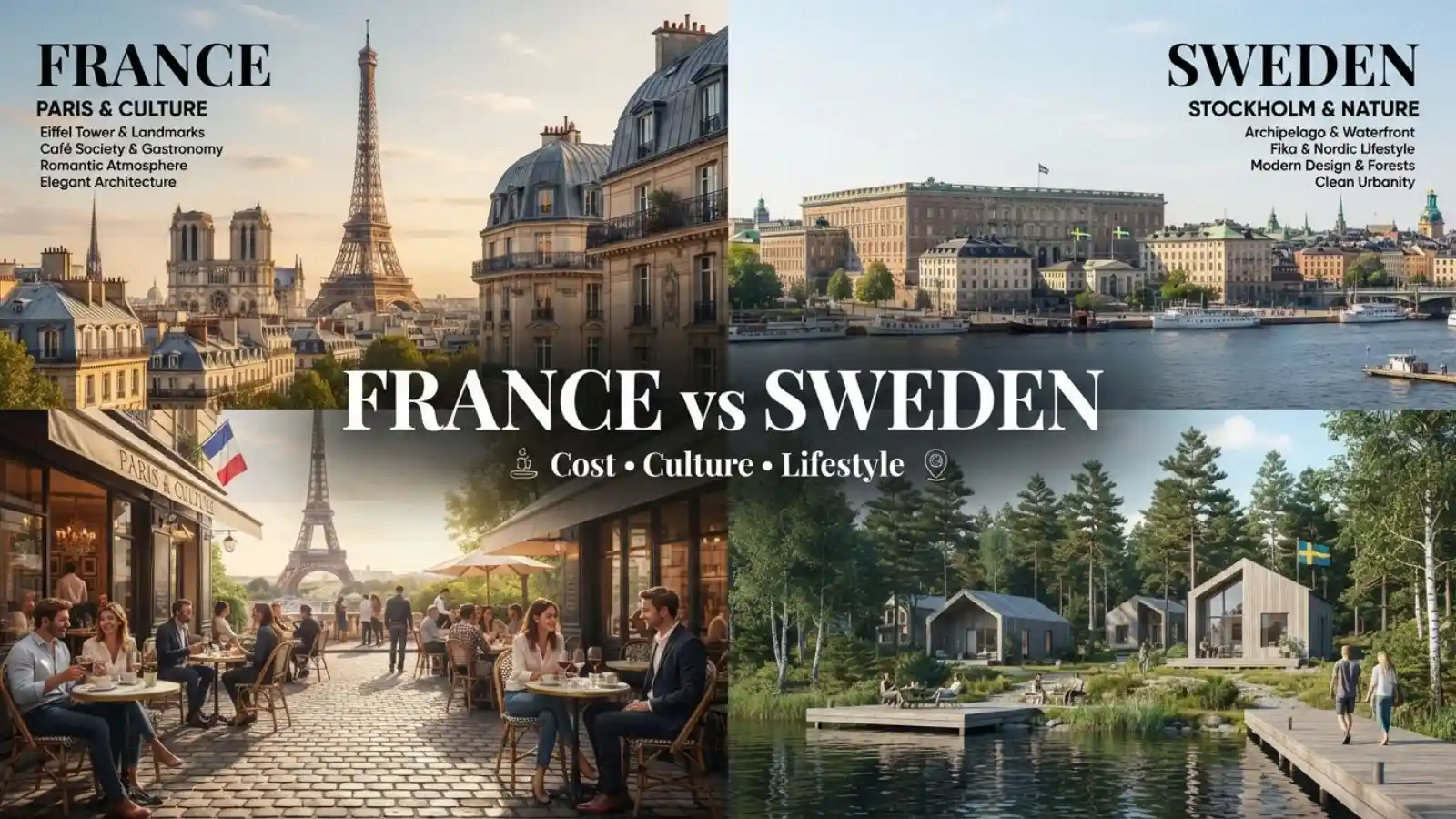
France vs Sweden is a comparison between two very different European countries. France is larger by population, has a bigger overall economy, warmer and more varied climates, and a famous food and cultural scene.
Sweden is smaller, colder, more sparsely populated, and has higher GDP per capita. The better choice depends on whether you prioritize climate, culture, income, nature, or lifestyle.
Key Takeaways:
- France has about 68.7 million people, compared with about 10.6 million in Sweden.
- France has the larger total economy, while Sweden has higher GDP per person.
- France generally offers more climate variety, while Sweden is better known for cooler weather and long winters.
- Cost-of-living comparisons are close and can change significantly depending on the city and lifestyle.
- Both countries are EU members and part of the Schengen Area.
France vs Sweden: At a Glance
France and Sweden are both developed European countries, but their geography and everyday lifestyles are quite different.
| Category | France | Sweden |
| Region | Western Europe | Northern Europe |
| Capital | Paris | Stockholm |
| Population | About 68.7 million | About 10.6 million |
| Official currency | Euro (€) | Swedish krona (SEK) |
| Main language | French | Swedish |
| Climate | Highly varied | Mostly cool to cold |
| Total GDP, 2025 | About $3.37 trillion | About $669 billion |
| GDP per capita, 2025 | About $48,986 | About $63,133 |
| EU member | Yes | Yes |
| Schengen member | Yes | Yes |
The population and economic figures show one of the biggest differences. France has more than six times Sweden’s population and an economy roughly five times larger, while Sweden’s GDP per person is substantially higher.
Geography, Population, and Basic Differences
France
France sits in Western Europe and has borders with several European countries. Its geography is unusually diverse, ranging from Atlantic and Mediterranean coastlines to the Alps and Pyrenees.
That geographic variety gives France several distinct regional identities. Paris is a major global city, while cities such as Lyon, Marseille, Bordeaux, Toulouse, and Nice offer very different experiences.
France also has overseas territories, making its overall geographic and cultural footprint broader than mainland France alone.
Sweden
Sweden occupies much of the eastern part of the Scandinavian Peninsula. It is considerably less densely populated than France, with large areas of forests, lakes, and sparsely populated northern territory.
Stockholm is the capital and largest urban center. Gothenburg and Malmö are other important cities.
Sweden’s northern location has a major influence on daily life. Winters can be long and dark, while summer brings very long daylight hours, particularly in the north.
France vs Sweden: Economy and Cost of Living
Which Country Has the Larger Economy?
France clearly has the larger economy in total. World Bank data puts France’s 2025 GDP at about $3.37 trillion, compared with approximately $669 billion for Sweden.
However, total GDP does not tell the entire story.
Sweden’s 2025 GDP per capita was about $63,133, compared with approximately $48,986 in France. In other words, Sweden produces more economic output per person even though France has the much larger overall economy.
Which Is More Affordable?
This is less straightforward.
Recent cost-of-living comparisons put France and Sweden fairly close overall. Expatistan’s September 2026 comparison describes France as roughly similar in total cost, while other datasets show France slightly cheaper. Results also vary by category.
Your city matters enormously.
Paris can be expensive, just as Stockholm has high housing costs. A smaller French city may produce a very different monthly budget from Paris, while living outside Stockholm can also reduce expenses.
For someone comparing the countries for relocation, it is therefore better to compare specific cities, salaries, rent, taxes, and transportation costs rather than relying on one national average.
Climate and Lifestyle
Climate is one of the clearest differences in the France vs Sweden comparison.
France generally has milder conditions and much greater regional variation. Northern and western areas can be cool and wet, while southern France has warmer Mediterranean conditions.
Sweden is farther north and generally cooler. Southern Sweden has a relatively moderate climate, but northern areas experience much colder winters and dramatic seasonal changes.
This creates different lifestyles.
France is attractive to people who want outdoor cafés, coastal destinations, mountains, vineyards, historic towns, and relatively mild weather in many regions.
Sweden appeals strongly to people who enjoy forests, lakes, hiking, winter activities, quiet surroundings, and a strong connection with nature.
Culture, Food, and Language
France has a globally recognized cultural identity built around food, art, fashion, architecture, literature, wine, and history.
French cuisine is also one of the country’s biggest cultural attractions. Regional food traditions vary widely, from Mediterranean dishes in the south to richer northern and eastern cuisines.
Swedish culture is often associated with Scandinavian design, simplicity, nature, sustainability, and concepts such as fika, the social tradition of taking a coffee break with something to eat.
Language is another practical difference.
French is essential for daily life in France, particularly outside major international environments. Sweden’s official language is Swedish, but English is widely spoken, especially in cities and professional settings.
Travel: France vs Sweden
For travelers, both countries offer strong advantages.
France is especially attractive for first-time European travelers because of its combination of major cities, beaches, mountains, countryside, historic sites, museums, and food destinations.
Sweden is better suited to travelers looking for Scandinavian scenery, forests, archipelagos, lakes, modern cities, and northern landscapes.
Both France and Sweden are members of the Schengen Area, so travelers moving between Schengen countries generally benefit from the area’s common travel framework. The European Union currently lists both countries among the EU members issuing Schengen visas.
For non-EU travelers, however, the exact visa requirement depends on nationality and purpose of travel. A short-stay Schengen visa generally covers stays of up to 90 days within a 180-day period when a visa is required.
France vs Sweden Football
There is also a major sports interpretation of France vs Sweden.
In the men’s FIFA World Cup on June 30, 2026, France defeated Sweden 3–0. Kylian Mbappé scored twice, while Bradley Barcola also scored for France.
Historically, France has also held an advantage in their recorded men’s meetings, although the exact total can vary by database depending on which competitions and matches are included.
So if someone searches “France vs Sweden” because of football, the recent result is an important piece of context. For a broader country comparison, however, the differences in geography, climate, economy, and lifestyle are much more significant.
France or Sweden: Which Is Better?
There is no universal winner.
Best for Warm Weather and Regional Variety
France has the advantage.
Its geography provides beaches, mountains, countryside, major cities, and Mediterranean destinations within one country.
Best for Nature and Northern European Lifestyle
Sweden is a strong choice.
Its forests, lakes, islands, outdoor culture, and northern landscapes make it particularly appealing to nature lovers.
Best for Food and Cultural Variety
France generally stands out.
The country’s regional cuisines, historical sites, museums, fashion, architecture, and cultural traditions offer exceptional variety.
Best for Higher Income Per Person
Sweden has the advantage based on GDP per capita.
The World Bank reports 2025 GDP per capita of about $63,133 for Sweden versus $48,986 for France.
That statistic does not directly equal an individual’s salary, but it provides useful context about economic output per person.
Frequently Asked Questions
Is France cheaper than Sweden?
France and Sweden are relatively close in overall living costs, but different datasets produce slightly different results. Recent comparisons have placed France around the same level or somewhat cheaper overall. Housing, city, transportation, and personal spending habits can easily change the outcome.
Which country is bigger, France or Sweden?
France is larger by population, with about 68.7 million people compared with Sweden’s roughly 10.6 million. France also has a larger total economy. Sweden, however, has a large land area and much lower population density.
Is Sweden colder than France?
Yes, generally. Sweden’s northern location produces colder winters and greater seasonal variation. France has a wider range of climates, including relatively warm Mediterranean conditions in the south.
Who won France vs Sweden in the 2026 World Cup?
France won the men’s World Cup match 3–0 on June 30, 2026. Kylian Mbappé scored twice and Bradley Barcola scored once.
Final Verdict:
France vs Sweden is ultimately a comparison between two different versions of European life.
Choose France if you value climate variety, food, history, major tourist destinations, regional diversity, and a much larger domestic market.
Choose Sweden if you prefer cooler weather, nature, Scandinavian culture, a smaller population, and higher economic output per person.
For travel, both are excellent choices. For relocation, the best answer depends heavily on your city, income, housing needs, language skills, and preferred lifestyle. Neither country wins every category and that is what makes the comparison useful.