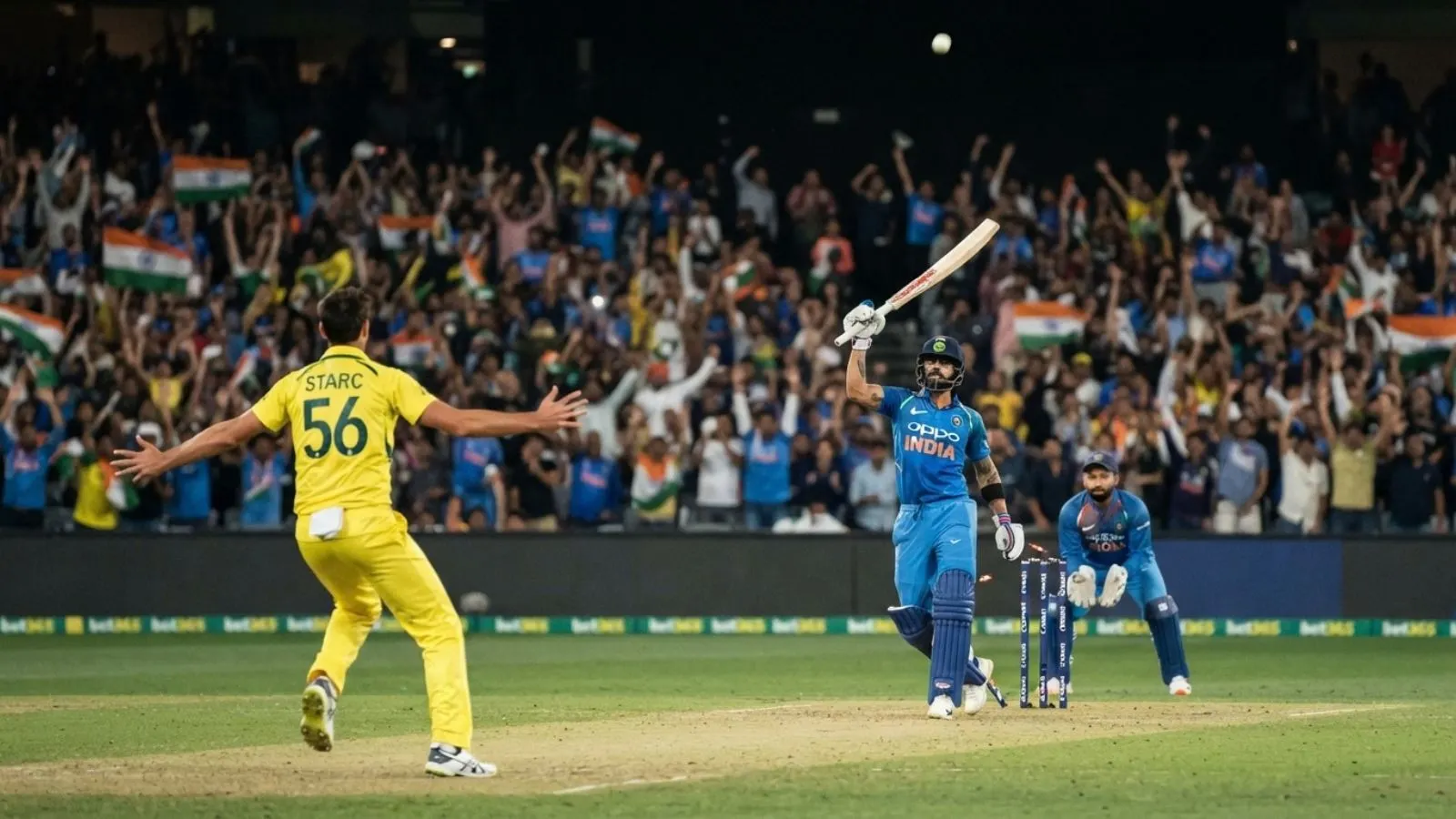
IND vs AUS means India vs Australia, one of international cricket’s most closely followed rivalries.
The two teams regularly meet in Tests, ODIs, and T20Is, as well as major ICC tournaments.
Their rivalry is especially famous for the Border-Gavaskar Trophy, World Cup clashes, competitive series, and battles between some of cricket’s biggest stars.
Key Takeaways:
- IND vs AUS is the common abbreviation for India vs Australia in cricket.
- The rivalry covers Tests, ODIs, T20Is, and ICC tournaments.
- The Border-Gavaskar Trophy is the centerpiece of their Test rivalry.
- India and Australia have produced several memorable World Cup and knockout matches.
- The rivalry combines Australia’s long cricket tradition with India’s enormous modern influence and competitive strength.
What Does IND vs AUS Mean?
IND vs AUS is simply the short form of India vs Australia in cricket. “IND” represents India, while “AUS” represents Australia.
You will commonly see the abbreviation on cricket scorecards, schedules, sports websites, television graphics, and social media.
The matchup can refer to any format. A Test match, ODI, T20I, or ICC tournament game may all be described as IND vs AUS.
Because the teams meet frequently across different competitions, the exact context matters when discussing their head-to-head record.
For example, an India vs Australia Test series is very different from an IND vs AUS T20 World Cup match.
India vs Australia Head-to-Head Rivalry
India and Australia have played each other across all three major international formats for decades.
Their records differ depending on whether you are looking at Tests, ODIs, or T20Is. That is important because a team can have an advantage in one format while the overall rivalry remains highly competitive.
| Format | Main Competition | What Makes It Important |
| Test | Border-Gavaskar Trophy | Long-form rivalry and series cricket |
| ODI | Bilateral & ICC events | World Cups and major one-day matches |
| T20I | Bilateral & ICC events | Fast-paced modern cricket |
| ICC events | World Cups and tournaments | High-pressure knockout games |
Test Cricket
Test cricket has become one of the defining parts of the India-Australia rivalry.
The two countries compete for the Border-Gavaskar Trophy, named after legendary Indian and Australian cricketers Sunil Gavaskar and Allan Border.
India’s emergence as a major Test force made this contest increasingly competitive. Australia had traditionally been one of the strongest teams in world cricket, while India developed into a formidable side both at home and overseas.
The rivalry became particularly significant as India began winning important Test series in Australia.
ODI Cricket
The ODI rivalry has produced some of the biggest India-Australia matches.
One-day cricket allows a single performance to change the result quickly, making batting partnerships, powerplay bowling, fielding, and death-over execution especially important.
The teams have also met in major ICC tournaments, where the pressure is considerably higher than in an ordinary bilateral series.
T20 International Cricket
T20Is provide a different version of IND vs AUS.
There is less time to recover from mistakes, and players must make quick decisions with the bat and ball. Explosive batting, variations from fast bowlers, spin, and athletic fielding can all determine the outcome.
The teams have also met in major T20 tournaments, adding another layer to the rivalry.
Why Is IND vs AUS Such a Big Rivalry?
The rivalry is bigger than a simple head-to-head record.
Both countries have deep cricket traditions, enormous fan bases, and teams capable of competing for major international trophies.
India brings a huge cricket following and has developed into a powerful force across formats. Australia has a long history of international success and a reputation for performing strongly in high-pressure matches.
When those qualities meet, even a regular bilateral game can attract significant attention.
The rivalry also includes contrasting cricket cultures. Australian cricket has traditionally emphasized aggressive competition and strong pace bowling, while India’s cricket strength has increasingly included world-class batting, spin bowling, fast bowling, and depth across formats.
The Border-Gavaskar Trophy
The Border-Gavaskar Trophy gives the Test rivalry its own identity.
Named after Allan Border and Sunil Gavaskar, the trophy represents one of international cricket’s most respected Test contests.
Unlike a single match, a Test series requires teams to perform consistently over several games. Conditions can change dramatically between venues, and players must handle fatigue, pressure, changing pitches, and long periods at the crease.
That makes a Test series between India and Australia particularly demanding.
World Cup and ICC Tournament Battles
ICC tournaments have added some of the rivalry’s most memorable chapters.
India and Australia have met at major global events, including the ODI World Cup and T20 World Cup.
These matches carry additional pressure because there is often little opportunity to recover from a defeat. A single poor performance can end a team’s tournament campaign.
The 2023 ODI World Cup final, played between India and Australia in Ahmedabad, is one of the most notable recent examples. Australia defeated India in the final to win the tournament.
India vs Australia: Major Cricket Moments
Australia’s Early Dominance
For much of the earlier history of international cricket, Australia possessed one of the strongest teams in the world.
Its successful generations produced outstanding batters, fast bowlers, all-rounders, and captains. India-Australia contests were therefore often viewed as a challenge against one of the sport’s established powers.
India’s Rise in Test Cricket
India’s transformation into a dominant Test team changed the balance of the rivalry.
The team developed greater pace-bowling depth while retaining its traditional strength in batting and spin. India’s overseas performances also became a major part of its cricketing identity.
Winning the Test series in Australia was especially significant because it demonstrated India’s ability to succeed in difficult overseas conditions.
The 2023 ODI World Cup Final
The 2023 World Cup final created another major chapter in the rivalry.
India entered the final as the host nation and one of the tournament’s strongest teams. Australia, however, produced a composed performance and won the final.
The result showed why Australia remains such a difficult opponent in major tournaments: the team has repeatedly demonstrated an ability to perform under extreme pressure.
Recent Test Rivalry
Modern India-Australia Test contests have featured several dramatic series.
Matches have involved close finishes, major batting performances, aggressive fast bowling, and strong contributions from both established players and younger stars.
The rivalry has also become more balanced than the traditional image of Australia simply dominating India.
India vs Australia: Playing Styles
India’s Strengths
India’s strengths can vary depending on the generation of players, but the team has traditionally produced outstanding batters and high-quality spin bowlers.
Modern Indian teams have also developed greater fast-bowling depth.
That combination makes India dangerous in both home and overseas conditions.
Australia’s Strengths
Australia has traditionally been known for aggressive cricket, high-quality fast bowling, strong fielding, and experienced top-order batting.
Australian teams have also developed a reputation for handling major tournament pressure.
The ability to produce strong performances in knockout games remains an important part of Australia’s cricket identity.
Who Has the Edge in IND vs AUS?
There is no single answer without specifying the format and competition.
Australia has an exceptional record in major international tournaments and has historically been one of the world’s most successful cricket teams.
India, meanwhile, has become one of the strongest teams across all formats and has enjoyed major success in Test cricket, including historic overseas performances.
The better team can therefore depend on the venue, format, players available, and competition.
For a Test series, the Border-Gavaskar Trophy provides the clearest measure of the rivalry. For ODIs, World Cup meetings can be more meaningful than older bilateral results. For T20Is, current form and individual matchups can have an even greater impact.
Frequently Asked Questions
What does IND vs AUS mean?
IND vs AUS means India vs Australia in cricket. “IND” is the abbreviation for India and “AUS” represents Australia. The term can refer to a match or series in Test cricket, ODIs, T20Is, or an ICC tournament.
Who has won more India vs Australia matches?
The answer depends on the format. India and Australia have played different numbers of matches in Tests, ODIs, and T20Is, and their records vary by competition. For an accurate comparison, the format and date should always be specified rather than relying on one combined record.
Why is India vs Australia such a major cricket rivalry?
The rivalry is important because both nations have strong cricket traditions, large fan bases, successful international teams, and a history of playing important matches. The Border-Gavaskar Trophy and major ICC tournament meetings have added even more significance.
What is the Border-Gavaskar Trophy?
The Border-Gavaskar Trophy is awarded to the winner of the Test series between India and Australia. It is named after former captains Allan Border of Australia and Sunil Gavaskar of India and has become one of the most important Test rivalries in international cricket.
Conclusion:
IND vs AUS represents much more than a simple cricket fixture. India and Australia have developed one of the sport’s most compelling international rivalries through Test series, ODI contests, T20Is, and major ICC tournaments.
The Border-Gavaskar Trophy gives their Test rivalry a distinctive identity, while World Cup and knockout matches provide some of their highest-pressure encounters.
For fans, the appeal is the uncertainty. Both teams have the talent, experience, and competitive mentality to change a match quickly, which is why India vs Australia remains one of cricket’s most closely watched matchups.

I’m Maya Angelou, the creator behind EmojiAura.com, where I explore emoji meanings, social media trends, and fun digital expressions. I’m passionate about helping people understand the real meaning behind emojis and use them creatively in chats, captions, posts, and everyday online conversations.