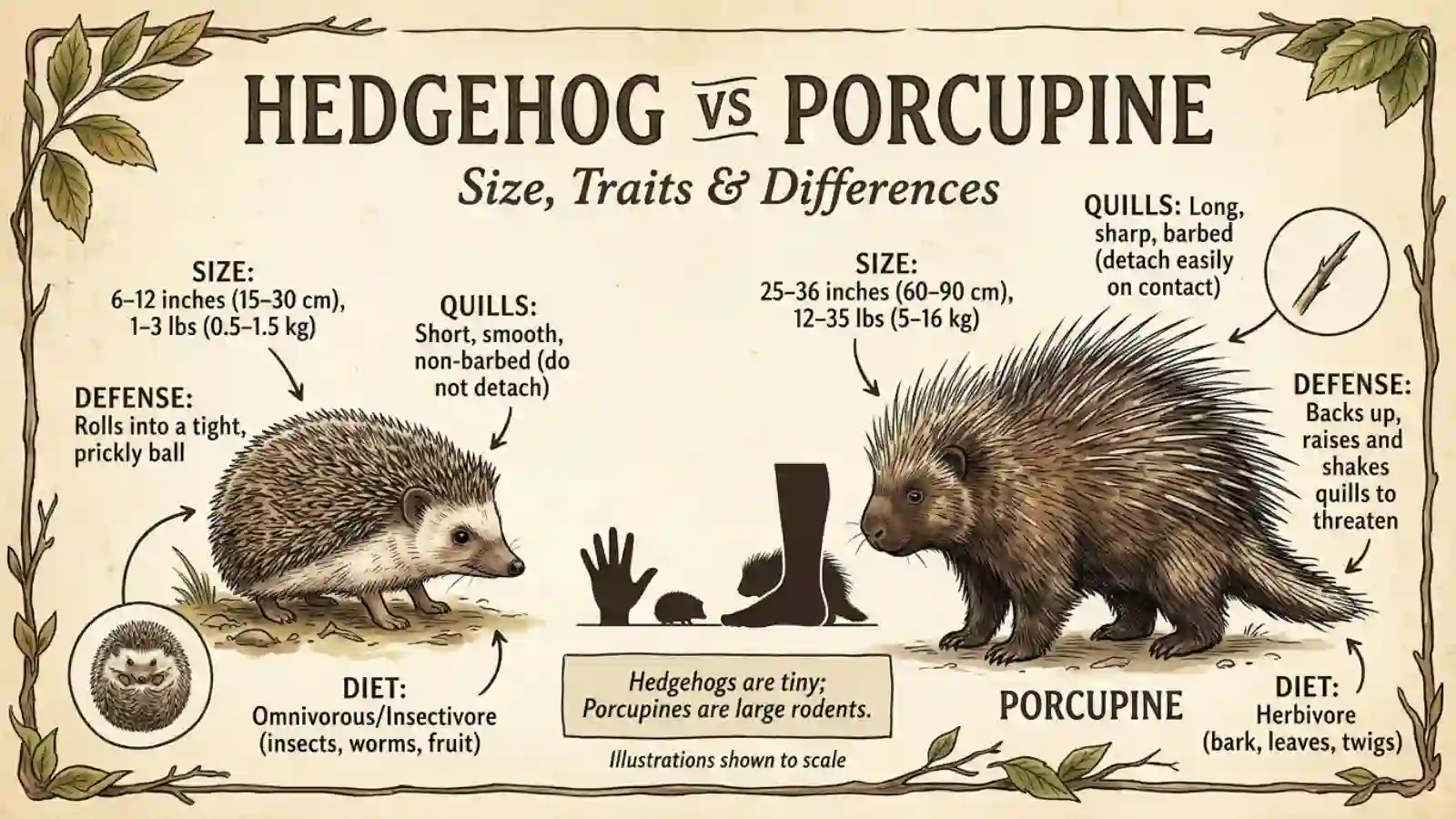
A hedgehog and porcupine are different animals, even though both have protective spines. Hedgehogs are small mammals related to shrews and moles, while porcupines are rodents.
Hedgehogs defend themselves by curling into a tight ball, while porcupines raise their quills and may use their tail against a predator.
Key Takeaways:
- Hedgehogs are much smaller than porcupines.
- Hedgehog spines are short and firmly attached; porcupine quills are longer and can detach.
- Hedgehogs are mainly insect-eating omnivores, while porcupines are herbivores.
- Hedgehogs curl into a ball when threatened.
- Porcupines cannot shoot their quills.
- In the U.S., porcupines are native wildlife, while hedgehogs are not native to the Americas.
Hedgehog vs Porcupine: Quick Comparison
| Feature | Hedgehog | Porcupine |
| Animal group | Erinaceidae / Eulipotyphla lineage | Rodentia |
| Typical size | Small | Much larger |
| Body covering | Short spines | Long quills |
| Spines/quills | Firmly attached | Many detach easily |
| Defense | Curls into a ball | Raises quills and turns toward threat |
| Diet | Mostly insects and other animal foods, with plant foods depending on species | Primarily plant material |
| Activity | Mostly nocturnal | Mostly nocturnal |
| Climbing | Can dig and climb depending on species | Many New World species climb trees |
| Native U.S. animal? | No native species | Yes, North American porcupine |
The biggest clue is size and defensive behavior. A small, round animal that can curl completely into a ball is a hedgehog. A much larger animal with long quills that turns its back toward danger is a porcupine.
Are Hedgehogs and Porcupines Related?
Not closely. Their similar appearance is an example of convergent evolution, where unrelated animals independently develop similar traits because those traits are useful for survival.
Hedgehogs belong to the family Erinaceidae and are more closely associated with animals such as shrews, moles, and gymnures. Porcupines belong to the order Rodentia, making them rodents.
So, despite their shared prickly appearance, a hedgehog is not a small type of porcupine, and a porcupine is not a giant hedgehog.
Their spiny coverings evolved separately as protective adaptations against predators.
Hedgehog vs Porcupine: Size and Appearance
Size is one of the easiest ways to tell these animals apart.
Hedgehogs are relatively small. For example, woodland hedgehogs can measure around 15–30 centimeters long and weigh roughly 600–1,500 grams, although size varies among species. They have compact bodies, short legs, pointed noses, and thousands of spines across their backs.
Porcupines are considerably larger. The North American porcupine typically reaches about 2–3 feet in length and weighs around 20 pounds, although individual size varies. It has a heavier body, short legs, and a coat containing roughly 30,000 quills.
Spines vs. Quills
The terms spines and quills are sometimes used interchangeably, but the structures are not identical.
Hedgehog spines are modified hairs. They are short, rigid, pointed, and firmly rooted in the skin. They are not designed to detach easily when a predator touches them.
Porcupine quills are specialized defensive structures. North American porcupine quills are hollow and loosely attached, allowing them to detach when they come into contact with a predator.
That difference explains why their defense strategies look so different.
How Their Defense Systems Differ
A hedgehog’s main defense is simple but effective: it curls into a tight ball.
When threatened, its muscles pull the head, legs, and tail inward while the spines point outward. This protects the softer parts of the body and makes the animal difficult for a predator to attack.
Porcupines use a different strategy. Instead of becoming a ball, they raise their quills, turn their back toward the threat, and may lash with the tail. Their loosely attached quills can become embedded in an attacker.
Can Porcupines Shoot Their Quills?
No. Porcupines cannot shoot, launch, or throw their quills.
This is one of the most common myths about porcupines. The quills detach when an attacker makes contact with them, making it appear as though the animal has fired them. In reality, physical contact is required.
Diet and Feeding Habits
Hedgehogs and porcupines also have very different diets.
Hedgehogs are generally opportunistic omnivores with a strong preference for animal foods. Depending on the species, their diet can include insects, worms, beetles, other invertebrates, small vertebrates, eggs, fruit, and fungi.
Porcupines are primarily herbivores. North American porcupines eat leaves, bark, buds, stems, berries, roots, grasses, and other plant material. Their diet changes with the seasons, with bark and evergreen needles becoming important during winter.
This creates an easy distinction:
Hedgehog = mostly animal-based foods and invertebrates.
Porcupine = primarily plants and woody vegetation.
Habitat and Geographic Range
Hedgehogs are native to parts of Europe, Asia, and Africa, depending on the species. They can live in grasslands, forests, scrubland, hedgerows, agricultural areas, and even suburban gardens. Some species have also been introduced outside their native ranges.
Porcupines have a much broader global distribution because there are different Old World and New World groups. North American porcupines occur across much of Canada, Alaska, and parts of the United States, while other porcupine species live in Africa, Europe, and Asia.
Habitat can also reveal which animal you are seeing. Some New World porcupines are capable tree climbers and regularly climb to find food. North American porcupines, for example, may climb trees to feed on buds and other vegetation.
Behavior and Lifestyle
Both animals are generally associated with nighttime activity, but their lifestyles are not identical.
Hedgehogs are often solitary and spend their nights searching for food. Woodland hedgehogs can travel considerable distances while foraging and may use gardens, parks, fields, and suburban areas.
Porcupines are also commonly active at night. North American porcupines spend much of their time on the ground but are capable climbers. Their strong claws help them climb trees in search of food and shelter.
Neither animal needs to be especially fast to survive. Their protective body coverings allow them to rely heavily on defense rather than speed when facing predators.
How to Tell a Hedgehog From a Porcupine
If you see a spiny mammal and are unsure what it is, look at these features:
1. Check the size.
A small, hand-sized or similarly compact animal is much more likely to be a hedgehog. A large, heavy-bodied animal is more likely to be a porcupine.
2. Look at the spines.
Hedgehogs have many short, relatively uniform spines. Porcupines have longer, more noticeable quills.
3. Watch the defense.
A hedgehog may curl completely into a ball. A porcupine typically raises its quills and presents its rear toward a threat.
4. Consider the location.
In the United States, a wild spiny mammal is far more likely to be a porcupine because hedgehogs have no native wild population in the Americas.
5. Look for climbing behavior.
A porcupine in a tree is entirely plausible, particularly for New World species. A hedgehog is primarily a ground-dwelling animal.
Which Animal Is More Dangerous?
Neither animal is normally looking for a fight with people.
A hedgehog’s spines can make it painful to handle, especially if the animal feels threatened. Its natural response is generally defensive rather than aggressive.
A porcupine deserves more caution because its detachable quills can become embedded in skin. The North American porcupine’s quills have tiny backward-facing barbs that help them lodge in tissue.
The best approach with either animal is to observe it without trying to touch, corner, or pick it up.
Frequently Asked Questions
Are hedgehogs and porcupines the same animal?
No. Hedgehogs and porcupines are different mammals from separate evolutionary groups. Hedgehogs belong to the Erinaceidae family, while porcupines are rodents. Their similar spiny coverings evolved independently as defenses against predators.
Are hedgehogs found in the United States?
Hedgehogs are not native to the United States. Their natural ranges are mainly in Europe, Asia, and Africa, although some species have been introduced elsewhere. North American porcupines, in contrast, are native to large parts of the United States and Canada.
Which is bigger, a hedgehog or a porcupine?
A porcupine is much bigger. Woodland hedgehogs can weigh roughly 600–1,500 grams, while North American porcupines commonly weigh around 20 pounds. Exact sizes vary by species, but the difference is substantial.
Can hedgehogs shoot their spines?
No. Hedgehogs cannot shoot or launch their spines. Their spines remain attached to the body and work primarily as protective armor. When threatened, a hedgehog curls into a ball so the spines face outward.
Final Takeaway:
The Hedgehog vs Porcupine comparison becomes easy once you focus on a few major differences.
Hedgehogs are small, compact mammals with short, firmly attached spines. Porcupines are much larger rodents with long quills that can detach when an attacker makes contact.
Their diets differ, too. Hedgehogs commonly eat insects and other animal foods, while porcupines primarily eat vegetation.
Their defenses are also distinct: the hedgehog curls into a ball, while the porcupine raises its quills and presents them to a threat.
So, if you remember only one thing, remember this: a hedgehog protects itself by becoming a ball of spines, while a porcupine protects itself with detachable quills.