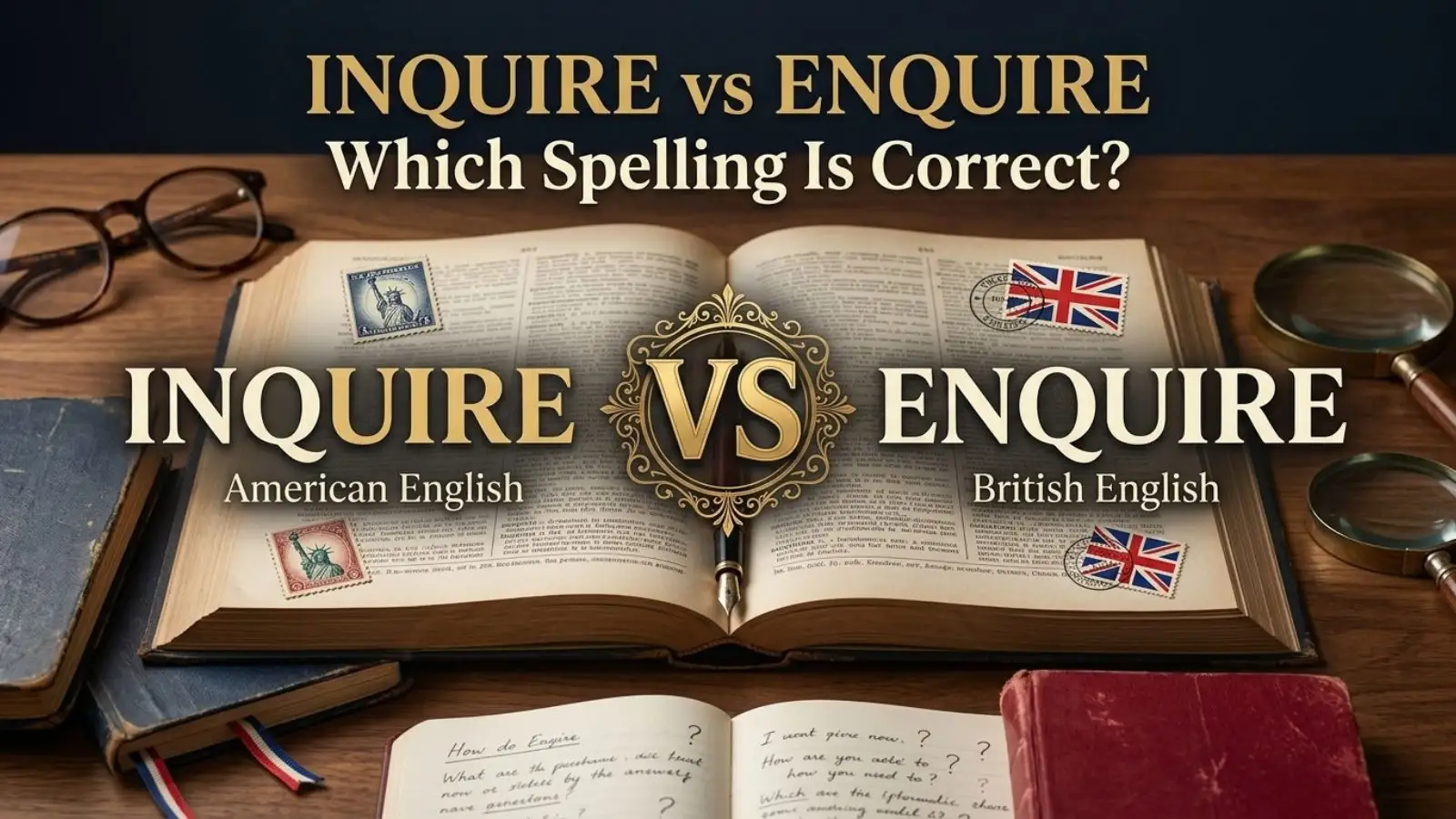
Inquire and enquire have the same basic meaning: to ask for information. The main difference is regional spelling.
Inquire is the standard and preferred form in American English, while enquire is especially common in British English.
Some British writers use enquire for general questions and inquire for formal investigations, but both spellings can be used in either sense.
Key Takeaways:
- Inquire is the preferred spelling in American English.
- Enquire is especially common in British English.
- Both words can mean to ask for information.
- Some British usage distinguishes enquire for general questions and inquire for formal investigations.
- In the U.S., use inquire and inquiry for consistency.
What Does Inquire Mean?
Inquire is a verb meaning to ask for information or seek an answer. It can also describe investigating something carefully.
For example:
I called the school to inquire about the application process.
Here, the speaker is simply asking for information.
The word can also be used for a more formal investigation:
The committee will inquire into the cause of the accident.
In American English, inquire is normally used for both meanings. Dictionaries such as Oxford and Collins recognize it as the standard North American form.
Common patterns include:
- inquire about something
- inquire into something
- inquire about a service
- inquire about a job
- inquire as to something
Inquire is somewhat formal compared with the everyday word ask. In a casual conversation, you would usually say, “Can I ask about the price?” In a formal email, “I would like to inquire about the price” sounds natural.
What Does Enquire Mean?
Enquire also means to ask for information. It is especially associated with British English.
For example:
I called the hotel to enquire about room availability.
The meaning is essentially the same as:
I called the hotel to inquire about room availability.
Oxford lists enquire as especially British English and notes that American English generally uses inquire instead.
You may see enquire frequently on British websites, forms, customer-service pages, and other types of formal writing.
For example:
Please enquire at the front desk for more information.
A British writer might naturally choose enquire, while an American writer would normally choose inquire.
Inquire vs Enquire: Key Difference
The biggest difference is regional spelling, not basic meaning.
| Word | Common Variety | Basic Meaning | Example |
| Inquire | American English | Ask for information or investigate | I called to inquire about the course. |
| Enquire | British English | Ask for information | I called to enquire about the course. |
The distinction becomes more interesting in British English. Some British writers use enquire when someone simply asks for information and inquire when referring to an official or formal investigation. Oxford notes this distinction but also explains that either spelling can be used in either meaning.
So, the distinction is useful, but it should not be treated as an absolute rule.
American English vs British English
For American readers, the choice is straightforward:
Use “inquire.”
For British readers, enquire is common, particularly when referring to an ordinary request for information.
For example:
American English:
I would like to inquire about your services.
British English:
I would like to enquire about your services.
Both sentences communicate the same idea.
The BBC also describes the difference primarily as a spelling difference, with inquire used in North American English and enquire used in British English.
Is Enquire Wrong in American English?
No. Enquire is a recognized English word, so it is not simply a misspelling.
However, it is not the normal spelling for American English. If you are writing for a U.S. audience, inquire will look more natural and consistent.
This matters particularly in professional writing. A U.S. business email, website, application, or customer-service message would normally use inquire.
Inquire vs Enquire Examples
The easiest way to understand the difference is to compare the same sentences.
Examples With Inquire
1. Asking about a product
I would like to inquire about the price of this laptop.
2. Asking about employment
She called to inquire about available positions.
3. Asking about a reservation
We contacted the hotel to inquire about room availability.
4. Asking for additional information
Please inquire with the admissions office if you have questions.
5. Formal investigation
The committee was asked to inquire into the complaint.
All of these examples work naturally in American English.
Examples With Enquire
The same ideas can be written with enquire:
I would like to enquire about the price of this laptop.
She called to enquire about available positions.
We contacted the hotel to enquire about room availability.
Please enquire with the admissions office if you have questions.
These forms are particularly natural in British English. The meaning does not suddenly change simply because the spelling changes.
Inquire vs Enquire in Business Writing
Your choice should match your audience.
If you are writing for customers in the United States, use inquire:
For more information, please inquire by email.
We received several inquiries from potential customers.
If you are writing for a British audience, enquire may be the preferred choice:
For further information, please enquire by email.
We received several enquiries from customers.
The most important point is consistency. If a document follows American English, use inquire, inquiry, and inquiries. If it follows a British style that uses the enquire family, use enquire, enquiry, and enquiries.
This is especially useful for websites, business documents, academic papers, and professional correspondence.
Inquiry vs Enquiry: What About the Nouns?
The same regional difference appears in the noun forms.
- Inquire → inquiry
- Enquire → enquiry
In American English, inquiry is the standard spelling.
For example:
We received an inquiry about the new service.
The plural is:
We received several inquiries about the new service.
In British English, enquiry and enquiries are commonly used for general requests for information. Some British usage reserves inquiry for a formal investigation.
For example:
| American English | British English |
| customer inquiry | customer enquiry |
| information inquiry | information enquiry |
| several inquiries | several enquiries |
| official inquiry | official inquiry |
That last example shows why British usage can sometimes be confusing. The exact distinction depends on the style being followed.
Which One Should You Use?
If you are writing for a U.S. audience, choose “inquire.”
That is the simplest and most reliable rule.
Use:
I would like to inquire about the position.
Not:
I would like to enquire about the position.
The second sentence is understandable, but inquire fits standard American spelling better.
If you are writing for a British audience, enquire is often the natural choice for a general request for information. If your organization or publication has a specific style guide, follow that guide instead.
For international writing, consider who will read the document. There is no need to treat one spelling as universally correct and the other as universally incorrect.
Common Mistakes to Avoid
One common mistake is assuming that enquire is always wrong. It is not. It is a legitimate spelling used especially in British English.
Another mistake is assuming that inquire only means “investigate.” In American English, it is commonly used for ordinary requests as well as investigations.
For example:
I called to inquire about the schedule.
This does not mean that the caller launched a formal investigation. It simply means they asked for information.
A final mistake is mixing spelling systems unnecessarily. If you are writing an American document, using inquire and inquiry throughout will give the document a more consistent style.
Frequently Asked Questions
Is enquire British or American?
Enquire is especially common in British English. American English normally uses inquire instead. Enquire is still a valid English word and can be understood by American readers, but it is not the usual U.S. spelling.
Should I use inquire or enquire in the USA?
Use inquire when writing for an American audience. It is the standard U.S. spelling for both asking for information and investigating something. The noun form is normally inquiry.
Are inquire and enquire interchangeable?
In many contexts, yes. Both words can mean to ask for information. British English sometimes uses enquire for a general question and inquire for a formal investigation, but this distinction is not universal. American English generally uses inquire for both.
Is inquire more formal than enquire?
Not necessarily. Both are relatively formal alternatives to the everyday verb ask. The main distinction is regional spelling. In American English, inquire is the normal form; in British English, enquire is commonly used for general requests for information.
Final Takeaway:
The Inquire vs Enquire question is mostly about English variety and spelling.
Both words can mean to ask for information, and both are correct. For American English, the best choice is inquire.
For British English, enquire is especially common for general questions, although inquire is also used.
If you are writing for a U.S. audience, stick with inquire, inquiry, and inquiries. That simple choice will keep your spelling natural, professional, and consistent.

I’m Maya Angelou, the creator behind EmojiAura.com, where I explore emoji meanings, social media trends, and fun digital expressions. I’m passionate about helping people understand the real meaning behind emojis and use them creatively in chats, captions, posts, and everyday online conversations.