Pakistan and India are neighboring South Asian countries that became independent in 1947 after the partition of British India. India is substantially larger in population, land area, and total GDP, while Pakistan has a smaller and younger population. Their relationship is shaped by shared history, the disputed Kashmir region, security concerns, and a major cricket rivalry.
Key Takeaways
- India has about 1.46 billion people, compared with about 255 million in Pakistan based on 2025 World Bank data.
- India covers roughly 3.29 million square kilometers, while Pakistan covers about 796,000 square kilometers.
- India’s 2025 nominal GDP was about $3.96 trillion, compared with $407 billion for Pakistan.
- Kashmir remains a central and unresolved issue in India-Pakistan relations.
- Cricket is one of the most visible areas of competition, with the teams meeting at major ICC tournaments.
Pakistan vs India at a Glance
The phrase “Pakistan vs India” can mean two different things. Some people are looking for a country comparison, while others are searching for an India-Pakistan cricket match or head-to-head record.
For a general country comparison, the major differences are scale and geography. India has a much larger population, territory, and economy. Pakistan is smaller but has a large population of its own, a younger demographic profile, and an important geographic position between South Asia, Central Asia, China, Iran, and Afghanistan.
| Category | India | Pakistan |
|---|---|---|
| Population, 2025 | 1.46 billion | 255.2 million |
| GDP, 2025 | $3.96 trillion | $407.3 billion |
| GDP per capita, 2025 | $2,702.50 | $1,595.90 |
| GDP growth, 2025 | 7.6% | 3.7% |
| Life expectancy, 2024 | 72 years | 68 years |
| Approx. area | 3.29 million km² | 796,000 km² |
The figures above come from the World Bank’s latest country data available for the respective indicators.
Population, Size, and Geography
Population
India is one of the world’s most populous countries, with approximately 1.46 billion people in 2025. Pakistan had approximately 255.2 million people in the same year.
That difference affects almost every large-scale comparison, including the size of domestic markets, labor forces, cities, infrastructure needs, and consumer demand.
Pakistan, however, has a relatively young and rapidly growing population. The World Bank recorded population growth of about 1.6% in Pakistan in 2025, compared with 0.9% in India.
Land Area and Location
India is also considerably larger geographically. Its territory is about 3.29 million square kilometers, while Pakistan’s area is roughly 796,000 square kilometers.
Both countries have access to the Arabian Sea and share a long border. Their geography also connects them to important regional systems involving China, Afghanistan, Iran, Central Asia, and the wider Indian Ocean region.
Economy and Development
GDP and GDP Per Capita
The economic difference is substantial when measured by total GDP.
According to the World Bank, India’s 2025 GDP was approximately $3.96 trillion, while Pakistan’s was approximately $407.3 billion. India’s GDP per capita was about $2,702.50, compared with approximately $1,595.90 in Pakistan.
India also recorded stronger annual GDP growth in the World Bank’s 2025 data, at 7.6%, compared with 3.7% for Pakistan. These figures describe economic output and growth for a particular year, rather than the living standards of every individual.
Economic Differences
India has a much larger domestic market and a broad economy spanning services, manufacturing, agriculture, technology, pharmaceuticals, finance, and other industries.
Pakistan’s economy also includes services, agriculture, manufacturing, textiles, construction, and other sectors. The World Bank notes that Pakistan’s economy has faced significant macroeconomic pressures while pursuing reforms intended to improve investment, productivity, and long-term growth.
This is an important distinction: total economic size and individual economic conditions are not the same measurement.
History and the Kashmir Dispute
The 1947 Partition
Modern India-Pakistan relations begin with the end of British colonial rule in South Asia in 1947.
British India was divided into two independent states, India and Pakistan. The Partition caused one of the largest mass migrations of the 20th century, with millions of people crossing newly created borders amid widespread communal violence.
The separation created lasting political, social, and territorial disputes. Kashmir became the most important unresolved territorial issue between the two countries.
Why Kashmir Matters
Kashmir had a Muslim-majority population and a Hindu ruler when British rule ended. The ruler eventually signed an accession agreement with India during the crisis of 1947, while Pakistan disputed the resulting status of the territory. Fighting followed, and the region became divided between areas administered by India and Pakistan, with China also controlling part of the wider historical region.
India and Pakistan maintain different positions on Kashmir, so a neutral comparison should not present one country’s legal or political interpretation as an uncontested fact.
The dispute has contributed to several wars and repeated periods of military tension. It remains one of the central issues affecting bilateral relations.
Government and International Role
India and Pakistan are both federal parliamentary systems, but their political institutions have developed differently since independence.
India is a federal union with states and union territories. Pakistan is a federal republic organized around provinces and territories.
Their international relationships also differ. India has developed major economic, diplomatic, and strategic relationships with countries including the United States, Russia, Japan, and members of the European Union. Pakistan maintains important relationships with China, the United States, Gulf states, and other regional partners.
Neither country can be understood only through its relationship with the other. Both have wider economic and diplomatic interests.
Military and Security
India and Pakistan are both nuclear-armed states, making their relationship particularly important for regional and international security. Their conventional military capabilities, defense budgets, geography, and strategic priorities differ.
India has a much larger economy and population, while Pakistan devotes significant resources to defense relative to the size of its economy. Different military databases also use different methodologies and dates, so simple rankings should be treated cautiously.
More importantly, military numbers cannot reliably answer what would happen in a hypothetical conflict. Geography, objectives, logistics, alliances, intelligence, political decisions, and escalation risks all matter.
The current relationship also reflects the history of several wars and recurring tensions. The Council on Foreign Relations describes Kashmir as a central factor in the long-running conflict between the two countries.
Pakistan vs India Cricket
Cricket gives the phrase “Pakistan vs India” another major meaning.
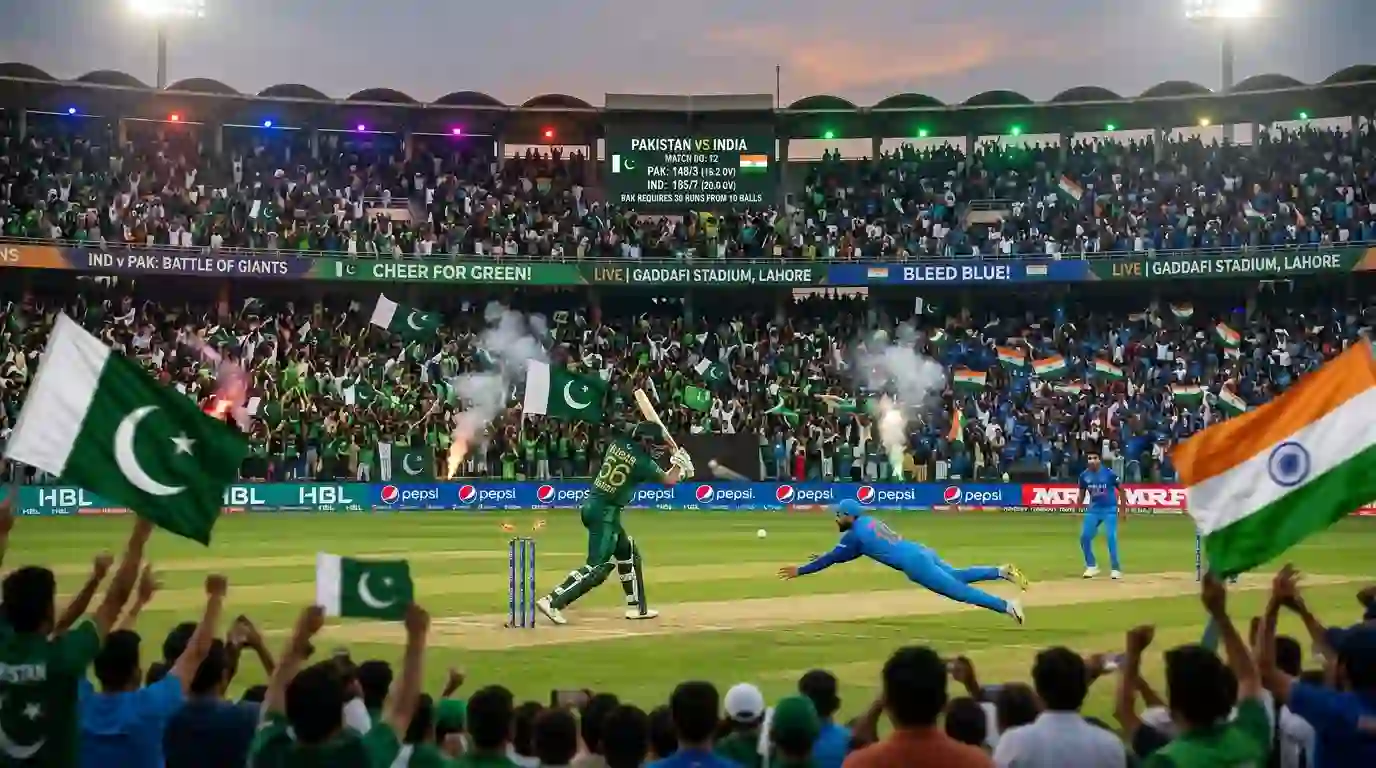
The two national teams have one of international cricket’s most closely followed rivalries. Matches are particularly significant at ICC tournaments because India and Pakistan do not regularly play bilateral series.
The most recent major men’s meeting as of October 2026 was at the 2026 ICC Men’s T20 World Cup on February 15, 2026, when India defeated Pakistan by 61 runs. The ICC reported that India scored 175/7 and Pakistan made 114 all out.
The tournament was played in India and Sri Lanka, and the two teams were placed together in Group A.
For someone searching “Pakistan vs India” because of cricket, the relevant information is therefore different from a general country comparison. Match date, format, score, tournament, and head-to-head statistics become more important than GDP or geography.
Pakistan vs India: What Is the Biggest Difference?
There is no single statistic that describes the entire difference between the two countries.
For population and geographic scale, India is substantially larger. For total economic output, the World Bank’s 2025 figures also show a large difference.
For history and foreign relations, the key issue is the legacy of Partition and the unresolved Kashmir dispute. For sports, cricket provides a separate and highly visible form of competition.
The useful way to understand Pakistan vs India is therefore to compare the specific category you care about rather than treating the countries as identical across every measure.
Frequently Asked Questions
Is India bigger than Pakistan?
Yes. India is considerably larger than Pakistan by land area. India covers about 3.29 million square kilometers, while Pakistan covers roughly 796,000 square kilometers.
Which country has more people, India or Pakistan?
India has more people. The World Bank’s 2025 figures put India’s population at about 1.46 billion and Pakistan’s at about 255.2 million.
Is India richer than Pakistan?
By total nominal GDP and GDP per capita in the World Bank’s 2025 data, India has higher figures. India’s GDP was about $3.96 trillion compared with Pakistan’s $407.3 billion, while GDP per capita was about $2,702.50 compared with $1,595.90.
Why are India and Pakistan rivals?
Their rivalry has roots in the 1947 Partition, territorial disputes, particularly Kashmir, and several wars and periods of military tension. Cricket has also developed into a major sporting rivalry between the two countries.
Did Pakistan and India used to be one country?
Before independence in 1947, the territories that became India and Pakistan were part of British India, although the region also contained princely states with different political arrangements. Partition created the independent states of India and Pakistan in 1947.
Conclusion
Pakistan vs India is more than a simple country comparison.
The two neighboring South Asian states share deep historical, cultural, linguistic, and geographic connections, but they have followed different political and economic paths since 1947.
Current data shows a major difference in population, land area, and total economic output, while their shared history and the Kashmir dispute continue to shape bilateral relations.
For sports fans, meanwhile, the phrase often refers specifically to one of cricket’s most closely followed international matchups.