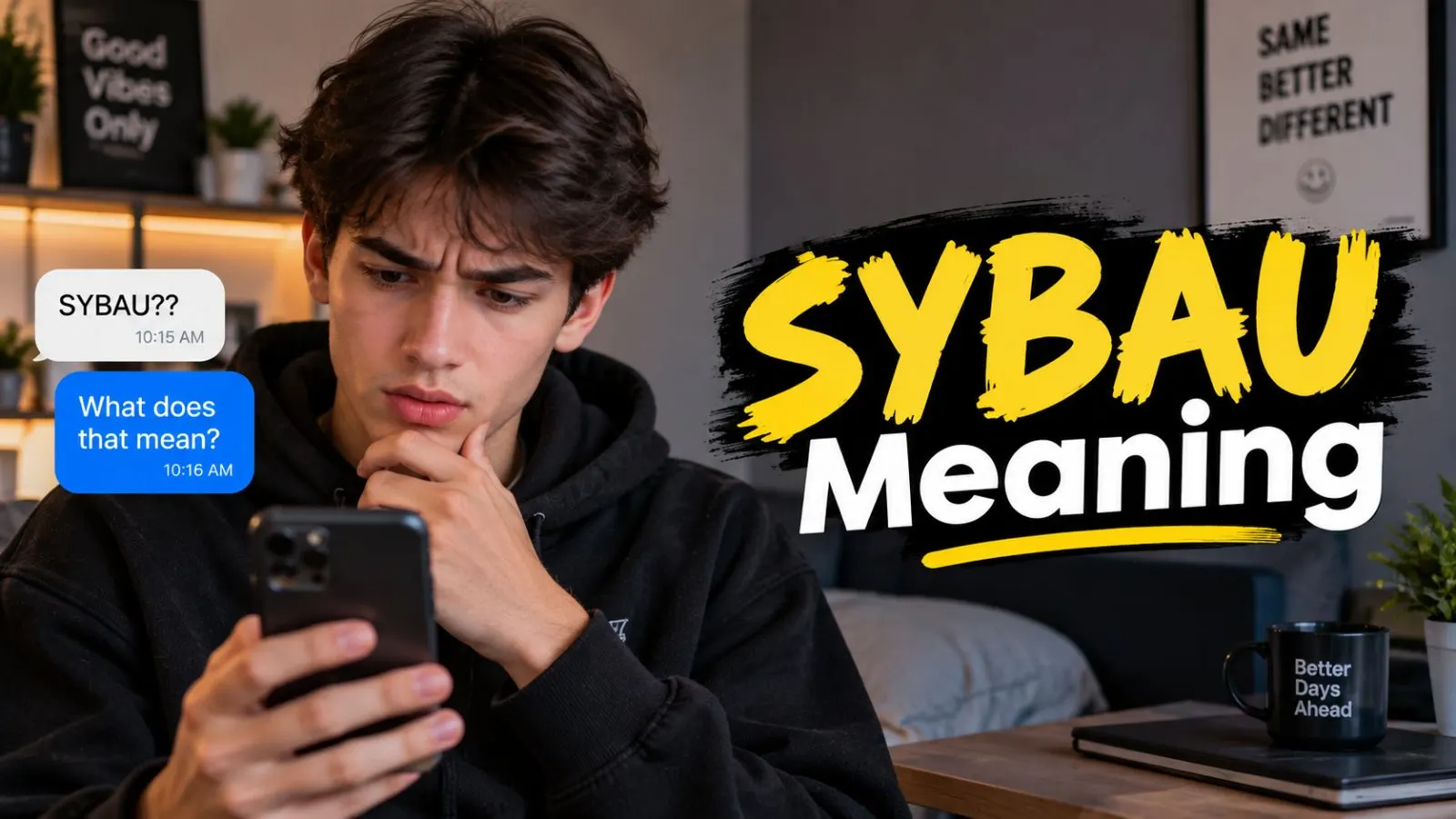
If you’ve spent any time in TikTok comment sections, Discord servers, or Roblox chats recently, chances are you’ve seen the word SYBAU thrown around usually in the middle of an argument or as a quick clapback.
At first glance, it looks like just another string of internet letters, but once you know what it stands for, the tone behind it becomes pretty clear.
SYBAU is part of a wave of acronym-heavy slang that’s taken over online spaces, often used specifically because typing it out avoids getting flagged or censored by platform filters. It’s blunt, it’s a little harsh, and it’s not something you’d want to say to your grandmother.
In this guide, we’ll break down exactly what SYBAU means, where it came from, how it’s used across different platforms today, and why so many parents are only just now discovering what their kids have been typing to them.
What Does SYBAU Stand For?
SYBAU is an acronym for shut your bitch ass up. It’s a blunt, aggressive way of telling someone to stop talking, significantly harsher in tone than a simple be quiet or shut up. The insult embedded in the phrase is what gives it its bite; it’s designed to shut down an argument or comment with maximum disrespect in as few characters as possible.
One reason the term has spread so widely in its acronym form, rather than being spelled out, comes down to content moderation. Most social platforms automatically flag or censor profanity, and typing SYBAU instead of the full phrase lets users get the same message across without tripping those filters. This is a common pattern with internet slang more broadly acronyms and abbreviations often exist specifically to slip past algorithms built to catch explicit language.
It’s worth noting that context does a lot of the work here. Among friends, SYBAU is sometimes used jokingly, almost as a term of endearment disguised as an insult similar to how people might say shut up affectionately in response to a compliment or a funny story. In more hostile contexts, like heated arguments in comment sections or gaming lobbies, it’s used exactly as intended: as a sharp, dismissive insult meant to end a conversation on a rude note.
Etymology and Origins
Despite feeling like a brand-new piece of internet slang, SYBAU has been around for much longer than most people realize. Evidence of the term appearing on Urban Dictionary dates back more than two decades, with early definitions posted as far back as 2008 and some records suggest usage tracing even further, to the early 2000s. Back then, it existed mostly in niche corners of the internet: early messaging platforms, forums, and gaming communities where short, aggressive shorthand was common.
For most of its existence, SYBAU stayed relatively obscure outside of these spaces. It wasn’t a term most casual internet users would recognize, let alone use in daily conversation. It sat alongside countless other acronyms coined the same way as a fast, coded way to insult someone without spelling out the profanity directly.
What’s changed isn’t the meaning or the origin of the term, but its scale. The acronym that once lived quietly in old forum threads and early Urban Dictionary entries has been rediscovered by a much younger, much larger online audience, largely thanks to short-form video platforms. This pattern is common with internet slang: terms can exist dormant for years before a single platform or trend cycle catapults them into mainstream visibility.
The 2024 to 2026 TikTok Resurgence
SYBAU’s jump from obscure internet slang to mainstream viral terms happened almost entirely because of TikTok. The acronym began gaining real traction on the platform toward the end of 2024, popping up primarily in comment sections as a quick, dismissive response to unpopular opinions, cringe content, or perceived overreactions.
Part of what made SYBAU spread so fast is how well it fits TikTok’s comment culture. Comment sections on the app are often fast-paced and combative, rewarding short, punchy responses over longer explanations. An acronym like SYBAU sharp, easy to type, and instantly recognizable to anyone in the know fit that environment perfectly.
The term didn’t spread in isolation, either. It quickly became linked with a cluster of other acronyms circulating at the same time, most notably TS, PMO, and ICL. Creators and commenters began stacking these terms together into intentionally overloaded, almost nonsensical sentences, as part of a broader brainrot meme trend built around slang so dense it becomes a kind of in-joke for younger users and largely unreadable to outsiders.
This stacking effect is a big part of why SYBAU has stuck around rather than fading as a one-off trend. It’s no longer just a standalone insult, it’s become a building block in a larger shared vocabulary among younger internet users, which tends to give slang terms significantly more staying power than trends that exist on their own.
Related Slang Terms
SYBAU rarely travels alone. It’s usually seen alongside a handful of other acronyms that make up the same slang ecosystem. Here’s a quick breakdown of the most common ones you’ll encounter alongside it.
TS Short for that’s so or sometimes used more loosely as filler before an exaggerated statement, similar to how like or literally functions in spoken slang. Its exact meaning shifts depending on sentence context, which is part of what makes these brainrot sentences feel intentionally confusing to outsiders.
PMO stands for piss me off. It’s typically used to express frustration or annoyance about something, often stacked into the same sentence as SYBAU for emphasis (e.g., pairing a complaint with a dismissive insult).
ICL Short for I can’t lie, used as a way to preface an honest or blunt statement, similar to saying not gonna lie or honestly before making a point.
Brainrot Not an acronym, but the umbrella term for this entire style of slang-heavy, intentionally nonsensical online communication. It describes content built almost entirely out of overlapping internet references and abbreviations, designed to be understood only by people deeply online.
When these terms are combined as in a TS PMO ICL style sentence the goal usually isn’t clear communication. It’s closer to a linguistic in-joke, signaling fluency in current internet culture while intentionally alienating anyone unfamiliar with the references.
The Fake Meaning Phenomenon
One of the more interesting side-stories around SYBAU isn’t about the term itself, but about how kids and teens have handled being asked what it means. Rather than admitting to the actual, fairly crude definition, many have taken to giving parents and other adults a sanitized, made-up alternative.
The most common version circulating is stay young, beautiful, and unique, with a close variant being stay young, beautiful, and unstoppable. Both sound wholesome enough to pass as an innocent inside joke, which is exactly the point they’re designed to satisfy a curious parent without revealing what’s actually being said.
This trend has become notable enough to generate its own coverage, with teachers and parents sharing stories online about receiving these fake explanations directly from kids, or noticing the same wholesome-sounding definition being repeated suspiciously consistently across different children. In some cases, adults have only learned the real meaning after seeing it explained elsewhere online, well after their kids had already used the cover story.
It’s a small but telling example of how slang functions as a kind of generational code not just a shorthand for communication, but sometimes a deliberate tool for maintaining privacy from parents and teachers. The fake-meaning trend has arguably given SYBAU even more visibility than the term might have had on its own, since it’s turned into a talking point about kids’ internet behavior rather than just a slang definition.
Is SYBAU Offensive? Tone and Context Guide
Whether SYBAU counts as genuinely offensive depends heavily on who’s saying it, to whom, and in what setting but it’s worth being upfront about one thing: the phrase it stands for is crude and disrespectful by design. It’s not a neutral term dressed up as slang; it’s a rude insult that happens to be abbreviated.
That said, tone varies a lot in practice. Among friends, it often functions more like a lighthearted shut up , the kind of thing said in response to a joke, a compliment, or friendly teasing, where everyone involved understands it’s not meant seriously. In this context, it reads closer to banter than hostility.
In other settings, it’s used exactly as intended: as a sharp, dismissive way to shut someone down during a real argument, if that’s in a gaming lobby, a comment section, or a group chat disagreement. Here, it functions as a genuine insult, and being on the receiving end of it can feel intentionally disrespectful, especially from a stranger.
Platform moderation has also flagged it as a concern precisely because it contains embedded profanity that slips past automated filters, which has led some communities to treat it as equivalent to typing out the full phrase, even though it looks harmless at a glance.
The safest read: treat SYBAU the same way you’d treat its spelled-out meaning. If that phrase would be inappropriate or hostile in a given context, the acronym version carries the same weight: it’s just wearing a disguise.
A Note for Parents and Educators
For adults who’ve come across SYBAU, if it was sent to them directly, spotted in a group chat, or flagged by another parent, the most useful first step is simply knowing what it actually means: shut your bitch ass up. It’s a rude, dismissive phrase, not the wholesome acronym many kids will initially claim it is.
It helps to understand why kids reach for a cover story in the first place. Admitting to a phrase like this feels riskier than offering a vague, pleasant-sounding alternative, especially when a parent is asking at the moment. This isn’t necessarily a sign of deep dishonesty so much as kids testing the same boundary-pushing behavior around language that’s existed for generations; it’s just playing out through slang and acronyms now instead of curse words whispered at school.
Rather than reacting with alarm, a more effective approach is usually a calm, direct conversation: naming the actual meaning, asking where and how it’s being used, and talking through why it might not be appropriate in every setting especially toward adults, teachers, or in tones meant to genuinely hurt someone rather than joke around.
It’s also worth remembering that slang like this moves fast. By the time a term becomes widely known to adults, it’s often already peaking or starting to fade among younger users, replaced by the next wave of acronyms. Staying generally aware of these patterns tends to be more useful long-term than trying to track every individual term as it emerges.
Frequently Asked Questions
What does SYBAU stand for?
SYBAU stands for shut your bitch ass up. It’s an aggressive, disrespectful way of telling someone to stop talking, commonly used online rather than in face-to-face conversation.
Is SYBAU a bad word?
It’s not a single curse word, but it’s built around one the phrase it abbreviates contains profanity and is generally considered rude or disrespectful, even though the acronym form often slips past content filters.
Where did SYBAU come from?
The term dates back more than two decades, with early definitions appearing on Urban Dictionary as far back as 2008. It stayed relatively obscure until a resurgence driven largely by TikTok starting around late 2024.
What does SYBAU mean on TikTok vs. Roblox or Discord?
The core meaning stays the same across platforms, but the context shifts. On TikTok, it’s often used as a public clapback in comment sections. On Roblox and Discord, it tends to show up as a quick, dismissive response during in-game arguments.
What do TS, PMO, and ICL mean?
These are related slang acronyms often used alongside SYBAU. TS is used loosely as filler or emphasis, PMO means piss me off, and ICL means I can’t lie. Together, they’re often stacked into intentionally dense, meme-style sentences.
Why do kids tell parents SYBAU means something wholesome?
Kids often give parents a sanitized fake meaning like stay young, beautiful, and unique to avoid admitting to the actual, cruder definition when asked directly.
Conclusion:
At its core, SYBAU is a simple acronym with a blunt meaning: shut your bitch ass up. What makes it worth understanding isn’t the phrase itself, but the story around it, a two-decades-old piece of internet slang.
That quietly resurfaced through TikTok, picked up a whole ecosystem of related acronyms, and even sparked its own trend of kids inventing wholesome fake definitions to keep adults in the dark.
Like most internet slang, its exact tone depends entirely on context. Between friends, it can be harmless banter; in a heated argument, it’s a genuine insult.
And like most viral terms, it likely won’t hold its current level of visibility forever; it’ll either fade, evolve, or get folded into whatever slang trend replaces it next.