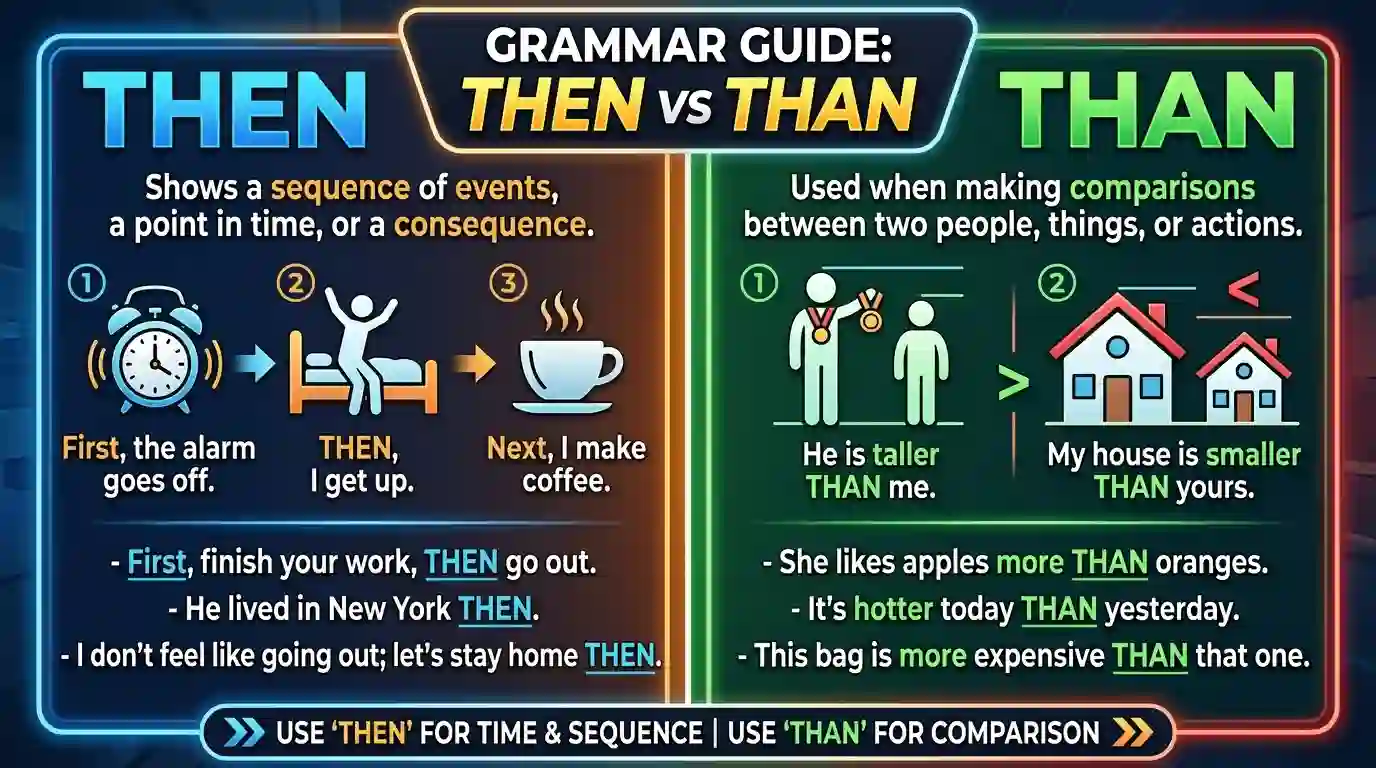
Then and than have different jobs in English. Use then when talking about time, sequence, order, or a result, as in “We ate dinner, then watched a movie.” Use than when making a comparison, as in “This movie is better than the last one.”
Key Takeaways
- Then usually relates to time, order, sequence, or consequence.
- Than is mainly used to make comparisons.
- Write better than, more than, and less than, not “better then,” “more then,” or “less then” when making comparisons.
- Then can also mean “at that time,” “next,” or “in that case.”
- A simple test is to ask: Am I comparing something, or am I describing when or what happens next?
Then vs Than: What Is the Difference?
The difference between then vs than is simple once you focus on meaning rather than spelling.
Then is connected with time, sequence, or consequence. For example:
We finished our homework and then went outside.
Here, then tells us what happened next.
Than, on the other hand, introduces a comparison:
My new laptop is faster than my old one.
The sentence compares two laptops, so than is correct.
These words are commonly confused because they look almost identical and can sound very similar in speech. However, they perform different grammatical functions. Grammar references consistently distinguish then as a word associated with time or sequence and than as a comparison word.
When to Use “Then”
Then for Time
Use then when you mean at that time.
Examples:
- I was living in Texas then.
- Things were different back then.
- We did not have smartphones then.
- I will call you then.
- She was much younger then.
In these sentences, then points to a particular time.
A useful substitution is “at that time.”
For example:
I was happier then.
You could rewrite it as:
I was happier at that time.
If the replacement works, then is probably the correct choice.
Then for Sequence
Use then to show that one event happens after another.
Examples:
- First, wash the vegetables, then cut them.
- We went to the store and then drove home.
- Open the file, then click “Save.”
- She finished her work and then took a break.
Here, then means something like next or after that.
This use is especially common in instructions and everyday conversation.
Then for Results and Conditions
Then can also appear in conditional sentences to show a result.
For example:
If you finish early, then you can leave.
The first part gives the condition. The second part gives the result.
More examples:
- If it rains, then we will stay home.
- If you need help, then call me.
- If the price is too high, then we can choose another option.
You do not use than in this structure.
Then as a Noun or Adjective
Although most learners first meet then as an adverb, it can have other grammatical roles.
As a noun, then can mean that time:
We cannot leave until then.
As an adjective, it can describe someone or something that held a particular position at a past time:
The then-president addressed the nation.
These uses are less common in basic writing, but they help explain why then has a wider grammatical range than the simple “next” rule suggests.
When to Use “Than”
Than for Comparisons
Use than when you compare people, objects, amounts, qualities, actions, or ideas.
Examples:
- Sarah is taller than Emma.
- This phone is cheaper than that one.
- My car is faster than yours.
- English is easier than I expected.
- The second test was harder than the first.
- He works more quickly than I do.
Than often follows comparative words such as:
- better than
- worse than
- bigger than
- smaller than
- faster than
- slower than
- older than
- younger than
- more than
- less than
- fewer than
The comparison does not always need to be between two physical objects. You can compare an action with an expectation, an amount with a limit, or one idea with another.
Than in Common Expressions
Some expressions regularly use than.
For example:
- more than
- less than
- rather than
- other than
- better than
- more likely than
- different than
Consider:
I would rather walk than drive.
Here, than follows rather to introduce the alternative.
Now compare it with:
We walked, then drove home.
Here, then shows the order of two actions.
That small difference can completely change the meaning of a sentence.
Than for “Other Than”
Than is also correct in the expression other than, which generally means except for or apart from.
Examples:
- Everyone other than Mike attended the meeting.
- I have no hobbies other than reading.
- We need another option other than this one.
So, than is not limited to sentences containing words such as “better” or “faster.” Its broader grammatical use includes established expressions such as other than.
Then vs Than Examples
| Sentence | Correct Word | Why |
|---|---|---|
| We ate dinner, ___ went home. | then | Shows sequence |
| This car is faster ___ mine. | than | Makes a comparison |
| I lived there ___ . | then | Refers to a past time |
| She is older ___ her brother. | than | Compares age |
| Finish this task, ___ start the next one. | then | Shows what happens next |
| It costs less ___ $20. | than | Compares an amount |
| Things were different back ___. | then | Refers to a past time |
| I would rather stay home ___ go out. | than | Shows an alternative |
| If you agree, ___ we can begin. | then | Shows a result |
| This test is easier ___ the last one. | than | Makes a comparison |
Common Then vs Than Mistakes
Better Than vs Better Then
The correct phrase is better than when you are comparing something.
Correct:
This option is better than the first one.
Incorrect:
This option is better then the first one.
However, then can appear after “better” when it performs its normal time-related job:
I felt better then.
Here, then means at that time, so it is correct.
More Than vs More Then
Use more than for a comparison or amount.
Correct:
The project costs more than $500.
Incorrect:
The project costs more then $500.
But then can appear separately when it means what happens next:
We finished the project and then submitted it.
Rather Than vs Rather Then
The standard expression is rather than.
Correct:
I would rather read than watch TV.
Incorrect:
I would rather read then watch TV.
The first sentence compares two choices or preferences. Then would indicate sequence instead:
I would read, then watch TV.
That sentence means reading happens first and watching TV happens afterward.
Less Than vs Less Then
Use less than when comparing an amount, number, degree, or measurement.
Correct:
The package weighs less than 10 pounds.
Correct:
The meeting lasted less than an hour.
Incorrect:
The package weighs less then 10 pounds.
The word than introduces the comparison with 10 pounds or one hour.
An Easy Trick to Remember Then vs Than
Try this two-question test.
Question 1: Am I comparing something?
If yes, use than.
My new phone is better than my old phone.
Question 2: Am I talking about time, order, or what happens next?
If yes, use then.
I bought a new phone and then transferred my data.
You can also use a replacement test.
For then, try:
- at that time
- next
- after that
- in that case
For than, think:
- compared with
- in comparison with
Another memory trick is to connect the vowels:
ThEn = timE
ThAn = comparison
This is only a memory aid, not a grammatical rule, but it can help you catch mistakes quickly.
Then vs Than Comparison Table
| Feature | Then | Than |
|---|---|---|
| Main purpose | Time, sequence, order, result | Comparison |
| Common meaning | At that time, next, after that | Compared with |
| Common phrase | back then | more than |
| Conditional use | if…then | No |
| Comparative use | No | Yes |
| Example | We left, then called her. | She is taller than me. |
| Common mistake | Using then in a comparison | Using than for sequence |
Frequently Asked Questions
Is it better than or better then?
Better than is correct when you are making a comparison.
This restaurant is better than the one we visited yesterday.
Use then only when it refers to time or sequence:
I felt better then.
Here, then means “at that time.”
Is it more than or more then?
The correct comparative expression is more than.
She earns more than I do.
Use then when it refers to time, sequence, or a result:
We finished dinner, then ordered dessert.
Is it rather than or rather then?
The standard expression is rather than.
I would rather walk than take the bus.
Then would change the meaning because it normally indicates sequence:
I would walk, then take the bus.
Can then and than be used interchangeably?
No. In standard modern English, they have different functions. Then normally relates to time, sequence, order, or consequence, while than is used for comparisons and related expressions. Swapping them can create a grammatical error or change the intended meaning.
What is the easiest way to remember the difference?
Remember:
Then = time or what happens next.
Than = comparison.
For example:
Eat dinner, then go home.
Dinner is better than fast food.
If you are still unsure, ask whether you can replace the word with “next” or “at that time.” If you can, then is likely correct. If the sentence compares two things, use than.
Conclusion
The difference between then vs than becomes much easier when you focus on what the word does in the sentence.
Use then for time, sequence, order, and results:
We finished work, then went home.
Use than for comparisons:
This job is easier than my previous one.
When proofreading, look for common patterns such as better than, more than, less than, faster than, and rather than. If you are describing what happens next or referring to a particular time, check for then instead.
The key rule is simple: than compares, while then tells you when, what happens next, or what follows from a condition.