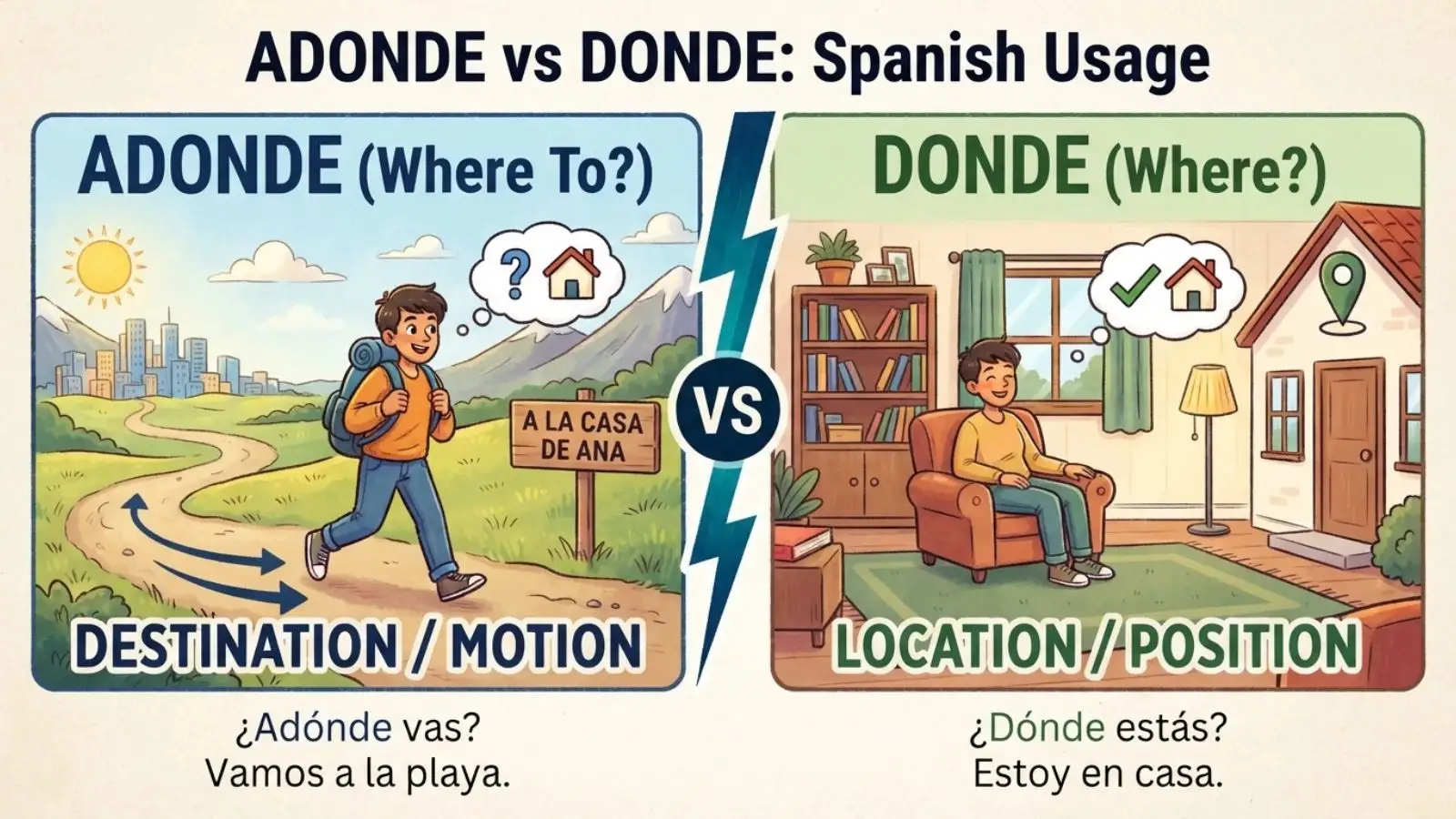
Adonde vs donde mainly differs in how Spanish expresses destination and location. Donde generally refers to a place or location, while adonde traditionally emphasizes movement toward a destination.
However, Spanish also allows donde with some movement verbs.
In questions, the accented forms adónde and dónde are used, with adónde commonly asking “where to?” and dónde asking “where?”
Key Takeaways
- Donde generally refers to where something or someone is located.
- Adonde is used with movement to indicate a destination.
- With movement verbs, donde can also be acceptable in many contexts.
- Dónde and adónde carry an accent when they are interrogative or exclamatory.
- Adonde and a donde are both accepted spellings in Spanish.
Adonde vs Donde: The Basic Difference
If you are learning Spanish, adonde and donde can be confusing because both can be translated with the English word “where.”
The easiest starting point is to think about location versus destination.
Donde is commonly used for the place where someone or something is located:
La casa donde vivo es pequeña.
The house where I live is small.
Adonde, without an accent, is a relative adverb associated with movement toward a destination:
La ciudad adonde viajamos es hermosa.
The city where we are traveling to is beautiful.
Spanish grammar is a little more flexible than this simple rule, though. With verbs that express movement, donde can also be used to refer to a destination. FundéuRAE notes that donde, adonde, and a donde can alternate in certain destination constructions.
So, the distinction is useful, but you should not assume that adonde is the only possible choice whenever movement is involved.
What Does Donde Mean in Spanish?
Donde is a Spanish relative adverb of place. It commonly means “where” and connects a place with information about that place.
For example:
El restaurante donde cenamos estaba lleno.
The restaurant where we had dinner was full.
Here, donde refers to the location of the restaurant.
Donde for Location
Use donde when you are talking about where someone or something is located.
Examples:
¿Dónde está mi teléfono?
Where is my phone?
Vivo donde hay muchos árboles.
I live where there are many trees.
Esa es la escuela donde estudié.
That is the school where I studied.
The Spanish Royal Academy’s dictionary defines dónde as an interrogative adverb referring to a place, including “in what place” and, in appropriate contexts, “to what place.”
Donde With Movement Verbs
This is where learners can become confused.
Although adonde specifically expresses destination, donde can also occur with verbs indicating movement when the destination is understood from context.
For example:
Vamos donde tú quieras.
We’ll go wherever you want.
FundéuRAE explains that with verbs indicating movement or destination, forms such as donde, adonde, and a donde can be used in appropriate constructions.
That means the basic rule “movement always requires adonde” is too strict.
What Does Adonde Mean in Spanish?
Adonde is a relative adverb associated with direction or destination. It can be understood as roughly “to where” or “where … to” depending on the English translation.
For example:
El lugar adonde vamos está cerca.
The place where we are going is nearby.
The destination is the place we are going to.
Another example is:
Regresamos a donde nos esperaba el taxi.
We returned to where the taxi was waiting for us.
The important idea is that adonde connects a movement with its destination. FundéuRAE specifically describes adonde as a form used when a verb implies movement and the expression indicates destination.
Adonde in Relative Clauses
You will often see a donde after a noun referring to a destination:
La playa adonde vamos es muy bonita.
The beach where we are going is very beautiful.
El pueblo adonde viajamos queda lejos.
The town where we are traveling to is far away.
However, modern Spanish also permits donde in many of these constructions:
La playa donde vamos es muy bonita.
This flexibility is recognized in Spanish usage guidance.
Adonde vs Donde: Side-by-Side Comparison
| Form | Main idea | Example | English |
| donde | Location/place | La casa donde vivo | The house where I live |
| adonde | Destination/direction | La ciudad adonde voy | The city where I am going |
| dónde | Question about location | ¿Dónde estás? | Where are you? |
| adónde | Question about destination | ¿Adónde vas? | Where are you going? |
This table gives you the most useful practical distinction, but remember that donde may also be used with movement verbs in Spanish. The RAE dictionary itself lists dónde as capable of referring to “to what place” with verbs of movement or destination.
Adónde vas Dónde: Why the Accent Matters
One of the biggest sources of confusion is the difference between:
- adonde
- adónde
- donde
- dónde
The accent is important because it helps distinguish the interrogative or exclamatory forms.
When to Use Dónde
Dónde has a written accent when it introduces a direct or indirect question or an exclamation.
For example:
¿Dónde vives?
Where do you live?
No sé dónde vive.
I don’t know where he lives.
¡Dónde has llegado!
What a place you’ve reached!
The RAE identifies dónde as an interrogative or exclamatory adverb.
When to Use Adónde
Adónde is used for an interrogative or exclamatory expression involving destination.
For example:
¿Adónde vas?
Where are you going?
No sé adónde vamos.
I don’t know where we are going.
¡Adónde iremos ahora!
Where will we go now!
A useful memory trick is:
dónde = where?
adónde = where to?
It is not a perfect rule for every Spanish construction, but it is an excellent starting point for learners.
The accented forms are associated with interrogative or exclamatory meaning, while the unaccented donde/adonde forms function as relative forms in ordinary statements.
Adonde vs A Donde: Are Both Correct?
Yes. Adonde and a donde can both be correct.
For example:
Vamos adonde quieras.
and:
Vamos a donde quieras.
Both spellings are accepted. FundéuRAE explains that the modern standard allows a donde and a donde to be used interchangeably in these relative constructions.
The same idea applies to the interrogative form:
¿Adónde vas?
¿A dónde vas?
Both are accepted spellings.
So, the presence or absence of a space between a and donde is not the main issue. The more important question is whether you are using the interrogative form and therefore need the accent.
Common Mistakes With Adonde and Donde
Mistake 1: Using a drone for a static location
When you mean “where someone or something is located,” use donde rather than adonde.
Better:
La casa donde vive Ana es grande.
The house where Ana lives is big.
For modern standard Spanish, adonde should not normally be used simply to mean “in the place where.” FundéuRAE specifically recommends donde, optionally with en, for location rather than destination.
Mistake 2: Forgetting the accent in a question
Write:
¿Dónde estás?
Not:
¿Donde estás?
And:
¿Adónde vas?
Not:
¿Adonde vas?
The accent helps mark these as interrogative forms.
Mistake 3: Assuming English “where” always translates to one Spanish word
English uses where for several situations:
- Where are you?
- Where are you going?
- Where did you put it?
- Where will we travel?
Spanish can distinguish these situations more explicitly through donde, dónde, adonde, and adónde.
Easy Way to Remember the Difference
Try this simple three-part system:
1. Location → donde
¿Dónde está el hotel?
Where is the hotel?
2. Destination → adonde
El hotel adonde vamos está cerca.
The hotel where we are going is nearby.
3. Question about destination → adónde
¿Adónde vamos?
Where are we going?
And remember the accent rule:
Question or exclamation → dónde/adónde
Relative statement → donde/adonde
This shortcut will help in many everyday situations, although real Spanish usage allows donde in some destination constructions too.
Frequently Asked Questions
Is adonde the same as donde?
Not exactly. Adonde traditionally expresses movement toward a destination, while donde generally refers to a location. However, with verbs of movement, donde can also be used in many constructions. For a learner, “destination = adonde” and “location = donde” is a useful starting distinction.
Does adonde always need an accent?
No. Adonde without an accent is normally used as a relative adverb in statements. Adónde with an accent is the interrogative or exclamatory form. Compare La ciudad adonde vamos with ¿Adónde vamos?
Is “a dónde” correct?
Yes. A dónde is an accepted spelling alongside adónde. Similarly, a donde is accepted alongside adonde in relative constructions.
Which word means “where are you?”
Use ¿Dónde estás? because the question asks about someone’s current location. If you ask about a destination, use ¿Adónde vas?, meaning “Where are you going?” The distinction between location and destination is the easiest way to remember these two forms.
Conclusion
The difference between Adonde vs Done becomes much easier when you focus on destination versus location.
Use donde when referring to where someone or something is located. Use adonde when connecting a place with movement toward that destination. In questions, the accented forms dónde and adónde are used.
Just remember:
donde = where
adonde = where to
dónde = where?
adónde = where to?
There are some flexible constructions in modern Spanish, especially with movement verbs, so these forms should not be treated as completely interchangeable or as an absolute movement rule.
- Where are you?
- Where are you going?
- Where did you put it?
- Where will we travel?
Spanish can distinguish these situations more explicitly through donde, dónde, adonde, and adónde.