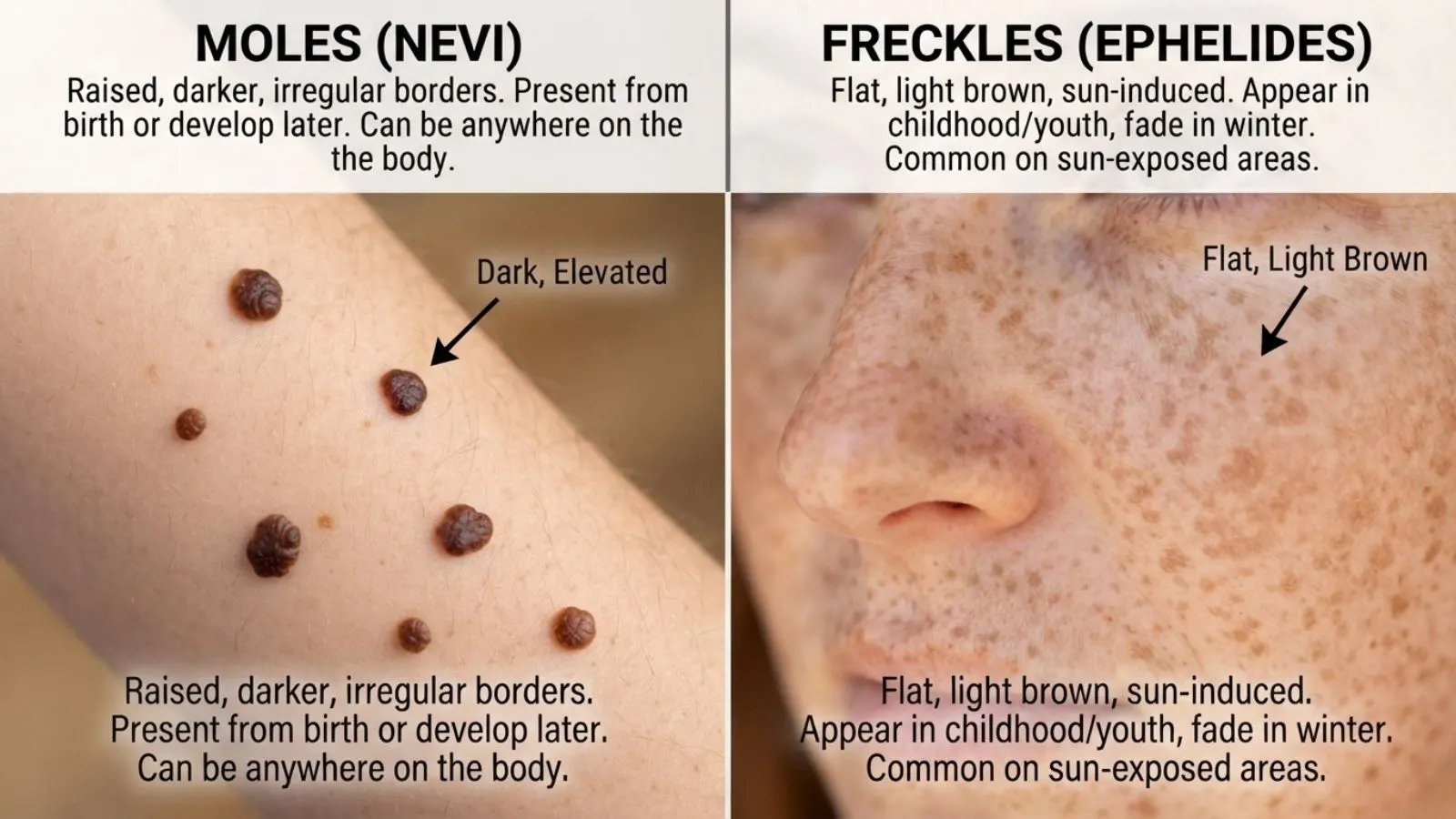
Moles vs freckles: Moles are clusters of pigment-producing cells and may be flat or raised, while ordinary freckles are usually small, flat areas of increased pigmentation that become more noticeable with sun exposure.
Most moles and freckles are harmless, but a new or changing spot should be checked by a dermatologist.
Key Takeaways
- Moles can be flat or raised and usually remain relatively stable.
- Freckles are typically flat and often become darker after sun exposure.
- Freckles do not simply “turn into” moles.
- A new, changing, bleeding, itching, or unusual spot deserves medical attention.
- The ABCDE rule can help identify changes that need professional evaluation.
What Is a Mole?
A mole, medically called a nevus, is a common skin growth that develops when pigment-producing cells called melanocytes form a cluster. Moles can appear almost anywhere on the body.
They may be brown, black, tan, pink, red, blue, skin-colored, or even nearly colorless. Some are completely flat, while others are slightly raised. Normal moles are often round or oval and tend to remain fairly stable over time.
Many people develop moles during childhood and adolescence, although new moles can appear later as well.
The important point is that not every mole looks exactly the same. One person may have several different-looking normal moles.
A mole can also have hair growing from it. That feature alone does not mean the mole is dangerous.
What Are Freckles?
Freckles are small, flat areas of increased pigmentation. They are usually tan, light brown, or darker brown and commonly appear on areas that receive sunlight, such as the face, nose, cheeks, arms, shoulders, and upper chest.
Ordinary freckles, known as ephelides, are strongly influenced by genetics and UV exposure. They often become darker and more noticeable during sunny months and may fade during winter when UV exposure decreases.
Unlike a typical mole, a freckle is generally flat rather than raised.
There is also an important distinction between freckles and solar lentigines, sometimes called sun spots or age spots. Solar lentigines can look similar to freckles but tend to persist year-round and are associated with cumulative UV exposure.
Moles vs Freckles: Key Differences
Although moles and freckles can both appear as brown spots, they have several useful differences.
| Feature | Moles | Freckles |
| Typical appearance | Flat or raised | Usually flat |
| Common color | Brown, black, tan, pink, skin-colored, or other shades | Usually tan or brown |
| Cause | Cluster of melanocytes | Increased melanin production influenced by genetics and UV exposure |
| Sun exposure | Can influence development and appearance | Often makes freckles darker |
| Seasonal changes | Usually remain relatively stable | Ordinary freckles may fade in winter |
| Size | Can vary considerably | Usually small |
| Common locations | Anywhere on the skin | Often sun-exposed areas |
| Cancer concern | Some atypical moles can be associated with melanoma | Ordinary freckles are generally harmless, but any changing pigmented spot should be evaluated |
These characteristics can help you understand a spot, but they cannot reliably diagnose it at home. A dermatologist may need to examine a suspicious lesion more closely.
How Can You Tell a Mole From a Freckle?
The easiest starting point is to look at texture, shape, pattern, and behavior.
A typical freckle is small and flat. You may have several freckles grouped across your cheeks, nose, shoulders, or arms. They may become more noticeable after time in the sun and less noticeable during periods of lower UV exposure.
A mole can also be flat, so being flat does not automatically mean a spot is a freckle. Moles are often more clearly defined individual lesions and may be raised above the surrounding skin.
For example, imagine several small, light-brown spots appearing across your nose after summer sun exposure. Those may fit the typical pattern of freckles.
Now imagine one darker spot that is noticeably different from the others, has an uneven shape, and has started changing. That deserves closer attention, regardless of whether you initially call it a mole or a freckle.
The behavior of a spot can be more important than its name.
Can Moles or Freckles Be a Sign of Skin Cancer?
Most ordinary moles and freckles are not cancerous. However, melanoma can sometimes resemble an ordinary mole or even a freckle-like spot. The American Academy of Dermatology recommends watching for new, changing, or unusual spots.
This is why you should avoid assuming that a spot is harmless simply because it looks like a freckle.
The ABCDE Rule
The ABCDE rule is a useful way to remember several warning signs of melanoma:
- A — Asymmetry: One half does not look like the other.
- B — Border: The edges are irregular, jagged, scalloped, or poorly defined.
- C — Color: The spot contains different colors or uneven shades.
- D — Diameter: Melanomas are often larger than 6 millimeters when diagnosed, although they can be smaller.
- E — Evolving: The spot is changing in size, shape, color, or appearance.
The E is especially important. A spot that is noticeably changing deserves attention even if it does not meet every other ABCDE characteristic.
The Ugly Duckling Sign
Another useful concept is the “ugly duckling” sign.
This means a spot looks noticeably different from the other spots on your skin. For someone with many similar moles or freckles, one lesion that suddenly stands out may be worth having examined.
You do not need to diagnose the spot yourself. The goal of these signs is to help you recognize when professional evaluation may be appropriate.
When Should You See a Dermatologist?
Consider making an appointment if a mole or other pigmented spot:
- Is new and unusual
- Changes in size, shape, or color
- Develops an irregular border
- Looks significantly different from your other spots
- Starts itching or bleeding
- Becomes painful
- Develops crusting or other noticeable changes
- Becomes raised or changes in height
The American Academy of Dermatology also advises getting a new mole that appears after age 30 evaluated by a dermatologist.
Importantly, you should not wait for a spot to become large before seeking advice. Melanomas can sometimes be smaller than 6 millimeters.
Can You Prevent or Reduce Freckles and New Moles?
You cannot completely prevent every mole or freckle. Genetics plays a role, and moles can develop naturally.
However, protecting your skin from excessive UV exposure is important. Sun exposure contributes to freckles and sun-related pigmentation, and UV radiation is also a known risk factor for skin cancer.
Helpful habits include:
- Use a broad-spectrum, water-resistant sunscreen with SPF 30 or higher.
- Reapply sunscreen as directed, especially after swimming or sweating.
- Wear protective clothing, sunglasses, and a wide-brimmed hat.
- Seek shade when UV exposure is strongest.
- Avoid tanning beds and intentional tanning.
If freckles are mainly a cosmetic concern, a dermatologist can discuss options for reducing their appearance. Treatment may include certain topical products, chemical peels, or laser-based procedures depending on the type of pigmentation.
Frequently Asked Questions
Are freckles and moles the same?
No. Freckles and moles are different types of pigmented skin spots. Freckles are usually small and flat and often become darker with sun exposure, while moles can be flat or raised and form from clusters of melanocytes.
Are moles more concerning than freckles?
A typical mole is not automatically dangerous, and ordinary freckles are generally harmless. However, some atypical moles can be associated with increased melanoma risk, and melanoma can sometimes resemble a new or changing freckle-like spot. Any unusual or evolving lesion should be professionally evaluated.
Can freckles turn into moles?
A typical freckle does not simply turn into a mole. Freckles and moles develop through different processes. However, because melanoma can resemble either type of pigmented spot, a freckle-like area that changes should not automatically be dismissed as an ordinary freckle.
When should I have a spot checked?
Have a spot checked if it is new, changing, noticeably different from your other spots, asymmetrical, irregular around the edges, multicolored, itchy, painful, or bleeding. A dermatologist can determine whether the spot is a normal mole, freckle, another benign lesion, or something requiring further evaluation.
Final Thoughts:
Understanding Moles vs Freckles can make it easier to notice changes in your skin. Freckles are generally small, flat, and influenced by sunlight, while moles can be flat or raised and may appear in many parts of the body.
The most important thing is not simply deciding whether a spot is a mole or freckle. Instead, pay attention to new or changing spots. Changes in shape, border, color, size, or symptoms such as itching or bleeding can warrant a professional skin examination.
This article is for general health information and cannot diagnose an individual skin lesion. If you are concerned about a particular spot, a dermatologist can provide an appropriate examination.

I’m Maya Angelou, the creator behind EmojiAura.com, where I explore emoji meanings, social media trends, and fun digital expressions. I’m passionate about helping people understand the real meaning behind emojis and use them creatively in chats, captions, posts, and everyday online conversations.