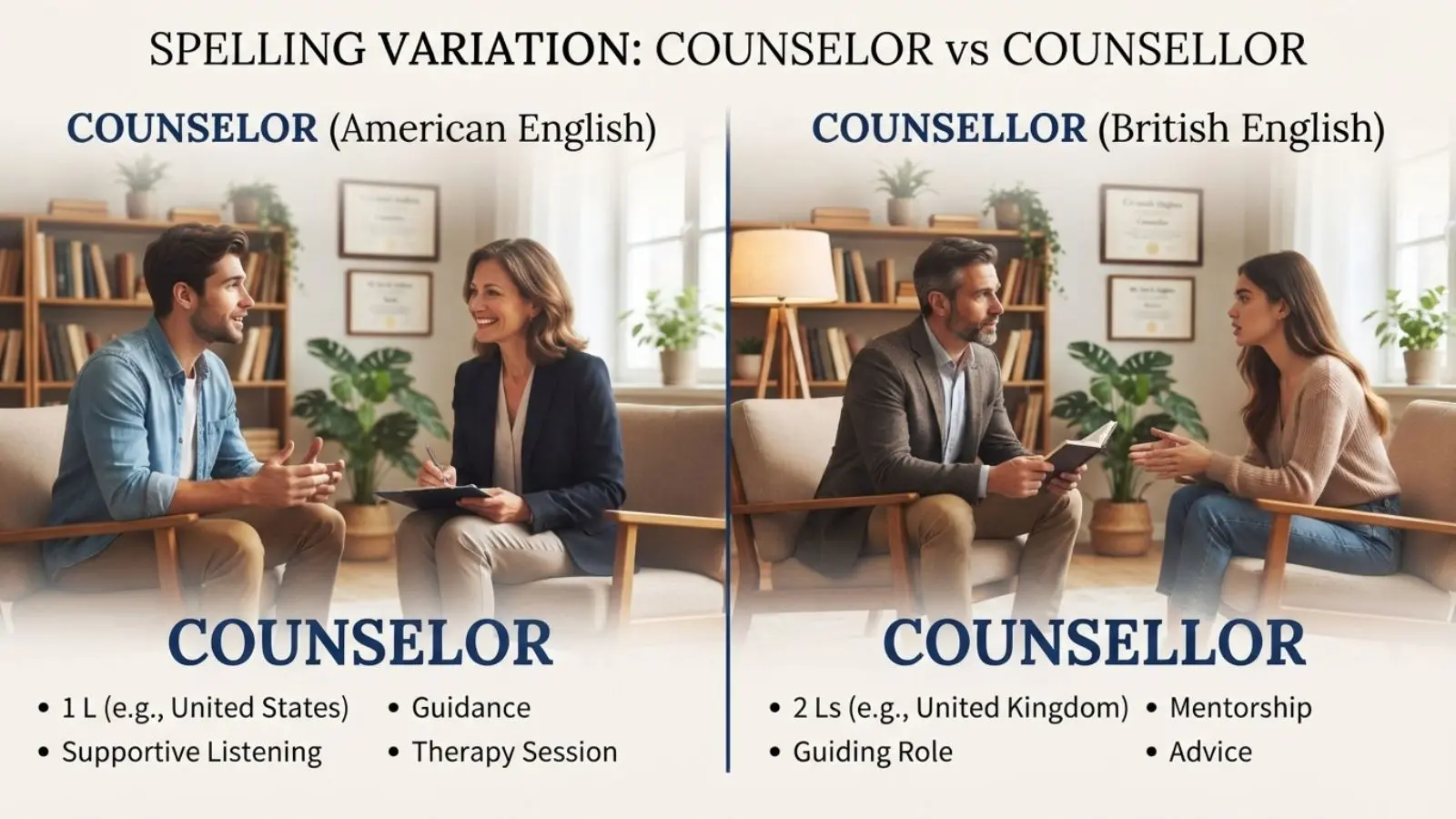
Counselor and Counsellor have essentially the same meaning: a person who provides advice, guidance, or support.
Counselor is the standard spelling in American English, while counsellor is mainly used in British English. For a U.S. audience, use a counselor with one l.
Key Takeaways
- Counselor is the standard American English spelling.
- Counsellor is mainly the British English spelling.
- Both words generally have the same meaning.
- The difference is primarily regional spelling, not meaning.
- For U.S. writing, resumes, websites, and school documents, use counselors.
What Is the Difference Between Counselor and Counsellor?
The difference between counselor vs counsellor is mainly spelling.
Both words describe someone who gives advice, guidance, or professional support. Cambridge lists counsellor as mainly British and notes that American English usually uses counselor. Its American English entry defines a counselor as someone whose job is to provide advice, help, or encouragement.
The easiest way to remember the distinction is:
| English variety | Preferred spelling |
| American English | counselor |
| British English | counsellor |
So, if you are writing for readers in the United States, choose a counselor.
If you are writing in British English, counselor is the usual form.
Counselor in American English
In American English, counselor is spelled with one l before the -or ending.
It can refer to different types of advisers or support professionals, depending on the context. For example, you might see:
- school counselor
- guidance counselor
- career counselor
- mental health counselor
- marriage counselor
- camp counselor
- legal counselor
The word is not limited to mental health. A counselor can provide guidance in education, careers, personal matters, law, or other settings. Dictionary sources also list uses involving lawyers and camp staff.
For Example:
The school counselor helped Maya choose her college courses.
Here, counselor means someone who provides guidance.
Another Example is:
I scheduled an appointment with a career counselor.
Again, the person provides advice or guidance in a particular area.
Counsellor in British English
Counsellor is the spelling commonly associated with British English.
It has the same basic meaning as the American counselor. Cambridge identifies counsellor as mainly UK and notes that the U.S. form is usually counselor.
For Example, British English may use:
The school counsellor spoke with the student.
An American publication would normally write:
The school counselor spoke with the student.
The person and the general meaning are the same. The spelling changes according to the variety of English being used.
Counselor vs Counsellor: Quick Comparison
| Feature | Counselor | Counsellor |
| Main variety | American English | British English |
| Spelling | One l | Two ls |
| Meaning | Person who gives advice or guidance | Person who gives advice or guidance |
| Common example | School counselor | School counsellor |
| Marriage context | Marriage counselor | Marriage counsellor |
| Career context | Career counselor | Career counsellor |
Dictionary.com also identifies counsellor as a variation of counselor, while its counselor entry labels the one-L spelling as American.
What Does Counselor Mean?
A counselor is generally a person who provides advice, guidance, help, or support.
The exact role depends on the context.
A school counselor, for example, may help students with academic planning, career choices, and personal concerns.
A mental health counselor works with clients on emotional, behavioral, or personal concerns within the scope of their professional training and credentials.
A career counselor helps people explore career options, education, and professional goals.
A camp counselor supervises or works with children at a camp.
The word can also appear in legal contexts. Cambridge notes that counselor can be used as a form of address for a lawyer in U.S. English.
So the meaning is broader than simply therapist.
What Does Counsellor Mean?
Counsellor carries essentially the same core meaning as counselor.
It can describe someone who provides advice or professional support, including people working in educational, personal, career, or counseling settings.
For Example:
She spoke with a counsellor about her career options.
In American English, the same sentence would normally use counselor:
She spoke with a counselor about her career options.
The spelling changes, but the basic word does not.
Counselor vs Counsellor Examples
Seeing both forms in sentences makes the distinction easier.
American English Examples
- My daughter met with her school counselor.
- He wants to become a career counselor.
- The couple visited a marriage counselor.
- The camp hired several summer counselors.
British English Examples
- My daughter met with her school counselor.
- He wants to become a career counsellor.
- The couple visited a marriage counsellor.
- The camp hired several summer counselors.
Notice that the sentence structure and meaning remain almost identical. Only the regional spelling changes.
Why Does Counselor Have One L and Counsellor Have Two?
The difference comes from regional English spelling conventions.
American English commonly uses counselors, while British English commonly uses counselors. This is part of a broader pattern in which American and British English sometimes use different spellings for the same word.
You can see a similar pattern in related words:
| American English | British English |
| counselor | counsellor |
| counseling | counselling |
| canceled | cancelled |
| traveled | travelled |
| labeled | labelled |
This does not mean that one form is inherently incorrect. It means that different English varieties have developed different spelling conventions.
Counselor vs Counsellor in Related Words
The same spelling difference appears in related terms.
In American English, you will commonly see:
- counseling
- counselor
- counselors
- counseled
British English commonly uses:
- counselling
- counsellor
- counsellors
- counselled
For Example:
U.S.:
She is studying counseling and hopes to become a counselor.
British:
She is studying counseling and hopes to become a counselor.
If you are writing an American English article, maintaining the U.S. spellings throughout the page makes the writing more consistent.
Counselor vs Councilor: Do Not Confuse Them
One important spelling issue is the difference between counselor and councilor.
These are different words.
Counselor refers to someone who gives advice, guidance, or counseling.
A councilor refers to a member of a council, especially in American English.
The words come from different roots:
- counsel → advice or guidance → counselor
- council → an organized group or governing body → councilor
For example:
The school counselor helped the student.
But:
The city councilor attended the public meeting.
The British spelling of the government role is generally councillor, with two ls. Collins specifically warns readers to avoid confusing counsellor with councillor.
This distinction is especially useful because counselor, counsellor, councilor, and councillor can look very similar.
Which Spelling Should You Use?
For U.S. Writing
Use a counselor.
This is the natural choice for American websites, school materials, resumes, professional documents, and general writing aimed at U.S. readers.
For example:
I am applying for a school counselor position.
Using counselor matches standard American spelling.
For British English
Use a counselor.
If your publication, school, employer, or audience follows British English, the double-L spelling is appropriate.
For example:
She works as a student counsellor.
For International Writing
If your content is intended for an international audience, choose a spelling system based on your primary audience and use it consistently.
Whether your website primarily targets Americans, a counselor is the better fit.
If it primarily targets British readers, a counsellor is appropriate.
The important point is not to treat one spelling as universally wrong. The choice depends largely on regional English conventions.
Frequently Asked Questions
Is the counselor or counsellor correct?
Both are correct spellings. Counselor is the standard American English form, while counsellor is mainly used in British English. They generally refer to the same type of person: someone who provides advice, guidance, or professional support.
Is counsellor wrong in American English?
Counsellor is not an invented or meaningless spelling, but counselor is the usual American English form. If you are writing specifically for a U.S. audience, use counselor for consistency with American spelling conventions.
Does counselor mean the same thing as counsellor?
Yes, in general. The two forms have the same core meaning. The primary distinction is regional spelling: counselor is American English, while counsellor is mainly British English. Both can describe someone who provides advice, guidance, or counseling.
What is the difference between counselor and councilor?
A counselor provides advice or guidance, while a councilor is a member of a council. Think of counsel as advice and council as a governing or advisory group. In British English, the latter is commonly spelled councillor.
Which spelling should I use in the United States?
Use a counselor with one l. This is the standard American spelling and is the natural choice for U.S. school, professional, business, and general writing. Cambridge specifically identifies counselor as the U.S. spelling of counsellor.
Conclusion:
The difference between Counselor vs Counsellor is simple: both words generally have the same meaning, but they belong to different regional spelling conventions.
For American English, use a counselor. For British English, use a counsellor.
If your target audience is in the United States, keep the one-L spelling throughout your content. And remember not to confuse counselor with councilor, because those words have different meanings.