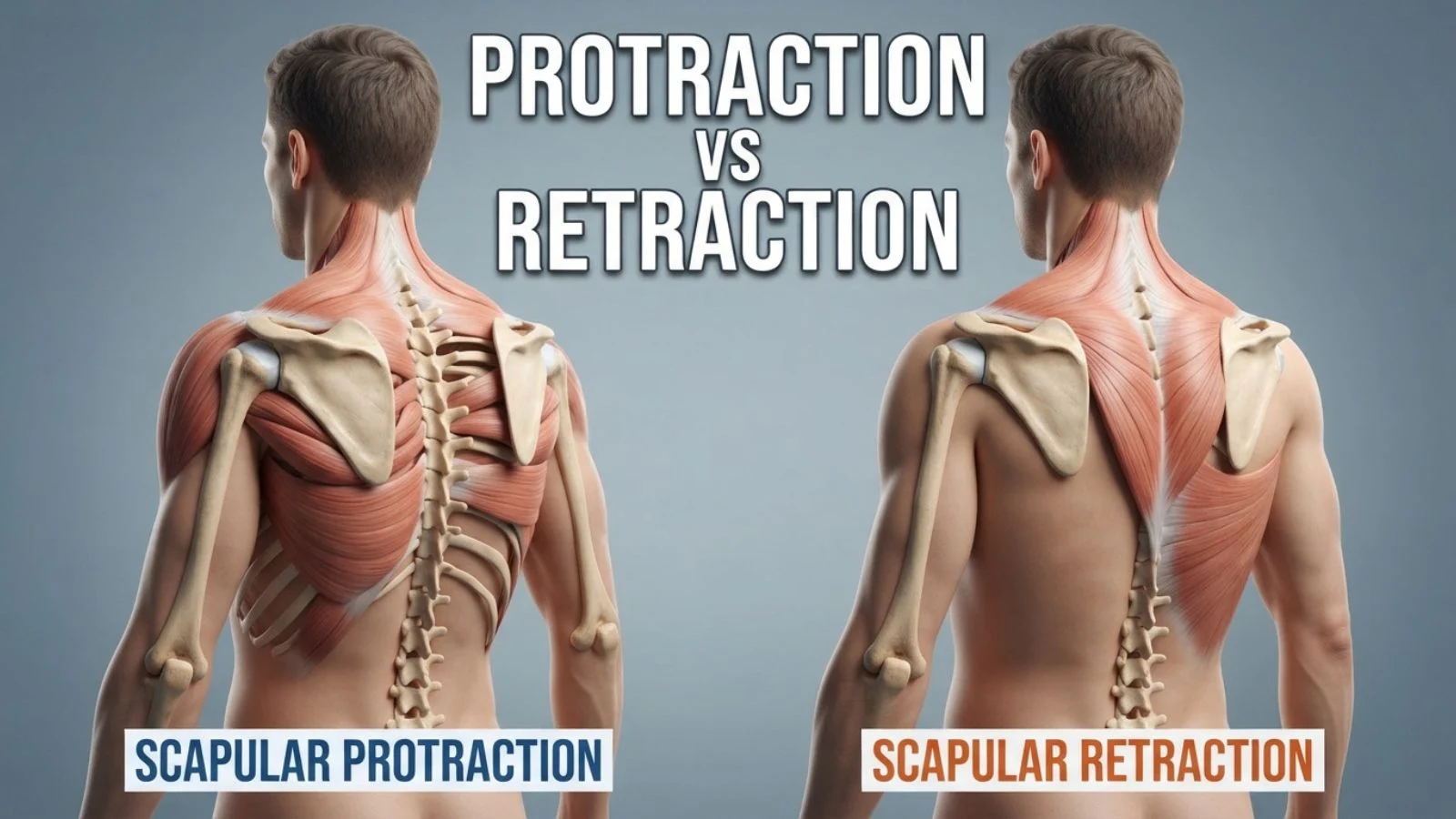
Protraction vs retraction describes two opposite anatomical movements. Protraction moves a structure forward or anteriorly, while retraction moves it backward or posteriorly.
The terms are commonly used for the scapula, or shoulder blade, and can also describe movement of the mandible, or lower jaw.
Key Takeaways
- Protraction moves the scapula forward and away from the spine.
- Retraction moves the scapula backward and toward the spine.
- The serratus anterior is a major muscle involved in scapular protraction.
- The rhomboids and middle trapezius are major muscles involved in scapular retraction.
- The same terms can describe forward and backward movement of the lower jaw.
What Is Protraction in Anatomy?
Protraction is an anatomical movement in which a body structure moves forward or anteriorly. When talking about the shoulder, protraction usually refers to the scapula moving forward around the rib cage.
Think about reaching both arms forward to grab something. Your shoulder blades move away from the spine and toward the sides of your body. That is scapular protraction.
Protraction is also involved in movements such as pushing, punching, and reaching. Standard anatomy texts describe scapular protraction as the shoulder moving forward, while the scapula moves anteriorly and laterally.
Scapular Protraction
The scapula is the flat, triangular bone commonly called the shoulder blade. During protraction, it glides forward along the thoracic wall rather than simply rotating at the shoulder joint.
A simple way to picture it is to imagine your shoulder blades moving away from your spine.
The serratus anterior is one of the primary muscles responsible for this movement. The pectoralis minor also contributes to scapular protraction.
Everyday Examples of Protraction
You use scapular protraction in many normal activities, including:
- Reaching forward to pick up an object
- Pushing a door
- Throwing a punch
- Performing the forward phase of certain pushing exercises
- Reaching both arms toward something in front of you
A useful memory clue is “pro = forward.” When the shoulder blade moves forward and away from the spine, you are thinking about protraction.
What Is Retraction in Anatomy?
Retraction is essentially the opposite movement. It occurs when a structure moves backward or posteriorly.
For the scapula, retraction means the shoulder blade moves toward the vertebral column. If you gently pull your shoulder blades together as though holding a pencil between them, you are demonstrating scapular retraction.
Retraction is particularly noticeable during pulling movements.
Scapular Retraction
During scapular retraction, the shoulder blades move posteriorly and medially toward the spine.
The rhomboid muscles and middle trapezius are important contributors to this movement. The rhomboids help pull the scapula toward the midline, while the middle trapezius produces a direct retraction force.
Retraction is not simply the opposite of reaching forward. It is part of coordinated shoulder movement and helps position and stabilize the scapula during activities involving the upper limb.
Everyday Examples of Retraction
Common examples include:
- Pulling your shoulders back
- Performing a rowing movement
- Drawing the shoulder blades together
- Pulling an object toward your body
- Returning from a forward-reaching position
For a simple memory trick, think “retract = pull back.”
Protraction vs Retraction: Key Differences
The easiest way to understand protraction vs retraction is to focus on direction.
| Feature | Protraction | Retraction |
| Basic direction | Forward | Backward |
| Scapula movement | Away from the spine | Toward the spine |
| Anatomical direction | Anterior/lateral | Posterior/medial |
| Common action | Reaching or pushing | Pulling or rowing |
| Major muscle contributors | Serratus anterior, pectoralis minor | Rhomboids, middle trapezius |
| Simple memory clue | Move forward | Pull back |
For the scapula, protraction involves forward movement away from the vertebral column, while retraction moves the scapula posteriorly and medially toward it.
One important point is that neither movement is automatically “good” or “bad.” Your body needs both. Normal shoulder function requires coordinated scapular motion rather than keeping the shoulder blades permanently pulled back.
Which Muscles Cause Protraction and Retraction?
The muscles responsible for these movements help explain why the movements feel different.
Muscles for Protraction
The serratus anterior is a primary muscle involved in scapular protraction. It attaches along the ribs and the medial border of the scapula, helping pull the scapula forward and maintain contact between the scapula and thoracic wall.
The pectoralis minor can also contribute to protraction. Together, these muscles help move and stabilize the scapula during forward-reaching and pushing activities.
Muscles for Retraction
The rhomboid major, rhomboid minor, and middle trapezius are important scapular retractors.
The rhomboids pull the scapula toward the midline, while the middle and lower portions of the trapezius contribute to scapular retraction and control.
This is why exercises involving controlled pulling or rowing can involve the muscles responsible for scapular retraction.
Protraction vs Retraction of the Jaw
Although the shoulder blade is one of the most common examples, protraction and retraction can also describe movements of the mandible, or lower jaw.
When the lower jaw moves forward, it can be described as protraction. When it moves backward, it is retraction. OpenStax specifically uses the lower jaw as an example of these anterior-posterior movements.
For example, gently pushing your chin forward demonstrates the basic idea of mandibular protraction. Pulling the jaw back demonstrates the opposite direction.
There is some terminology variation in anatomy resources. Terms such as protrusion and retrusion are also commonly used for forward and backward movement of the mandible. Kenhub notes that these terms can overlap in descriptions but distinguishes them from the more specific anterolateral/posteromedial meaning often applied to scapular protraction and retraction.
So, when studying anatomy, always consider which body structure the terminology is describing.
Protraction and Retraction in Everyday Movement
These movements are easier to understand when you connect them with actions you already perform.
Imagine doing a push-up. As you actively move your shoulder blades around the rib cage at the end of the movement, scapular protraction becomes important. The serratus anterior is particularly involved in controlling this movement.
Now imagine performing a rowing exercise. As you pull your arms back and bring the shoulder blades toward the spine, scapular retraction becomes more prominent.
The two movements can also work together. Many normal activities require the scapula to move smoothly between protracted and retracted positions rather than holding it in one position.
Scapular movement is part of the larger system that allows the upper limb to move efficiently. The scapula can also elevate, depress, and rotate, so protraction and retraction should not be viewed as the only movements occurring at the shoulder girdle.
How to Remember Protraction vs Retraction
If you regularly mix up these terms, use this simple rule:
Protraction = forward.
Retraction = backward.
For the shoulder blades:
Protraction: shoulder blades move away from the spine.
Retraction: shoulder blades move toward the spine.
You can also connect the words with familiar actions:
- Punch or reach forward → protraction
- Pull or row backward → retraction
This mental shortcut is especially useful for students learning anatomical movement terminology.
Frequently Asked Questions
Is protraction forward or backward?
Protraction is generally a forward or anterior movement. For the scapula, it means the shoulder blade moves forward and away from the vertebral column. For the mandible, it can refer to moving the lower jaw forward.
Is retraction forward or backward?
Retraction is generally a backward or posterior movement. In the scapula, retraction moves the shoulder blade toward the vertebral column. It is the opposite direction from scapular protraction.
What muscles protract the scapula?
The serratus anterior is a primary muscle involved in scapular protraction. The pectoralis minor also contributes. These muscles help move the scapula forward and maintain its relationship with the thoracic wall.
What muscles retract the scapula?
The rhomboids and middle trapezius are major muscles involved in scapular retraction. They pull the shoulder blade toward the body’s midline and help control its position during upper-body movements.
Final Takeaway:
The main difference in protraction vs retraction is direction. Protraction moves a structure forward, while retraction moves it backward.
For the scapula, protraction moves the shoulder blade away from the spine, while retraction brings it toward the spine.
Remember “pro = forward” and “retract = pull back.” Once you connect these terms with familiar actions such as reaching, pushing, pulling, and rowing, the distinction becomes much easier to remember.

I’m Maya Angelou, the creator behind EmojiAura.com, where I explore emoji meanings, social media trends, and fun digital expressions. I’m passionate about helping people understand the real meaning behind emojis and use them creatively in chats, captions, posts, and everyday online conversations.