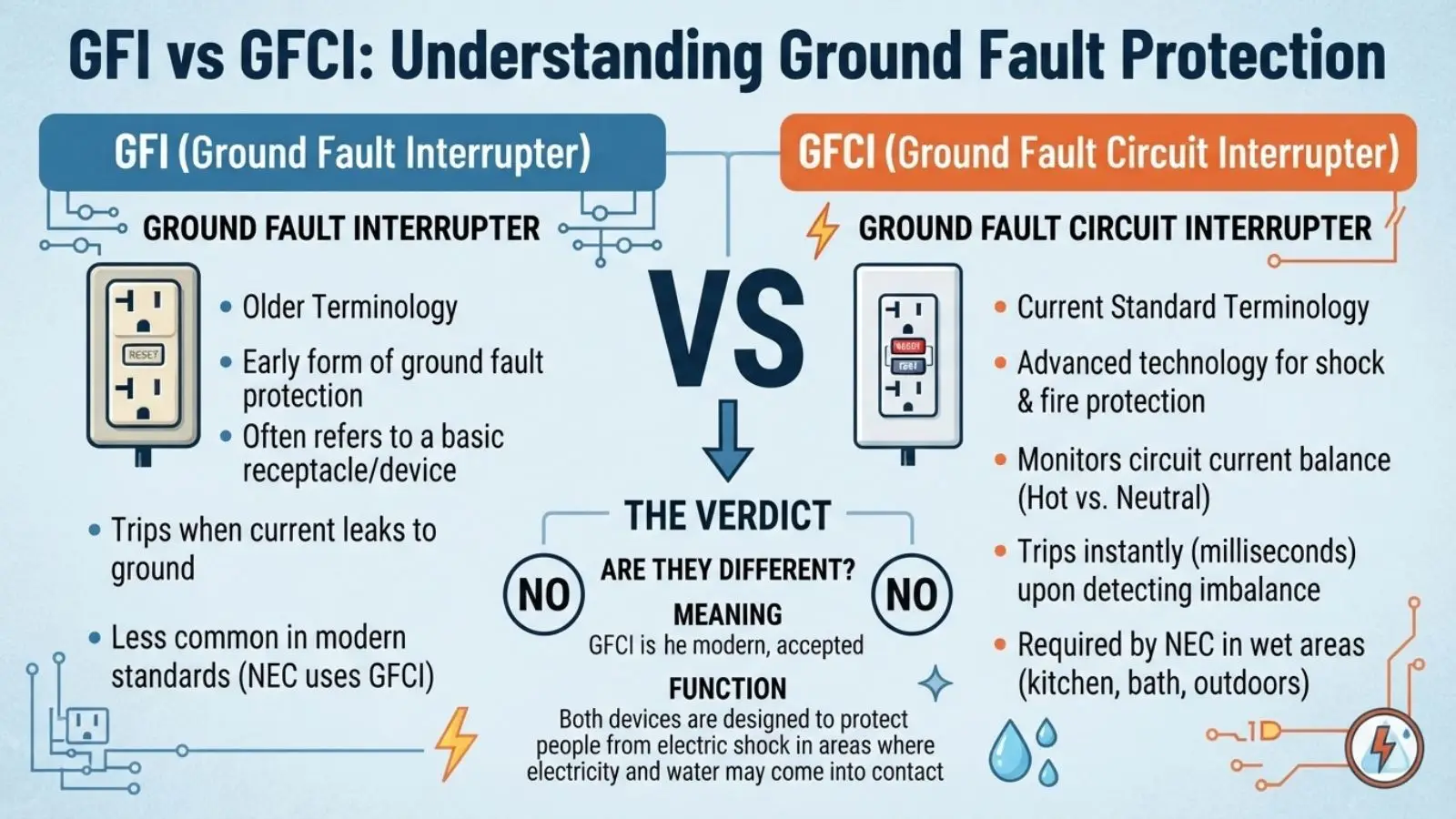
GFI and GFCI generally refer to the same type of electrical safety device. GFI means Ground Fault Interrupter, while GFCI means Ground Fault Circuit Interrupter.
Both terms describe protection designed to detect a dangerous current imbalance and interrupt power to help reduce the risk of electrical shock. GFCI is the more commonly used technical term in the United States.
Key Takeaways:
- GFI and GFCI generally describe the same ground-fault protection.
- GFCI stands for Ground Fault Circuit Interrupter.
- A GFCI detects certain current imbalances and quickly interrupts power.
- GFCI protection can be provided by a receptacle or circuit breaker.
- GFCI outlets have TEST and RESET buttons for checking operation.
- A GFCI is not a substitute for ordinary overload or short-circuit protection.
Is There a Difference Between GFI and GFCI?
The short answer is usually no.
GFI and GFCI are two terms commonly used for ground-fault protection. GFI is short for Ground Fault Interrupter, while GFCI means Ground Fault Circuit Interrupter.
The difference is mainly in the wording, not the basic protective function.
The term GFCI is more common in electrical terminology and product descriptions. You may still see or hear GFI outlets, particularly in everyday conversation or when someone is referring to an older installation.
For a homeowner, the important point is that an outlet labeled GFI is generally referring to the same type of ground-fault protection commonly called a GFCI.
What GFI Means
GFI stands for Ground Fault Interrupter.
It is a shortened name used to describe a device that interrupts electrical power when it detects a potentially dangerous ground fault.
The name focuses on the interruption function: the device detects an abnormal path for electrical current and shuts off power.
What GFCI Means
GFCI stands for Ground Fault Circuit Interrupter.
This is the terminology you are more likely to encounter on modern GFCI receptacles, circuit breakers, electrical documentation, and safety information.
The longer name makes the function clearer because the device interrupts a circuit when it detects the type of current leakage associated with a ground fault.
GFI vs GFCI: Quick Comparison
| Feature | GFI | GFCI |
| Full name | Ground Fault Interrupter | Ground Fault Circuit Interrupter |
| Basic function | Ground-fault protection | Ground-fault protection |
| Primary purpose | Help reduce shock risk | Help reduce shock risk |
| Common usage | Informal/shortened term | Common technical term |
| Can refer to an outlet? | Yes | Yes |
| Can you refer to circuit protection? | Sometimes | Yes |
| TEST/RESET buttons | On applicable receptacles | On applicable receptacles |
| Different technology? | Generally no | Generally no |
So, when comparing GFI vs GFCI, you are usually comparing two names for the same type of protection rather than two competing technologies.
How Does a GFCI Work?
A GFCI continuously monitors the electrical current passing through the circuit.
Under normal conditions, current leaving through the energized conductor should correspond closely with current returning through the neutral conductor. If some current takes an unintended path to ground, the device can detect the imbalance.
If the detected ground-fault current reaches the applicable trip threshold, the GFCI interrupts power. Class A GFCIs are designed around a range in which they do not trip below 4 mA and are required to trip at 6 mA or higher under the applicable performance criteria.
What Is a Ground Fault?
A ground fault happens when electricity finds an unintended conductive path to ground.
For example, imagine a damaged appliance cord that allows current to travel through a person who is touching the appliance while also providing a path toward ground.
That unintended path can create a serious shock hazard.
A GFCI is designed to detect the resulting current imbalance and disconnect power quickly, helping reduce the duration and severity of the electrical shock hazard.
Why GFCIs Help Prevent Electric Shock
A conventional circuit breaker primarily responds to conditions such as excessive current caused by an overload or short circuit.
A GFCI serves a different purpose: it focuses on potentially dangerous current flowing through an unintended path.
That distinction matters because a relatively small amount of leakage current can be dangerous to a person without necessarily being large enough to trip an ordinary circuit breaker. GFCI protection is therefore an important layer of electrical safety.
Where Are GFCI Outlets Used?
GFCI protection is especially important in locations where electricity may come into contact with people and moisture.
Common examples include:
- Bathrooms
- Kitchens
- Garages
- Outdoor areas
- Laundry areas
- Areas near sinks
- Other locations where applicable electrical codes require GFCI protection
Exact requirements depend on the installation, location, equipment, and applicable electrical code. Local jurisdictions can also have requirements that differ from a general summary of the NEC.
The key idea is simple: GFCI protection is intended to provide additional protection against electrical shock where ground-fault hazards are a concern.
GFCI Outlet vs GFCI Circuit Breaker
Not every GFCI device looks like a wall outlet.
A GFCI receptacle is the familiar outlet with TEST and RESET buttons. It can provide protection at the receptacle and, when wired appropriately, can also protect certain downstream receptacles.
A GFCI circuit breaker, on the other hand, is installed in the electrical panel. It can provide ground-fault protection for the circuit it serves.
This means the term GFCI can describe more than one physical device.
For example, you might have a GFCI receptacle in a bathroom or a GFCI breaker protecting a circuit from the electrical panel.
This is one reason GFCI is more useful as a general technical term than thinking of the protection as simply a special kind of outlet.
How to Test a GFCI Outlet
Most GFCI receptacles have clearly marked TEST and RESET buttons.
A basic functional test is straightforward:
- Plug a suitable lamp or similar device into the receptacle.
- Turn the device on.
- Press the TEST button.
- The GFCI should trip and interrupt power.
- Press RESET to restore power.
Leviton recommends monthly testing of its GFCI receptacles, and its instructions explain that pressing TEST should interrupt power before RESET restores it.
If the device does not behave as expected, do not assume it is protecting you simply because the outlet still provides power.
Some modern GFCI products also perform automatic self-tests and provide indicator lights showing their status.
What If a GFCI Will Not Reset?
A GFCI that refuses to reset can have several possible causes.
There may be no power reaching the device, a ground fault may still be present, the device may be incorrectly wired, or the GFCI itself may have failed.
One common installation problem is reversing the LINE and LOAD connections. Manufacturer documentation warns that incorrect line/load wiring can prevent a GFCI from operating correctly or resetting.
If a GFCI repeatedly trips, will not reset, or shows an indication of failure, avoid repeatedly forcing it back into service. Unplugging connected equipment can sometimes help identify whether an appliance is contributing to the problem, but persistent electrical problems should be evaluated by a qualified electrician.
GFI vs GFCI: Which Term Should You Use?
If you are searching for an electrical replacement, shopping for a receptacle, or reading installation instructions, GFCI is generally the clearest term to use.
For example, searches such as:
- “GFCI outlet”
- “GFCI receptacle”
- “GFCI breaker”
- “GFCI replacement outlet”
- “GFCI protection”
will usually make your intended product or topic clear.
That does not mean GFI is incorrect in everyday use. It is simply a shorter term for the same general concept.
The important thing is to focus on the actual device’s specifications, certification, wiring instructions, electrical rating, and suitability for the intended installation rather than assuming two products are identical merely because both are called GFI or GFCI.
Frequently Asked Questions
Is GFI the same as GFCI?
Yes, in common U.S. electrical usage, GFI and GFCI generally refer to the same type of ground-fault protection. GFI means Ground Fault Interrupter, while GFCI means Ground Fault Circuit Interrupter. GFCI is the more common technical terminology used for these devices.
Is a GFCI better than a GFI?
Neither term represents a separate level of protection. A GFI and GFCI generally describe the same protective concept. When selecting a device, compare its actual specifications, certification, electrical rating, features, and suitability for your installation rather than choosing based solely on whether the label says GFI or GFCI.
Does a GFCI protect against overloads?
Not by itself. GFCI protection is designed primarily to detect ground-fault current and help protect people from electrical shock. It does not replace ordinary overcurrent protection for conditions such as circuit overloads and short circuits. Those functions are handled by appropriate overcurrent protection such as circuit breakers or fuses.
How often should a GFCI be tested?
Manufacturer guidance commonly recommends testing GFCI receptacles monthly. A typical test uses the TEST button to interrupt power and the RESET button to restore it. If the device fails the test or cannot reset properly, it should not simply be assumed to be safe.
Conclusion:
When it comes to GFI vs GFCI, the main difference is terminology rather than function. GFI stands for Ground Fault Interrupter, while GFCI stands for Ground Fault Circuit Interrupter.
Both terms generally describe electrical protection designed to detect ground faults and interrupt power to help reduce electric-shock risk.
For modern electrical information, GFCI is the clearer and more commonly used term. If you are dealing with a GFCI receptacle.
GFCI circuit breakers always follow the manufacturer’s instructions and applicable electrical requirements.