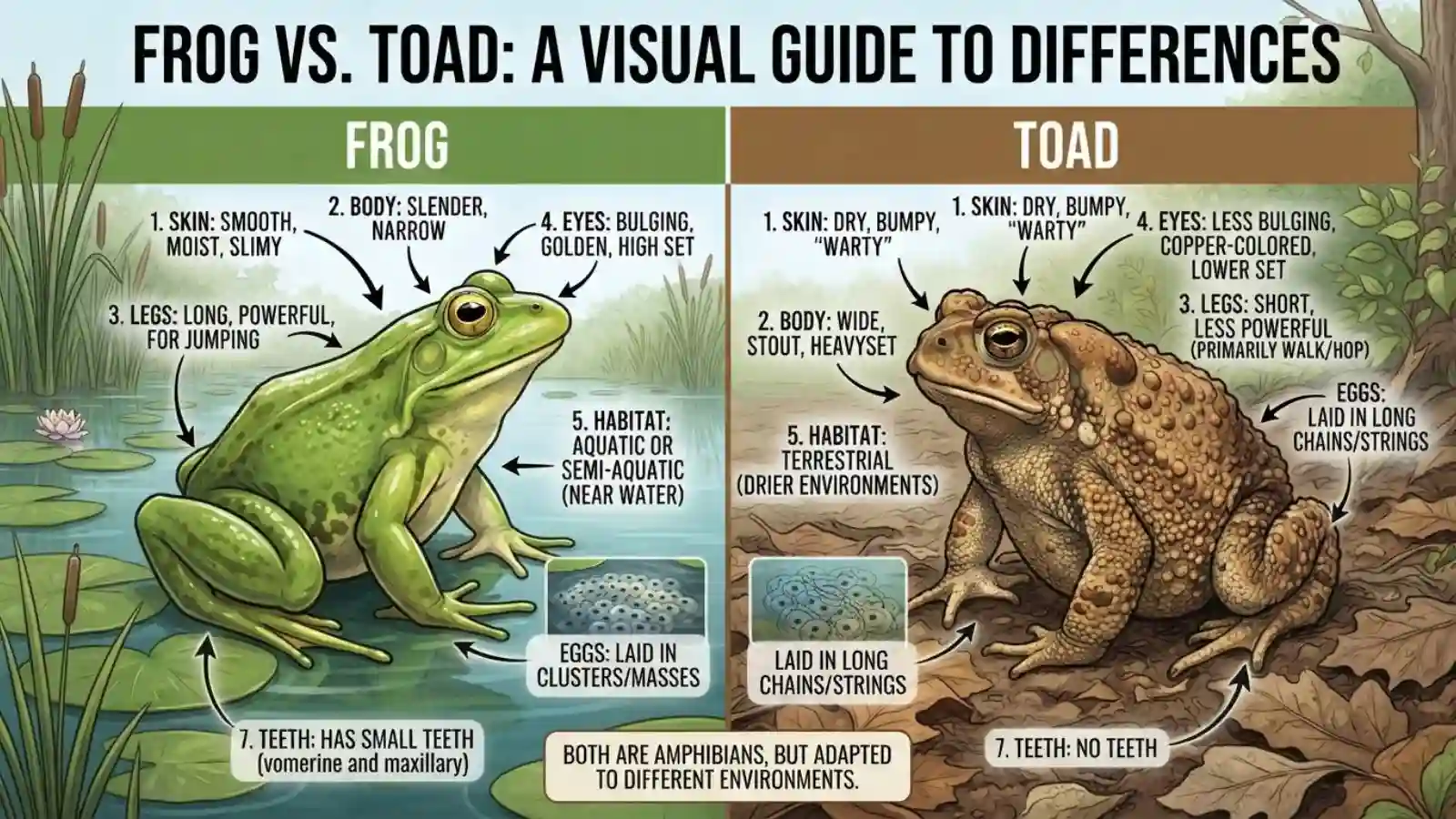
The main difference between a frog and a toad is their typical appearance and lifestyle. Frogs usually have smooth, moist skin, longer hind legs, and a stronger association with water.
Toads typically have drier, bumpier skin, shorter legs, and spend more time on land. However, “toad” is not a separate biological order; toads are part of the broader frog group called Anura.
Key Takeaways:
- Frogs and toads are both tailless amphibians in the order Anura.
- Frogs typically have smoother, moister skin and longer hind legs.
- Toads generally have rougher skin, shorter legs, and more terrestrial habits.
- True toads have noticeable parotoid glands behind their eyes.
- Egg appearance can help identify them, but there are important species-specific exceptions.
Frog vs Toad: What’s the Main Difference?
When people search for frog vs toad, they usually want a simple way to tell these two animals apart. The easiest starting point is appearance: a typical frog looks smoother, slimmer, and longer-legged, while a typical toad looks stockier, bumpier, and shorter-legged.
But there is an important biological detail that makes this comparison more interesting.
Frogs and toads are both members of the order Anura, which contains tailless amphibians. In everyday language, “frog” often describes the smoother, more aquatic-looking animals, while “toad” describes animals with a classic rough-skinned, land-dwelling appearance.
So, in a broad scientific sense, a toad is a type of frog. The word “toad” is commonly associated with the true toad family, Bufonidae, although several other anuran species also have “toad” in their common names.
Frog vs Toad Comparison Table
| Feature | Typical Frog | Typical Toad |
| Skin | Smooth and moist | Rougher, drier, and bumpy |
| Body | Often slimmer | Often broader and stockier |
| Hind legs | Long and powerful | Shorter and sturdier |
| Movement | Long jumps | Short hops or walking |
| Habitat | Often close to water | More often found on land |
| Parotid glands | Usually not prominent | Prominent in true toads |
| Eggs | Often laid in clusters | Often laid in strings |
| Water dependence | Generally higher | Adults often tolerate drier areas |
These characteristics are useful identification clues, but they are general patterns rather than absolute rules. The enormous diversity of frogs means some species do not fit the familiar picture.
How to Tell a Frog From a Toad
Skin and Body Texture
Skin is usually the first thing people notice.
Typical frogs have smooth, moist skin. Their skin needs to remain sufficiently moist because amphibians can exchange water and gases through their skin. Toads generally have thicker-looking, rougher, bumpier skin that helps them function in more terrestrial environments.
The bumps on a toad are not human warts. They are natural structures associated with the animal’s skin and glands.
Still, don’t rely on skin texture alone. Some animals called “toads” have surprisingly smooth skin. The Smithsonian, for example, notes that Panamanian golden frogs have smooth skin despite being referred to as toads.
Legs and Movement
Leg shape provides another useful clue.
Frogs commonly have long, powerful hind legs designed for jumping. When startled, many can make a quick leap toward vegetation or water.
Toads generally have shorter hind legs relative to their bodies. Instead of making dramatic jumps, they are more likely to walk, crawl, or make shorter hops.
If you see a slim amphibian suddenly launch itself several body lengths away, you may be looking at a typical frog. A squat animal moving with short hops across a garden is more consistent with a typical toad.
Parotoid Glands
One of the most useful clues for identifying a true toad is the presence of parotoid glands.
These are raised structures located behind the eyes. In true toads, they contain defensive skin secretions that can discourage predators. Historical Smithsonian material also describes the characteristic glands behind the eyes of true toads and their defensive secretions.
This feature can be more useful than simply asking whether an animal looks “warty.”
Feet and Swimming
Many frogs have feet adapted for swimming or climbing, depending on the species. Webbing between the toes can help aquatic frogs move through water.
However, webbing is not a perfect frog-versus-toad test. Species differ considerably, and some toads are capable swimmers.
This is why identification guides often consider several characteristics together, including the animal’s shape, glands, skin, and other anatomical features. The Minnesota Department of Natural Resources, for example, lists structures such as the tympanum, cranial ridge, dorsolateral fold, and parotid gland as useful identification features.
Frog vs Toad: Habitat
Habitat can provide another strong clue.
Typical frogs are strongly associated with moist environments. You may find them around ponds, streams, wetlands, damp vegetation, or other areas where water is readily available.
Toads are generally better adapted to spending time away from standing water. They may be found in gardens, yards, woodland, grassland, or other terrestrial environments and return to suitable water sources for breeding.
The reason relates partly to their skin. Amphibian skin is highly important for water exchange, so moisture is essential for survival.
However, saying that frogs “live in water” and toads “live on land” is too simplistic. Both groups contain species with different lifestyles, and some animals called toads are highly aquatic. Smithsonian’s Oriental fire-bellied toad, for example, spends much of its time in slow-moving streams and ponds.
Frog vs Toad: Eggs and Reproduction
Eggs can also provide clues when adult animals are difficult to see.
Many familiar frogs lay their eggs in gelatinous clusters or masses. These masses may float on water or attach to aquatic plants.
Many true toads, by contrast, lay their eggs in long strings that can become wrapped around underwater vegetation.
This difference is useful when identifying common species, but it should not be treated as universal. Frogs and toads have evolved many unusual reproductive strategies. Some frogs use foam nests, while other species place eggs on leaves so that newly hatched tadpoles can reach water.
Both frogs and toads generally begin life through an aquatic larval stage called a tadpole. During metamorphosis, the young animal develops adult features and changes its body and lifestyle.
What Do Frogs and Toads Eat?
Adult frogs and toads commonly eat small animals such as insects and other invertebrates.
Their diets vary according to species, body size, habitat, and what prey is available.
Both can play useful ecological roles by consuming insects and serving as prey for other animals. Their feeding behavior also changes as they develop. Tadpoles typically have very different diets and body structures from adults.
Frog and Toad Similarities
Despite the obvious differences, frogs and toads have a lot in common.
Both are:
- Amphibians
- Tailless as adults
- Members of the order Anura
- Ectothermic
- Dependent on moisture during at least part of their life cycle
- Often associated with aquatic breeding environments
- Predators of many small organisms as adults
- Capable of producing distinctive calls
Their life cycles can also include eggs, aquatic tadpoles, metamorphosis, and adult animals.
This shared biology is why the frog-versus-toad distinction is mostly about common names and recognizable traits rather than two completely separate groups.
Common Myths About Frogs and Toads
Can Toads Give You Warts?
No. A toad cannot give you human warts.
The rough bumps on a toad’s skin may look like warts, but they are part of the animal’s natural anatomy. Human warts are caused by viruses, not by touching a toad.
You should still avoid touching your face or eyes after handling amphibians and wash your hands afterward.
Are Toads Poisonous?
Some toads produce defensive chemicals through their skin glands. These secretions can be irritating or harmful to predators and may pose a particular risk when pets bite or mouth a toad.
“Poisonous” and “venomous” are not the same thing. A venomous animal actively delivers venom through a specialized structure, while a poisonous animal contains or produces harmful substances that can affect another animal through contact or ingestion.
The strength and effects of defensive secretions vary between species, so it is better not to assume that every toad has the same level of toxicity.
Frequently Asked Questions
Are toads frogs?
Yes, in the broad biological sense. Frogs and toads belong to the order Anura, the group of tailless amphibians. “Toad” is a common name used for certain anurans, especially members of the true toad family Bufonidae. Therefore, the two terms describe overlapping groups rather than completely separate animal orders.
Which lives closer to water, frogs or toads?
Typical frogs are more strongly associated with water or damp habitats, while many toads can spend more time on land. This is a general pattern, not an absolute rule. Some frogs live away from open water, and some animals called toads are strongly aquatic. Habitat should therefore be considered alongside skin, legs, glands, and other features.
Do frogs and toads lay different eggs?
Often, yes. Many familiar frogs lay eggs in gelatinous clusters, while many true toads lay eggs in long strings. However, reproductive strategies vary widely among anurans. Some species use foam nests, attach eggs to vegetation, or have unusual parental-care strategies. Egg arrangement can be a helpful clue, but it should not be the only identification method.
How can you quickly identify a toad?
Look for several clues together. A typical toad has rough or bumpy skin, a stockier body, shorter hind legs, and may have prominent parotoid glands behind its eyes. It is also more likely to be found away from open water. If several of these characteristics appear together, the animal is more consistent with a typical toad than a typical frog.
Final Thoughts:
The Frog vs Toad comparison is easier once you understand that the two aren’t completely separate biological groups.
A typical frog has smooth, moist skin, long hind legs, and a strong association with water. A typical toad has rougher skin, shorter legs, prominent glands in true toads, and a greater ability to spend time on land.
The most reliable approach is to look at several characteristics together rather than relying on one rule.
Skin, body shape, movement, habitat, glands, and egg patterns can all help you identify an unfamiliar amphibian.
And the biggest fact to remember is simple: all toads are frogs in the broad biological sense, but not all frogs are called toads.

I’m Maya Angelou, the creator behind EmojiAura.com, where I explore emoji meanings, social media trends, and fun digital expressions. I’m passionate about helping people understand the real meaning behind emojis and use them creatively in chats, captions, posts, and everyday online conversations.