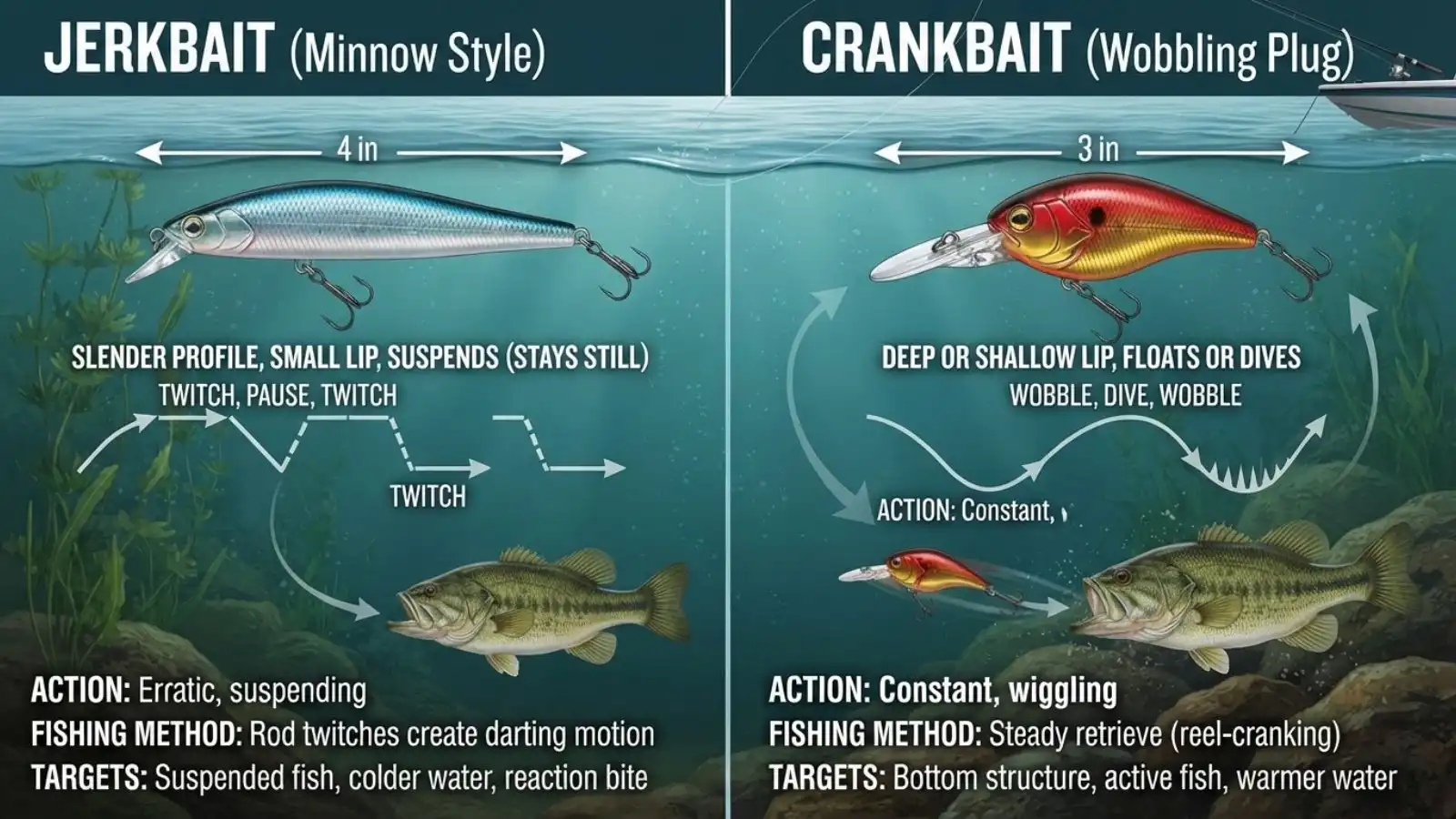
The main difference between a Jerkbait vs Crankbait is how each lure creates action. A jerkbait is usually a slender, minnow-shaped lure worked with rod movements and pauses, while a crankbait generally creates a steady wobble as you reel it in.
Jerkbaits often excel in clear, cool water, while crankbaits are useful for covering water, fishing structure, and working stained water.
Key Takeaways:
- Jerkbaits use an erratic, stop-and-go presentation and are especially useful around clear water and suspended bass.
- Crankbaits generally provide continuous vibration and are excellent for covering water and contacting structure.
- Water temperature matters, but it should not be the only deciding factor.
- Water clarity, depth, forage, fish position, and cover can change which lure makes more sense.
- Neither lure is universally better; each solves a different fishing problem.
What Is the Difference Between a Jerkbait and Crankbait?
At first glance, jerkbaits and crankbaits can seem similar. Both are commonly used hard baits, often have treble hooks, and can imitate baitfish. The major difference is how they move and how anglers normally present them.
A jerkbait typically has a long, narrow, minnow-like profile. Anglers manipulate it with the rod, creating quick darts followed by pauses. Suspending models can remain in roughly the same part of the water column during those pauses, giving a bass time to inspect and strike.
A crankbait usually has a shorter, deeper body and a bill that helps it dive and create its characteristic wobble. The lure generally produces much of its action automatically as you reel it.
That distinction is important because you are not simply choosing between two different shapes. You are choosing between two different presentations.
Jerkbait Basics
A typical hard jerkbait is designed to imitate a small baitfish. Its biggest weapon is the change from movement to stillness.
A common retrieve is two or three rod snaps followed by a pause. The bait darts from side to side, then hangs or slowly changes position depending on whether it is floating, suspending, or sinking.
The pause can be especially useful when bass are reluctant to chase.
Crankbait Basics
A crankbait uses its bill to dive and generate swimming action. Different bills and body designs allow anglers to target different depths and situations.
Squarebills are commonly used around shallow cover, while medium- and deep-diving crankbaits can reach deeper fish. Lipless crankbaits are another category with different characteristics because they have no diving bill.
That variety means saying “crankbait” does not automatically tell you exactly how deep or how aggressively the lure will fish.
Jerkbait vs Crankbait: Quick Comparison
| Feature | Jerkbait | Crankbait |
| Typical profile | Long and slender | Shorter and fuller |
| Main action | Darting and pausing | Wobbling and vibrating |
| Angler input | Rod-driven | Mostly reel-driven |
| Typical presentation | Twitch-pause | Steady retrieve |
| Strong situation | Clear water | Stained or dirty water |
| Common seasonal use | Spring and fall | Broad seasonal range |
| Fish position | Often suspended or near baitfish | Shallow, mid-depth, or deep |
| Cover approach | Usually more open water | Excellent around many types of cover |
| Depth | Depends on model | Wide range of options |
| Key advantage | Controlled stop-and-go presentation | Efficient water coverage |
These are general patterns rather than strict rules. Experienced anglers can catch bass on either lure outside the “ideal” conditions.
When Should You Use a Jerkbait?
A jerkbait becomes especially useful when bass are looking at baitfish and you want to give them an easy target that changes direction and then pauses.
Clear Water
Clear water is one of the classic jerkbait situations because the visual profile and erratic movement can be seen from farther away.
Professional angler Bill Lowen has described jerkbaits as a highly visual technique and favors them in clear water, while preferring crankbaits when water becomes more off-color.
That does not mean a jerkbait cannot catch fish in stained water. Rather, its visual presentation can become harder for fish to locate as visibility decreases.
Cold to Cool Water
Jerkbaits are particularly well known for cold-water fishing because the retrieve can be slowed dramatically.
Instead of forcing a bass to chase a continuously moving lure, you can make the bait stop in front of the fish.
The exact pause should depend on fish behavior rather than a rigid number. Bassmaster has documented jerkbait retrieves in cold water where pauses can range from very short periods to much longer pauses depending on the fish’s activity level.
Suspended Bass and Baitfish
A jerkbait is also useful when bass are suspended around points, bluff banks, creek channels, or schools of baitfish.
The lure can travel through the strike zone, stop, and remain available to the following fish.
This is one reason jerkbaits are especially popular during spring and fall baitfish patterns.
When Should You Use a Crankbait?
Crankbaits shine when you want to cover water efficiently or make a lure interact with structure.
Stained or Dirty Water
When visibility decreases, vibration and movement become important parts of a lure’s appeal.
A crankbait’s continuous wobble can help fish locate it when they cannot see it as clearly. Major League Fishing’s expert advice similarly notes that when muddy water reduces the effectiveness of a visual jerkbait presentation, a tight-wobbling crankbait can be an alternative.
However, clarity alone should not determine your choice. Depth, cover, forage, and fish activity still matter.
Covering Water
If you are trying to locate active bass across a large area, a crankbait can be an efficient search tool.
Instead of stopping after every few rod movements, you can make long casts and maintain a productive retrieve throughout much of the cast.
This makes crankbaits particularly useful when bass are actively feeding or when you are trying to discover where fish are positioned.
Fishing Structure and Different Depths
Crankbaits are also valuable around rocks, wood, ledges, banks, and other forms of structure.
A squarebill, for example, can be worked around shallow cover, while a deep-diving model can reach fish holding farther down.
The bill can also help a crankbait deflect when it contacts underwater objects. That sudden change in direction can trigger a reaction strike. Bassmaster’s structure-fishing guidance specifically includes crankbaits around features such as roadbeds, flats, and other structures.
Jerkbait vs Crankbait by Water Conditions
There is no single temperature at which you must stop using one lure and switch to the other.
Instead, think of temperature as one part of a larger decision.
Water Temperature
In cooler water, a suspending jerkbait can be valuable because you can slow the presentation and extend the pause.
As water warms and bass become more willing to chase, a crankbait’s continuous action can become increasingly useful.
But the two techniques overlap.
Major League Fishing documented a spring event where anglers continued using jerkbaits successfully even as water moved out of the colder range and fish became more active.
So instead of memorizing “below X degrees = jerkbait,” watch how the fish respond.
Water Clarity
A simple starting point is:
- Clear water: Consider a jerkbait first.
- Lightly stained water: Either may work.
- Heavy stain or muddy water: Consider a crankbait with noticeable vibration.
This is a starting framework, not a hard rule. Lowen’s approach similarly uses clarity as one of his major factors when choosing between these reaction baits.
Depth
Depth is another major consideration.
If bass are suspended several feet below the surface, a suspending jerkbait can keep the lure in front of them.
If fish are holding close to the bottom or around deeper structure, a properly selected deep-diving crankbait may be more practical.
Remember that lure design matters. Not every jerkbait runs shallow, and crankbaits are available for everything from very shallow water to substantial depths.
Wind and Light
Calm, clear conditions can make a jerkbait presentation particularly attractive because fish can track the bait visually.
Wind can change the equation by reducing visibility and encouraging fish to feed more aggressively around banks and structure.
In those conditions, a crankbait may give you a better way to cover water and generate vibration.
How to Fish a Jerkbait
The classic approach is simple:
Cast → reach the desired depth → twitch → twitch → pause → repeat.
The mistake many beginners make is treating the retrieve like a fixed rhythm.
Instead, experiment.
If fish are active, shorten the pause and make sharper movements.
If the water is cold and fish are sluggish, slow down and lengthen the pause.
A suspending jerkbait can be especially effective when bass follow the lure but do not immediately commit. The pause gives them another opportunity to strike.
How to Fish a Crankbait
Crankbait fishing is generally more straightforward.
Cast toward your target, get the lure down, and maintain a controlled retrieve. The lure’s bill creates the diving and swimming action.
The important part is not simply reeling as fast as possible.
Match your retrieve to the fish and lure.
Around rocks or wood, allow the crankbait to contact appropriate cover when the lure is designed for that application. Deflection can cause an abrupt change in direction that triggers a reaction strike.
The key is knowing the running depth of your crankbait and matching it to where the bass are actually holding.
Which One Should You Choose?
Use this simple decision process before your next cast:
1. Are the bass suspended and following baitfish?
Start with a jerkbait, particularly when the water is clear.
2. Is the water cold and the fish reluctant to chase?
A suspending jerkbait gives you the ability to slow the presentation.
3. Is the water stained or muddy?
Consider a crankbait that produces noticeable vibration.
4. Do you need to search a large area?
A crankbait can cover water efficiently.
5. Are bass holding tight to shallow cover?
A suitable squarebill crankbait may be a logical starting point.
6. Are fish suspended over a point or break?
A jerkbait may allow you to keep the lure in their zone longer.
The biggest lesson is that jerkbait vs crankbait is not an either-or argument. The right choice changes with the conditions.
Common Mistakes to Avoid
Using temperature as the only rule:
Temperature matters, but clarity and fish position can completely change the result.
Fishing every jerkbait at the same speed:
Change your cadence and pause length based on how bass respond.
Choosing a crankbait without checking its running depth:
A shallow squarebill and a deep diver are very different tools.
Ignoring water clarity:
A lure’s visibility and vibration become more important as water conditions change.
Using the same retrieve all day:
If neither lure is producing, change speed, depth, cadence, or location before assuming the lure itself is wrong.
FAQs
Is a jerkbait better than a crankbait in cold water?
A jerkbait is often a strong choice in cold water because its stop-and-pause presentation lets you slow down and keep the lure in the strike zone. However, crankbaits can also catch cold-water bass, particularly when fish are positioned around shallow rock or other structure. The best choice still depends on clarity, depth, forage, and fish activity.
Can you fish a jerkbait in warm water?
Yes. Jerkbaits are not limited to cold water. As bass becomes more active, you can increase the speed of the retrieve, shorten pauses, and use more aggressive rod movements. Major League Fishing has documented successful faster jerkbait presentations during spring conditions as fish became increasingly active.
Are crankbaits better in muddy water?
Crankbaits can be especially useful in stained or muddy water because their wobble and vibration provide another way for bass to detect the lure. A jerkbait can still produce in dirty water under the right circumstances, but reduced visibility can make its visual presentation less effective.
Which lure is easier for beginners?
A crankbait is often simpler to learn because the lure generates much of its action while you reel. A jerkbait requires more control over rod movement, cadence, and pauses. That does not make jerkbait fishing difficult, but it takes more practice to consistently control the presentation.
Final Thoughts:
The Jerkbait vs Crankbait decision becomes much easier when you stop looking for one universal winner.Think about what the bass are doing.
If fish are suspended around baitfish in clear, cool water, a jerkbait gives you an erratic presentation with a useful pause.
If fish are active, spread out, or holding around cover, a crankbait can help you cover water while producing continuous vibration and deflection.
Temperature is important, but it should be treated as a guide rather than a strict rule. Water clarity, depth, structure, forage, wind, and fish behavior all deserve consideration.
The best approach is to carry both and let the conditions tell you which presentation to try first.

I’m Maya Angelou, the creator behind EmojiAura.com, where I explore emoji meanings, social media trends, and fun digital expressions. I’m passionate about helping people understand the real meaning behind emojis and use them creatively in chats, captions, posts, and everyday online conversations.