Choosing between steel and aluminum is one of the most consequential decisions in engineering, manufacturing, and design and it’s rarely as simple as picking the stronger or lighter option.
Steel has built bridges, skyscrapers, and ships for over a century, prized for its strength, durability, and low cost.
Aluminum, by contrast, revolutionized aerospace and now dominates industries where weight savings translate directly into performance and efficiency, from electric vehicles to consumer electronics.
The truth is, neither metal is universally better, each shines under different conditions, and the right choice depends on your specific application, budget, environment, and performance requirements.
What Are Steel and Aluminum?
Steel is an alloy made primarily of iron combined with carbon, typically ranging from 0.05% to 2% carbon content.
This small addition of carbon dramatically increases iron’s strength and hardness, transforming a relatively soft base metal into one of the most versatile structural materials on earth. Steel comes in several major categories: carbon steel (the most common, valued for strength and affordability), stainless steel (enhanced with chromium for corrosion resistance), and alloy steel (blended with elements like manganese, nickel, or vanadium to boost specific properties like toughness or wear resistance).
Aluminum, on the other hand, is a lightweight, non-ferrous metal rarely used in pure form for structural purposes.
Instead, it’s alloyed with elements like copper, magnesium, silicon, or zinc to improve strength and workability. These alloys are classified by a four-digit numbering system; the 6000 series (like 6061), for example, is prized for its balance of strength, corrosion resistance, and machinability, while the 7000 series offers higher strength for aerospace applications.
The production processes also differ significantly. Steel is produced by smelting iron ore in blast furnaces, then refining it to control carbon content. Aluminum is extracted from bauxite ore through the energy-intensive Hall-Héroult electrolysis process, a key reason aluminum typically costs more per pound than steel, despite being more abundant in the earth’s crust.
Physical & Mechanical Properties
This is where steel and aluminum truly diverge, and where most material-selection decisions are won or lost.
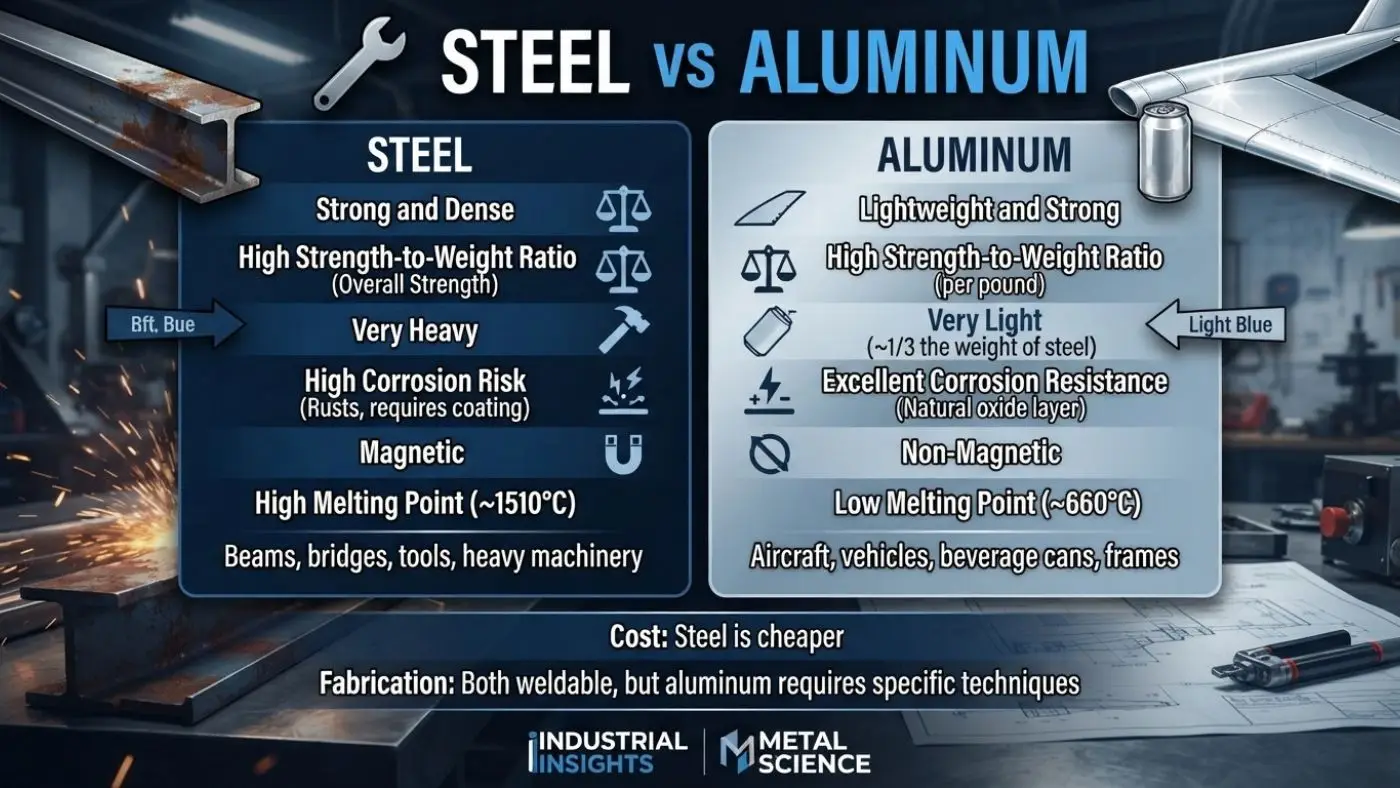
Weight and density are the most obvious differences. Aluminum weighs roughly one-third as much as steel, about 2.7 g/cm 3 compared to steel’s 7.85 g/cm 3. This makes aluminum the go-to choice whenever reducing mass improves performance, fuel efficiency, or handling.
Strength tells a more nuanced story. Steel generally has higher tensile and yield strength by volume, making it the default for heavy structural loads. But aluminum’s strength-to-weight ratio often wins out pound for pound, certain aluminum alloys rival or exceed steel’s performance, which is why aircraft and race cars favor it despite steel’s raw strength advantage.
Stiffness favors steel decisively. Its modulus of elasticity is about three times higher than aluminum’s, meaning steel structures flex and deform less under load critical for applications demanding rigidity.
Fatigue behavior is an often-overlooked factor. Steel has a defined fatigue limit below a certain stress threshold, it can theoretically endure infinite load cycles without failing. Aluminum has no such limit; it will eventually fatigue and fail under repeated stress, no matter how small. This matters enormously in aerospace and automotive design.
Ductility and hardness vary by alloy in both metals, but aluminum is generally easier to form and shape at room temperature, while steel often requires heat treatment to reach comparable workability.
Corrosion Resistance
Corrosion resistance is often the deciding factor in outdoor, marine, or humid environments and here, the two metals behave in fundamentally different ways.
Steel is inherently vulnerable to rust. When exposed to moisture and oxygen, iron in the steel oxidizes, forming iron oxide (rust) that flakes away and progressively weakens the material. Left untreated, ordinary carbon steel can corrode significantly within months in harsh conditions. To combat this, manufacturers rely on protective measures: galvanizing (coating with zinc), painting, powder coating, or upgrading to stainless steel, which contains at least 10.5% chromium to form a passive, corrosion-resistant layer. These treatments add cost and require ongoing maintenance as coatings wear down over time.
Aluminum has a natural advantage: when exposed to air, it immediately forms a thin, tough oxide layer on its surface. Unlike rust, this oxide layer doesn’t flake off; it bonds tightly to the metal and actually protects the layers beneath it from further corrosion. This self-healing property means untreated aluminum can perform well in humid or wet environments for years without additional coatings.
That said, aluminum isn’t invincible. It can suffer from galvanic corrosion when in direct contact with dissimilar metals (like steel) in the presence of moisture, and certain alloys are more prone to pitting in saltwater environments without proper treatment.
Thermal & Electrical Properties
Beyond strength and corrosion, how these metals conduct heat and electricity shapes their use in everything from cookware to power grids.
Thermal conductivity clearly favors aluminum. It conducts heat roughly three to four times faster than steel, making it the preferred choice for applications requiring rapid heat transfer, think heat sinks in electronics, engine components, and cookware. Steel’s slower thermal conductivity actually works in its favor for applications like cast-iron-style cookware or fire-resistant structural elements, where retaining heat evenly matters more than dissipating it quickly.
Electrical conductivity also favors aluminum over steel, though copper remains the top conductor overall. Despite conducting electricity less efficiently than copper, aluminum is widely used in long-distance power transmission lines because its light weight allows for longer spans between towers and lower installation costs; the conductivity trade-off is offset by massive weight savings.
Thermal expansion is an important but often overlooked factor, especially in mixed-material assemblies. Aluminum expands and contracts with temperature changes at roughly twice the rate of steel. When the two metals are joined directly in automotive or construction applications this mismatch can cause stress, warping, or loosened fasteners over time if not properly engineered for.
Behavior at extreme temperatures also differs sharply. Aluminum loses strength rapidly in high heat and has a much lower melting point (~660°C vs steel’s ~1370°C), making it less suitable for fire-prone environments. Conversely, steel maintains better performance in high-heat conditions but can become brittle at very low temperatures, depending on the alloy.
Machinability, Fabrication & Welding
How easily a metal can be cut, shaped, and joined has a direct impact on manufacturing timelines and costs and this is an area where practical experience often outweighs theoretical properties.
Machining favors aluminum in most shop environments. It’s softer and generates less heat during cutting, allowing for faster machining speeds, longer tool life, and lower energy consumption. Steel, being harder and more abrasive, wears down cutting tools faster and often requires slower speeds, specialized tooling, or coolant systems to manage heat buildup especially with high-strength or hardened alloys.
Forming and fabrication also tend to favor aluminum for complex shapes, since many alloys can be bent, stamped, or extruded at room temperature with less springback. Steel often requires heat treatment or annealing to achieve similar formability, particularly for high-strength grades.
Welding is where the gap widens considerably. Steel is generally easier and cheaper to weld using standard methods like MIG or stick welding, and it forgives minor technique inconsistencies reasonably well. Aluminum welding is more technically demanding: it requires TIG welding or specialized MIG setups, shielding gas to prevent oxidation, and precise heat control since aluminum conducts heat away from the weld pool quickly and doesn’t change color as it approaches melting point making it easy to burn through if you’re inexperienced.
Cost Comparison
Cost is rarely a simple line-item comparison; it depends on whether you’re looking at raw material price, total fabrication cost, or long-term lifecycle expenses.
Raw material cost generally favors steel. Per pound, steel is typically cheaper than aluminum, largely because it’s more abundant and less energy-intensive to refine from raw ore. However, when compared by volume rather than weight, the gap narrows since aluminum is roughly one-third the density of steel, you often need less aluminum by weight to achieve the same structural volume.
Fabrication and labor costs can shift the equation. Steel is generally cheaper to weld and fabricate using conventional methods, while aluminum’s specialized welding requirements and machining considerations can add labor costs, potentially offsetting its lighter material weight.
Long-term costs tell a different story. Steel often requires ongoing investment in corrosion protection galvanizing, painting, or coatings plus maintenance as these wear down over time. Aluminum’s natural corrosion resistance can reduce these lifecycle costs, especially in outdoor or marine applications, even if the upfront material cost is higher.
Recycling value favors aluminum significantly. It retains a high scrap value and can be recycled repeatedly with minimal loss of quality, using only about 5% of the energy required for virgin aluminum production. Steel is also highly recyclable, but the process is more energy-intensive and the scrap value per pound is typically lower.
Sustainability & Environmental Impact
As industries face increasing pressure to reduce their environmental footprint, the sustainability profile of steel versus aluminum has become a major factor in material selection.
Production energy intensity clearly favors steel for virgin material. Producing raw aluminum from bauxite ore via the Hall-Héroult electrolysis process is extremely energy-intensive, often cited as requiring roughly three to four times more energy per ton than producing virgin steel. This is why aluminum smelting facilities are frequently located near cheap hydroelectric power sources to offset costs and emissions.
Recycling changes the picture dramatically. Aluminum’s recycling process is remarkably efficient, using only about 5% of the energy required to produce virgin aluminum, with no loss in material quality meaning recycled aluminum performs identically to new aluminum. Steel is also highly recyclable and is, in fact, the most recycled material on the planet by total tonnage, but its recycling process (typically via electric arc furnaces) is more energy-intensive than aluminum’s.
Lifecycle carbon footprint depends heavily on application. In transportation, aluminum’s weight savings can reduce fuel consumption and emissions over a vehicle’s operational lifetime, potentially offsetting its higher production emissions. For static structures like buildings, where weight savings offer no ongoing benefit, steel’s lower production footprint may make it the greener choice.
Industry trends are pushing both metals toward greener production: green steel made using hydrogen instead of coal, and low-carbon aluminum smelted with renewable electricity, are both emerging as manufacturers respond to sustainability demands.
Industry Applications Head-to-Head
Automotive: Steel remains the backbone of vehicle chassis and safety structures, prized for its strength, crash-energy absorption, and low cost. Aluminum has surged in popularity for body panels, hoods, and increasingly full-body construction (like the Ford F-150) and it’s especially dominant in electric vehicles, where every pound saved extends battery range.
Aerospace: Aluminum has long been the aerospace industry’s material of choice, prized for its exceptional strength-to-weight ratio, which directly translates to fuel efficiency and payload capacity. While advanced composites are increasingly competing for this role, aluminum alloys (especially 7000-series) remain essential in aircraft frames, wings, and fuselages.
Construction & Architecture: Steel dominates structural applications beams, columns, and reinforcement where load-bearing strength and cost-efficiency are paramount. Aluminum is favored for window frames, curtain walls, roofing, and architectural cladding, where corrosion resistance, light weight, and design flexibility matter more than raw strength.
Marine: Aluminum is popular for smaller boats, yachts, and high-speed vessels due to its corrosion resistance and light weight, improving speed and fuel efficiency. Steel remains standard for large commercial ships and hulls, where strength and cost-effectiveness at scale outweigh the corrosion-management burden.
Consumer Goods: Aluminum shows up in cookware, laptops, phones, and furniture for its light weight and finish quality. Steel remains common in appliances, tools, and heavy furniture requiring durability.
Pros and Cons Summary
| Factor | Steel | Aluminum |
| Weight | Heavy (~7.85 g/cm³) | Light (~2.7 g/cm³) about ⅓ the weight |
| Strength (by volume) | Higher tensile/yield strength | Lower by volume, but better strength-to-weight |
| Stiffness | High resists flexing well | Lower flexes more under load |
| Fatigue resistance | Has a defined fatigue limit | No fatigue limit will eventually fail under cyclic stress |
| Corrosion resistance | Prone to rust; needs coatings/galvanizing | Naturally forms protective oxide layer |
| Thermal conductivity | Lower | Higher better for heat dissipation |
| Electrical conductivity | Lower | Higher (used in power transmission) |
| Machinability | Slower, more tool wear | Faster, easier to machine |
| Welding | Easier, more forgiving | Requires specialized techniques (TIG, shielding) |
| Raw material cost | Generally cheaper per pound | Generally more expensive per pound |
| Recyclability | Highly recyclable, energy-intensive process | Highly recyclable, very energy-efficient process |
| Melting point | ~1370°C better fire resistance | ~660°C weakens quickly in high heat |
| Common industries | Construction, shipbuilding, heavy machinery | Aerospace, automotive (EVs), consumer electronics |
Quick takeaway:
Steel wins on raw strength, stiffness, cost, and weldability making it the default for heavy structural and load-bearing applications. Aluminum wins on weight savings, corrosion resistance, thermal/electrical conductivity, and machinability making it ideal where reducing mass or resisting environmental wear is the priority.
How to Choose: Decision Framework
With so many trade-offs, choosing between steel and aluminum comes down to asking the right questions about your specific project.
1. What are your load and strength requirements?
If your application involves heavy structural loads, high stiffness, or resistance to repeated cyclic stress over decades (bridges, building frames, heavy machinery), steel’s strength and defined fatigue limit make it the safer choice.
2. Does weight matter for performance?
If reducing mass improves speed, fuel efficiency, handling, or payload capacity as in aerospace, EVs, or portable equipment aluminum’s superior strength-to-weight ratio usually wins.
3. What environment will it face?
For humid, marine, or corrosive environments where low maintenance is a priority, aluminum’s natural oxide layer offers an advantage. If you choose steel for such environments, budget for galvanizing, coating, or stainless-grade upgrades.
4. What’s your budget upfront or lifecycle?
If minimizing initial material and fabrication costs is the priority, steel is typically cheaper. If you’re optimizing for total cost of ownership including maintenance, corrosion protection, and longevity aluminum may pay off despite higher upfront costs.
5. What fabrication capabilities do you have access to?
Steel is easier and cheaper to weld with standard equipment. If your team or supplier lacks specialized aluminum welding expertise (TIG, inert gas shielding), factor in added cost or outsourcing needs.
6. Will it be exposed to extreme heat?
For fire-prone or high-temperature environments, steel’s higher melting point and heat tolerance make it the safer option.
Emerging Trends
The steel-versus-aluminum debate isn’t static; both industries are innovating rapidly to close each other’s gaps and meet evolving demands.
Advanced High-Strength Steels (AHSS) are reshaping the weight conversation. New generations of steel alloys including dual-phase, martensitic, and press-hardened steels offer significantly higher strength than traditional steel at reduced thicknesses, allowing manufacturers to use less material while maintaining structural performance. This has helped steel claw back market share in automotive applications once thought to be aluminum’s exclusive territory.
Next-generation aluminum alloys are also advancing, particularly for EVs and aerospace. New 7000-series and specialty alloys are being engineered for improved strength, better weldability, and enhanced crash performance, addressing some of aluminum’s traditional weaknesses in safety-critical applications.
Hybrid multi-material design is arguably the biggest shift in modern manufacturing. Rather than choosing one metal exclusively, automakers and engineers increasingly combine steel and aluminum within the same structure using steel for high-stress safety zones (like vehicle crash cages) and aluminum for weight-sensitive panels and components. This requires solving new engineering challenges, particularly around galvanic corrosion and joining dissimilar metals, but it allows designers to capture the best properties of both materials simultaneously.
Green production methods are accelerating on both sides. Hydrogen-based green steel and renewable-powered low-carbon aluminum smelting are moving from pilot projects to commercial scale, driven by regulatory pressure and corporate sustainability commitments meaning the environmental calculus between these two metals will likely keep shifting in the coming years.
Frequently Asked Questions
Is aluminum stronger than steel?
Not by volume steel has higher tensile and yield strength pound-for-pound of material. However, aluminum has a better strength-to-weight ratio, meaning it can match steel’s performance in weight-sensitive applications using less mass.
Which is lighter, aluminum or steel?
Aluminum is significantly lighter, roughly one-third the density of steel (2.7 g/cm 3 vs 7.85 g/cm 3).
Does aluminum rust like steel?
No. Aluminum doesn’t rust because it lacks iron. Instead, it forms a thin, protective oxide layer when exposed to air, which prevents further corrosion. Steel rusts unless treated with coatings, galvanizing, or alloyed into stainless steel.
Why is aluminum used instead of steel in cars and planes?
Primarily for weight savings. Lighter materials improve fuel efficiency, extend EV battery range, and increase payload capacity critical in automotive and aerospace design.
Is steel or aluminum better for outdoor use?
Aluminum generally requires less maintenance outdoors due to its natural corrosion resistance. Steel can perform just as well outdoors but typically needs protective coatings or must be upgraded to stainless steel.
Is aluminum cheaper than steel?
No steel is usually cheaper per pound as a raw material. Aluminum can become more cost-effective over a product’s lifecycle due to lower maintenance and corrosion-protection needs.
Final Takeaway:
Steel and aluminum each excel where the other falls short. Steel offers superior strength, stiffness, weldability, and lower upfront cost ideal for heavy structural and load-bearing work.
Aluminum delivers a better strength-to-weight ratio, natural corrosion resistance, and easier machining perfect where weight savings and low maintenance matter most.
There’s no universal winner; the right choice depends on your load requirements, environment, budget, and fabrication capabilities.
When in doubt, consult a materials engineer to match the metal’s properties precisely to your project’s real-world demands.