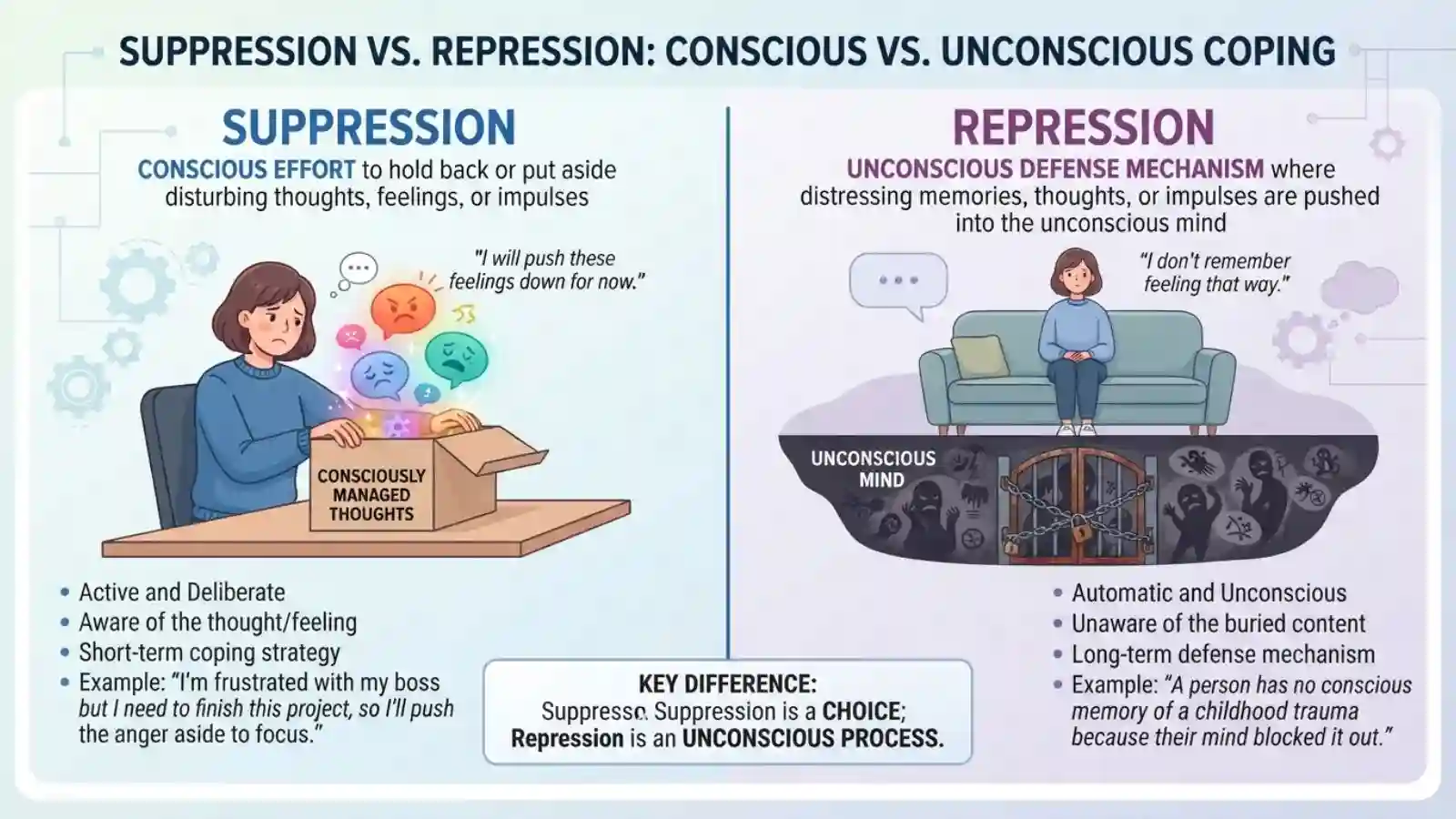
Suppression vs Repression mainly differs in awareness. Suppression is generally described as a conscious decision to push an unwanted thought, feeling, or memory aside.
Repression traditionally refers to an unconscious process that keeps distressing mental content outside conscious awareness.
However, psychologists have debated how clearly these processes can be separated.
Key Takeaways:
- Suppression is usually conscious: You know a thought or emotion is present but deliberately set it aside.
- Repression is traditionally unconscious: The unwanted material is kept outside conscious awareness without deliberate intent.
- Both concepts are associated with managing uncomfortable thoughts, feelings, or impulses.
- Thought suppression can sometimes produce a rebound effect, although research findings are not completely uniform.
- “Repressed memory” is a controversial concept, so forgetting a traumatic event should not automatically be interpreted as proof of repression.
What Is Suppression in Psychology?
Suppression is generally understood as a conscious mental process. You recognize a thought, feeling, memory, or impulse but intentionally decide not to focus on it.
For example, imagine that you receive an upsetting email shortly before an important work presentation. You are angry, but you tell yourself, “I will deal with this after the presentation.”
You have not forgotten the anger. You are aware of it and have deliberately chosen to put it aside temporarily.
This is the basic idea behind suppression.
Suppression can sometimes serve a practical purpose. People may temporarily put emotions aside so they can concentrate, handle an emergency, finish an important task, or avoid reacting impulsively.
The important point is awareness. You know the unwanted thought or emotion exists.
How Suppression Works
Suppression involves directing attention away from something you do not want to think about at that moment.
You might:
- Stop thinking about an argument until later.
- Avoid dwelling on an embarrassing mistake.
- Hold back anger during a professional conversation.
- Put worries aside while completing an urgent task.
- Choose not to discuss a painful subject until you feel prepared.
This does not necessarily mean the emotion has disappeared. Instead, you are intentionally controlling your attention or expression.
Example of Suppression
“I am upset about what happened, but I need to finish this meeting first.”
That is a straightforward example of conscious suppression because the person knows what they are feeling and intentionally postpones dealing with it.
What Is Repression in Psychology?
Repression has traditionally been described as an unconscious defense mechanism in which distressing thoughts, feelings, memories, or impulses are kept outside conscious awareness.
The concept has strong roots in psychoanalytic theory. The APA Dictionary of Psychology describes repression in classical psychoanalytic theory as excluding painful experiences and unacceptable impulses from consciousness as a protection against anxiety.
Unlike suppression, the traditional concept of repression does not involve a deliberate decision such as, “I do not want to think about this.”
Instead, the person is not consciously choosing to block the material.
How Repression Works
A simplified example would be someone experiencing an internal conflict that they find extremely difficult to tolerate. According to traditional psychoanalytic theory, the mind may keep aspects of that conflict outside conscious awareness.
The person may therefore experience an emotional reaction without clearly understanding where it comes from.
However, it is important not to treat every unexplained feeling, memory gap, or avoidance behavior as evidence of repression. Modern psychology has debated the mechanisms behind repression, particularly when the concept is used to explain forgotten traumatic memories.
Example of Repression
A traditional theoretical example might involve a person having an unwanted memory or impulse that is inaccessible to conscious awareness, while related feelings or behaviors remain noticeable.
The key feature is not simply that the person avoids the subject. It is that the material is described as being outside conscious awareness.
Suppression vs Repression: Key Differences
The easiest way to understand suppression vs repression is to compare awareness and intention.
| Feature | Suppression | Repression |
| Awareness | Usually conscious | Traditionally unconscious |
| Intention | Deliberate | Involuntary |
| Recognition | Person knows the thought or feeling exists | Person may not recognize the underlying material |
| Control | Intentionally puts something aside | Not consciously chosen |
| Typical example | “I will deal with this later.” | Distressing material remains outside awareness |
| Main theoretical context | Emotion and thought regulation | Psychoanalytic defense |
The distinction is useful, but it should not be treated as an absolute scientific dividing line. Researchers have pointed out that definitions of consciousness and unconsciousness can be complicated, and some psychological theories do not use the terms in exactly the same way.
Conscious vs. Unconscious
This is the most commonly taught difference.
Suppression:
“I know I am angry, but I am choosing not to think about it right now.”
Repression:
“I am not consciously aware of the underlying thought, feeling, or memory that is being kept outside awareness.”
Voluntary vs. Involuntary
Suppression requires some degree of deliberate mental control.
Repression, in its traditional definition, happens without conscious intention.
That difference explains why someone can usually say what they are suppressing but may not be able to identify something they supposedly repress.
Thoughts, Emotions, and Memories
Both concepts can be discussed in relation to thoughts and emotions, but memory creates additional complexity.
Someone can consciously avoid thinking about an unpleasant memory. That is suppression.
A claim that a memory was completely inaccessible because of an unconscious psychological process falls into the more controversial territory of repression and repressed memories.
Examples of Suppression vs Repression
Consider these situations:
Suppression:
You are angry with a coworker but decide not to address the issue until you have calmed down.
Suppression:
You keep thinking about an embarrassing conversation, then deliberately redirect your attention to another activity.
Traditional example of repression:
A person has no conscious access to a psychologically threatening experience or impulse, even though the concept proposes that it remains outside awareness.
The difference is therefore not simply how strong the emotion is. It is primarily about how awareness and mental control are understood.
What Happens When You Suppress Thoughts or Emotions?
Putting an emotion aside does not necessarily cause a problem. Sometimes temporary emotional control is useful.
However, deliberately trying not to think about something can sometimes have an unexpected effect.
Classic research by Daniel Wegner and colleagues found that attempts to suppress a particular thought could produce a later rebound in which the thought returned more frequently.
Other experiments have also reported delayed increases in thoughts after suppression.
This does not mean that every suppressed emotion will inevitably come back stronger. Research has identified differences between people and situations, and the rebound effect has not appeared consistently in every study.
A more practical lesson is that repeatedly trying to force an unwanted thought completely out of your mind may not always work as intended.
Are Repressed Memories Real?
This is one of the most important areas where careful wording matters.
The idea of a repressed memory suggests that a traumatic or otherwise distressing memory can become inaccessible through an unconscious psychological process and later return to awareness.
This concept has been extensively debated in psychology.
Research shows that people can forget experiences and later remember them. However, remembering something later does not by itself prove that the memory was previously repressed. Researchers have identified several possible explanations for apparently recovered memories, including ordinary forgetting, changes in retrieval, dissociation, and false-memory processes.
The APA also notes that recovered memories are a controversial subject, particularly when memories of childhood abuse emerge after a period of apparent unavailability.
Research has additionally demonstrated that memories can be influenced by suggestion and that people can sometimes develop compelling false memories.
Therefore, it is not scientifically sound to assume that an unexplained memory gap automatically means a traumatic memory was repressed.
Suppression, Repression, and Denial: Are They the Same?
No. Although the terms can overlap in everyday conversation, they describe different ideas.
Suppression involves consciously putting a thought or feeling aside.
Repression traditionally involves keeping unwanted mental content outside conscious awareness.
Denial generally involves refusing to accept or acknowledge some aspect of reality.
For example, someone might know that they received bad news but insist that it is not serious. That is different from consciously deciding not to think about the news for an hour.
Understanding these differences prevents several psychological terms from being used interchangeably.
How to Respond to Difficult Thoughts and Emotions
Not every uncomfortable emotion needs to be dealt with immediately. Sometimes taking a temporary break is reasonable.
A useful distinction is whether you are choosing to postpone something or whether you feel unable to understand or access what is happening.
If a difficult thought keeps returning, causes significant distress, interferes with daily life, or relates to a traumatic experience, discussing it with a qualified mental health professional can provide a safer way to understand it.
It is also important to avoid trying to force yourself to uncover a supposed “repressed memory.” Memory is reconstructive, and research shows that suggestion can influence recollection.
Frequently Asked Questions
Is suppression conscious or unconscious?
Suppression is generally described as conscious and intentional. You are aware of the thought, feeling, or memory but deliberately choose to put it aside. For example, you may recognize that you are angry but decide to postpone discussing the issue until you have calmed down.
Is repression a defense mechanism?
Yes. In classical psychoanalytic theory, repression is a defense mechanism that keeps distressing experiences, impulses, or feelings outside conscious awareness. The exact meaning and scientific status of repression have been debated, so modern discussions should distinguish traditional theory from contemporary research.
Can emotions be repressed?
The term repressed emotions is commonly used to describe feelings that are believed to remain outside conscious awareness. In psychological literature, however, repression has different definitions across theoretical traditions. Feeling emotionally numb or having difficulty identifying an emotion does not automatically prove that the emotion has been repressed.
Can a repressed memory be recovered?
People can remember previously inaccessible or forgotten experiences, but a later-recalled memory is not automatically proof of psychological repression. Research has identified multiple explanations for recovered memories, and memory can also be affected by suggestion.
Conclusion:
The main difference between Suppression vs Repression is traditionally based on awareness.
Suppression is generally conscious: you know a thought or emotion is present and intentionally set it aside.
Repression is traditionally unconscious: unwanted mental material is kept outside conscious awareness without deliberate choice.
The distinction is useful, but psychology does not treat every aspect of repression as settled science.
In particular, claims about repressed and recovered traumatic memories remain a complex and debated area of memory research.
For everyday situations, the simplest rule is: suppression means consciously putting something aside; repression traditionally means something is kept outside awareness without conscious intention.