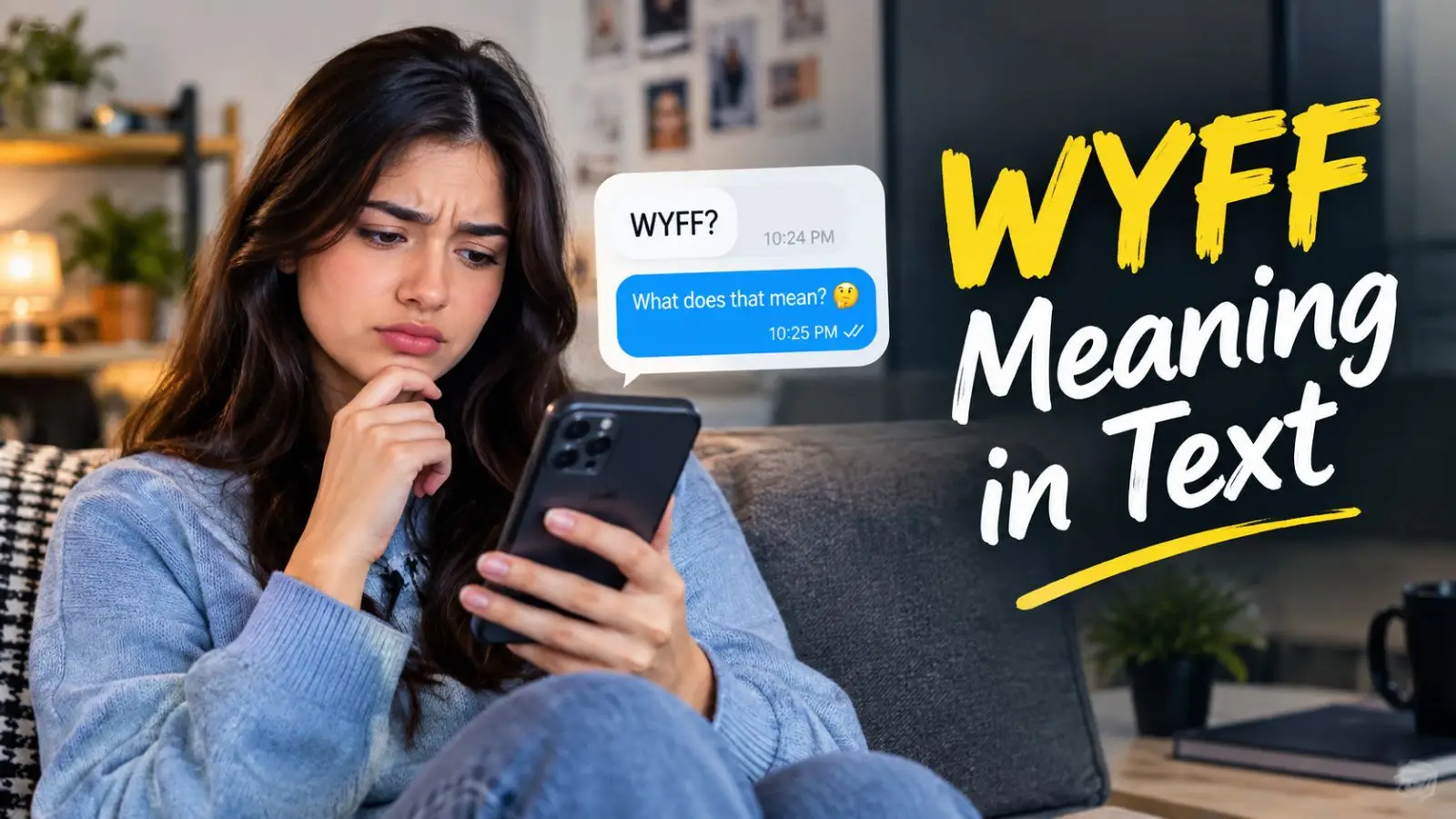
You’re scrolling through a text or a comment section, and there it is: WYFF. No context, no explanation, just three letters (well, four) staring back at you, and suddenly you’re wondering if you’re being complimented, called out, or asked something entirely different.
Here’s the thing about WYFF: unlike more established texting slang, it doesn’t have one universal meaning.
Depending on who sent it, the platform you’re on, and the tone of the conversation, WYFF could be short for “why you frontin’?” (calling out fake or boastful behavior), a casual stylized spelling of “wife,” or even a typo-turned-variant of the more common “WYF” (“where you from?”).
Confusing? Absolutely. But by the end of this guide, you’ll know exactly how to decode WYFF in any conversation and how to respond without missing the intended tone.
What Does WYFF Stand For?
Unlike acronyms with a single fixed meaning, WYFF shifts depending on context. Here are the most common interpretations you’ll come across.
1. “Why You Frontin’?”
This is the most widely recognized meaning, rooted in African American Vernacular English (AAVE). “Frontin'” means putting on a fake persona, acting tougher, richer, or more confident than you really are. So “why you frontin’?” is a direct call-out to someone questioning why you’re being insincere or putting up a front. This usage has strong ties to hip-hop culture, where the phrase has appeared in lyrics for decades before making its way into everyday texting.
2. A Stylized Spelling of “Wife”
In romantic or flirty exchanges, WYFF can simply be a playful, phonetic way of typing “wife.” Some people type quickly or lean into regional pronunciation, turning “wife” into “wyff.” In this context, it often signals playful long-term intentions, an inside joke between partners, or flirtatious banter rather than anything confrontational.
3. A Variant or Typo of “WYF”
“WYF” (Where You From?) is a far more established piece of texting slang. Because WYFF looks so similar, it’s sometimes just a typo, an extra letter added out of habit, or a regional variation of the same question.
4. Niche or Group-Specific Uses
In smaller communities or group chats, WYFF might function as initials for a name, an inside reference, or shorthand unique to that friend group meanings you’d only catch with full conversation context.
Origins and History
To understand WYFF, it helps to trace where its different meanings actually came from because each interpretation has its own backstory.
The “why you frontin’?” meaning has the deepest roots. “Frontin'” emerged from African American Vernacular English (AAVE) and became widely popularized through hip-hop music starting in the late 1990s and early 2000s. Rappers used the phrase to call out rivals, skeptics, or anyone perceived as putting on a fake image for status or attention. Over the following decades, the phrase moved from song lyrics into everyday conversation, eventually getting compressed into the acronym WYFF as texting and social media made shorthand the norm.
The “wife” interpretation has a much more organic, informal origin. It isn’t tied to any single cultural moment; instead, it reflects a broader trend of phonetic spelling in casual texting, where words get typed the way they sound rather than how they’re formally spelled. “Wife” becoming “wyff” fits a pattern seen across other slang terms shaped by fast typing and regional pronunciation.
Meanwhile, WYFF’s resemblance to “WYF” (“where you from?”) suggests a simpler explanation for some appearances of the term: letter doubling is a common quirk in internet slang, whether from typos, autocorrect, or people mimicking how a word “feels” when typed quickly.
How to Tell Which Meaning Is Intended
Since WYFF doesn’t have one fixed definition, the real skill isn’t memorizing meanings, it’s reading context. Here’s what to look at before you respond.
1. Tone of the Conversation
Is the exchange playful and warm, or does it feel pointed and confrontational? A sharp, challenging tone usually signals the “why you frontin’?” meaning. A soft, affectionate tone points toward the “wife” interpretation.
2. Who Sent It
Consider your relationship with the sender. A romantic partner or someone you’re flirting with is far more likely using WYFF as a cute nod to “wife.” A friend, acquaintance, or someone calling you out about behavior is more likely using the confrontational meaning.
3. The Platform
Context shifts by app. On dating apps or in flirty DMs, WYFF leans romantic. In group chats or comment sections, especially ones involving debates, callouts, or social dynamics, it’s more likely tied to “frontin’.”
4. What Came Before and After
Look at the surrounding messages. If the conversation involves someone showing off, exaggerating, or acting differently than usual, WYFF is likely a callout. If it follows compliments, inside jokes, or relationship talk, it’s probably affectionate.
5. When All Else Fails, Ask
If you genuinely can’t tell, there’s no shame in asking directly “wait, what do you mean by that?” It’s far better than responding based on the wrong interpretation.
Example Conversations
Seeing WYFF in action makes it much easier to recognize which meaning applies. Here are three realistic examples.
Example 1: “Why You Frontin’?” (Callout)
Jay: yo I heard you told everyone you ran the whole event by yourself
Mia: lol wyff, you know the whole team worked on that
Jay: my bad, didn’t mean to make it sound like that
Here, WYFF is used to challenge an exaggeration, a lighthearted but direct call-out.
Example 2: “Wife” (Flirty/Romantic)
Sam: can’t wait for you to meet my parents this weekend
Alex: wyff behavior fr 😭
Sam: stop 😂 but yeah kind of
In this exchange, WYFF is a playful nod to long-term relationship energy, not an accusation of anything.
Example 3: “Where You From?” (Variant/Typo)
Stranger: Hey! saw you liked the same show as me
You: yeah it’s so good! wyff?
Stranger: I’m from Austin, you?
Here, WYFF is simply a stretched-out version of “WYF,” used as an icebreaker question.
Example 4: Group Chat Shorthand
Group Chat: wyff coming to game night or nah
Friend: who’s wyff lol
Original sender: oh sorry, autocorrect meant “who”
How to Respond to WYFF
Once you’ve figured out which meaning fits the conversation, responding becomes much easier. Here’s how to handle each scenario.
If It’s a Callout (“Why You Frontin’?”)
If someone uses WYFF to challenge you, stay lighthearted unless the conversation feels genuinely tense. A simple acknowledgment works well:
- “Lol my bad, I was exaggerating a bit”
- “Nah for real though, here’s what actually happened…”
If it feels more serious or accusatory, it’s worth clarifying calmly rather than getting defensive. Most callouts like this are meant to keep things honest, not start a fight.
If It’s Flirty (“Wife” Reference)
When WYFF shows up as a playful nod to a relationship, match the tone. You don’t need to overanalyze it a light, teasing response keeps the moment fun:
- “Lol stop 😭”
- “Wyff behavior confirmed”
- Simply continuing the conversation naturally, since the comment is usually more about vibe than a literal statement
If It’s a “Where You From?” Variant
Treat it like any icebreaker question answer directly and, if you want to keep the conversation going, ask something back:
- “I’m from [city], you?”
If You’re Not Sure
When context doesn’t make the meaning obvious, it’s okay to ask directly:
- “Wait what do you mean by wyff lol”
Related Slang & Acronyms
WYFF doesn’t exist in isolation; it’s part of a broader family of texting acronyms built around quick, casual questions and callouts. Knowing these related terms makes it easier to spot patterns and avoid mixing them up.
WYF “Where You From?”
The most direct relative of WYFF. Widely used as a casual icebreaker on social media and dating apps.
WYD “What Are You Doing?”
A common check-in text, often used to start a conversation or see if someone’s free.
WYA “Where You At?”
Used to ask about someone’s current location, often in a “let’s meet up” context.
WBU “What About You?”
A follow-up question after answering something yourself, keeping the conversation balanced.
TBH “To Be Honest”
Used to preface a candid or blunt statement, sometimes paired with callout-style messages similar to WYFF’s “frontin'” meaning.
Frontin’ / Fronting
Not an acronym, but the root phrase behind one of WYFF’s main meanings calling someone out for acting fake or exaggerating.
Quick Comparison Table
| Acronym | Common Meaning |
| WYFF | Context-dependent: “why you frontin’?”, stylized “wife,” or a WYF variant |
| WYF | Where are you from? |
| WYD | What are you doing? |
| WYA | Where are you at? |
| WBU | What about you? |
Common Misunderstandings & Mistakes
Because WYFF carries multiple meanings, it’s easy to misread and a few recurring mix-ups trip people up more than others.
1. Confusing WYFF with WYF
Since the two acronyms look nearly identical, people often assume WYFF is just a typo for “where are you from?” even when the sender actually means “why you frontin’?” This mix-up can lead to a mismatched response, like answering a hometown question when someone was actually calling you out.
2. Misreading Tone
Text lacks vocal inflection, so WYFF used as a lighthearted callout can come across as more aggressive than intended or vice versa. Someone might read “wyff” as a serious accusation when it was meant as a joke among friends, or read it as playful when the sender was genuinely annoyed.
3. Assuming It’s Always Romantic
Because the “wife” interpretation has become popular in flirty texting, some readers automatically assume WYFF is romantic in any context. This can create awkward misunderstandings if the term was actually meant as a callout or an icebreaker question.
4. Overanalyzing a Simple Typo
Not every instance of WYFF carries deep meaning. Sometimes it really is just an autocorrect slip or an extra letter added out of habit while typing “WYF” quickly. Reading too much into it can create confusion where none was intended.
5. Not Asking for Clarification
When context genuinely doesn’t make the meaning clear, guessing wrong is more common than people expect. A quick clarifying question almost always beats assuming.
Regional and Generational Usage
Like most internet slang, WYFF isn’t used uniformly across all groups; its meaning and popularity shift depending on age, platform, and cultural background.
Generational Differences
WYFF is most common among younger texters primarily Gen Z and younger Millennials who are accustomed to fast-paced, abbreviation-heavy communication. Older generations are less likely to use or recognize the term at all, and when they do encounter it, they’re more likely to interpret it literally (as a typo) rather than as intentional slang.
Platform-Based Trends
- TikTok and Instagram: WYFF appears frequently in comment sections, often tied to the “frontin'” callout meaning, especially in reaction to viral posts or debates.
- Dating Apps: The “wife” interpretation shows up more often here, used playfully to signal romantic interest or long-term compatibility.
- Group Texts and Close Friend Chats: WYFF is more likely to appear as shorthand specific to that group, sometimes disconnected from any of the “official” meanings.
Cultural and Linguistic Roots
The “why you frontin’?” meaning is closely tied to African American Vernacular English (AAVE) and hip-hop culture, and its usage often reflects that linguistic lineage, even as the term spreads into broader, more general online slang. Meanwhile, the “wife” and “WYF” variants are less culturally specific and instead reflect general trends in phonetic spelling and letter-doubling common across internet slang as a whole.
Frequently Asked Questions
Is WYFF the same as WYF?
Not exactly. WYF almost always means “where are you from?” WYFF looks similar but more often carries a different meaning, usually “why you frontin’?” or a stylized version of “wife.” Sometimes WYFF is simply a typo of WYF, but it shouldn’t be assumed automatically.
Is WYFF flirty or aggressive?
It depends entirely on context. Used between friends or in a callout-style message, it can feel confrontational. Used in a romantic or flirty exchange, it’s typically playful and affectionate. The same four letters can carry very different emotional weight depending on the conversation.
Where did WYFF come from?
Its most established meaning, “why you frontin’?”, traces back to AAVE and hip-hop culture. The “wife” interpretation likely developed separately, as part of a broader trend of phonetic, casual spelling in texting.
Will WYFF still be used in 2026?
Yes, though usage remains inconsistent and largely dependent on age group, platform, and region. It hasn’t become as standardized as terms like WYD or WYA, so it’s more likely to show up in specific communities than universally.
Should I ask what someone means if I’m unsure?
Absolutely. Since WYFF has multiple valid interpretations, asking for clarification is a normal and low-stakes way to avoid misreading the message.
Conclusion:
WYFF doesn’t have one fixed meaning and that’s exactly the point. Depending on the sender, platform, and tone, it could be a playful callout (“why you frontin’?”), a flirty nod to “wife,” or simply a stretched-out version of “where are you from?”
Rather than guessing, the best approach is reading context: who sent it, how the conversation has gone, and what platform you’re on. And when in doubt, asking for clarification beats misreading the message entirely.
Slang like this evolves fast, so don’t be surprised if WYFF picks up new meanings down the line. For now, context is your best decoder.