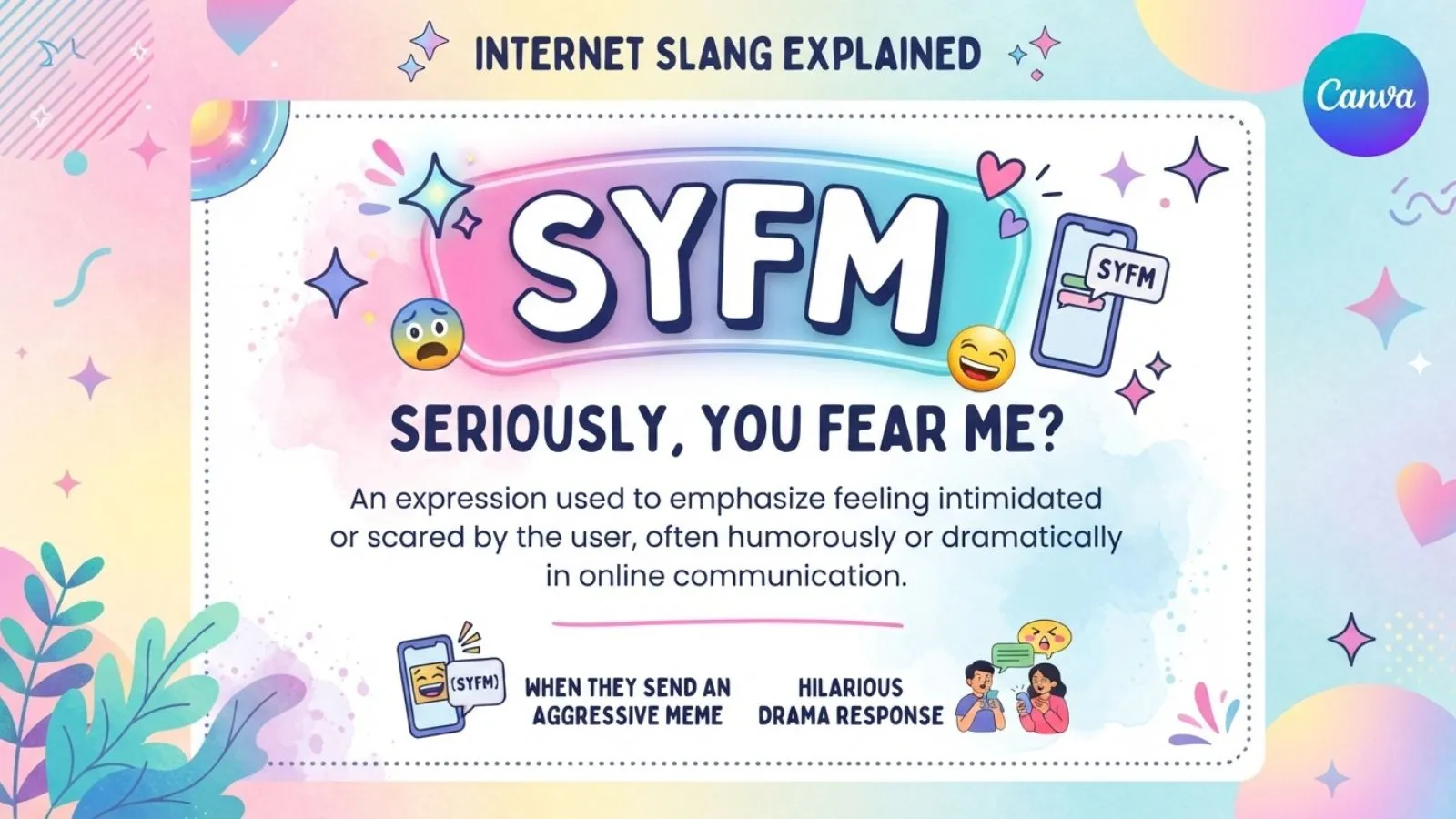
If you’ve scrolled through TikTok, a group chat, or the comments section lately, chances are you’ve run into the letters SYFM and wondered what on earth they mean.
Unlike wholesome classics like LOL or BRB, this one isn’t as innocent as it looks. SYFM is blunt, a little crude, and has exploded across TikTok and texting culture thanks to a viral meme moment.
So what does SYFM actually stand for? In short: it’s short for Shut Your F***ing Mouth a rude, no-nonsense way of telling someone to stop talking.
But like most internet slang, the letters alone don’t tell the whole story. Where it came from, how people actually use it, and whether it’s meant as a joke or an insult all depend on context.
In this guide, we’ll break down the full meaning, origin, and etiquette around using SYFM so you’re never left guessing again.
What Does SYFM Stand For?
At its core, SYFM is an initialism meaning each letter stands for a word rather than the acronym being pronounced as its own word. The full phrase is Shut Your F***ing Mouth, and it’s classified as internet slang and text-messaging slang, specifically flagged as vulgar, an initialism of shut your fucking mouth. wiktionary
Unlike acronyms that express a feeling or reaction (think SMH for shaking my head or LOL for laughing out loud), SYFM is a command. It’s not describing how someone feels it’s telling someone else to do something, specifically, to stop talking. That distinction matters, because it changes how the phrase functions in a conversation. Where SMH might just punctuate a reaction, SYFM is directed at a person and demands a response (or silence).
It’s also worth noting that SYFM isn’t a polished or safe term for work. It carries real profanity baked into its expansion, which is part of why it reads as aggressive or edgy depending on who’s using it and why. This is different from mild slang that’s crossed fully into mainstream, casual use SYFM still carries some bite, even when it’s used jokingly.
Origin of the Term
SYFM didn’t emerge in a vacuum; it can be traced back to a specific pop-culture reference. The phrase Shut your f–king mouth! is a line delivered by Charles Bronson in the film Bronson, and that exact line is what eventually got repurposed into internet slang.
The real viral spark, though, came from TikTok. A video originally posted by user @morphelius.wetness featured a kid on stage talking about his dad being old, joking that his father was the one with the naturally black hair, even though he’s 50. A meme creator then dubbed in audio of a voice yelling Shut your f–king mouth back at the kid, as if his own dad was heckling him from the audience. The dubbed line was not the real father’s voice, but the mismatch between the innocent kid comedy and the sudden aggressive audio clip is exactly what made it funny and shareable.
From there, other TikTok creators began reusing the same audio and phrase format in their own videos, applying it to unrelated clips for comedic effect. One creator, @cal3xyt, even made a video specifically joking about the evolution of slang, asking how the internet went from using SYBAU to SYFM showing that users themselves were aware they were watching a new slang term take shape in real time.
How SYFM Went Viral on TikTok
Once the original dubbed audio clip started circulating, it followed a familiar pattern for TikTok trends: creators didn’t just watch the video, they remixed it. The father checking his son’s audio became a reusable sound effect, and people began layering it over completely unrelated clips anytime a video needed a sudden, comedic shut up moment, the SYFM audio was there to deliver it.
Captions played a big role in how the meme spread, too. One widely shared version of the original video was captioned Bro’s dad was having none of that, paired with a dead rose emoji, which set the tone: humorous, exaggerated disapproval rather than genuine anger. That framing helped the meme travel fast, since viewers understood it as playful rather than mean-spirited.
SYFM also didn’t spread in isolation. It emerged alongside a cluster of similar slang acronyms that were going viral around the same time, including TS, PMO, and ICL all part of what’s been described as a slang overload trend. Many of these terms, SYFM included, draw from African American Vernacular English (AAVE), a pattern that’s been noted (and criticized) as part of how internet slang trends tend to spread and get flattened into meme format.
SYFM vs. Similar Slang (SYBAU, STFU, and More)
Because SYFM shares its rough meaning and vulgar tone with a handful of other slang terms, it’s easy to mix them up. Here’s how the main ones compare:
| Slang | Full Meaning | Typical Tone |
| SYFM | Shut Your F***ing Mouth | Harsh, blunt, command |
| SYBAU | Shut Your Bitch Ass Up | Very similar, slightly more aggressive phrasing |
| STFU | Shut The F*** Up | Older, more mainstream, slightly less meme-coded |
| IDGAF | I Don’t Give A F*** | Dismissive, not a command to silence someone |
SYBAU is the closest relative to SYFM, both in meaning and in internet history in fact, one of the memes that helped SYFM spread was itself a joke about the transition from SYBAU to SYFM, with creators poking fun at how quickly this kind of slang mutates and gets replaced.
STFU, by contrast, predates the recent TikTok slang wave by years and has become common enough that it barely registers as internet slang anymore; it shows up in everyday texting, gaming chats, and casual conversation without much shock value. SYFM, being newer and more tied to a specific meme, still carries a bit more of that meme-y, of-the-moment energy.
IDGAF is worth including for contrast: it sounds similar in vulgarity level, but it’s not a command at all; it expresses indifference rather than telling someone to be quiet, which is a meaningfully different function in conversation.
Tone and Context: How to Read SYFM
Like most slang, SYFM doesn’t have one fixed emotional temperature; the same four letters can read as a joke or as a genuine insult, depending entirely on who’s saying it, who it’s said to, and what surrounds it.
Punctuation and emojis do a lot of the interpretive work here. A message like Haha SYFM, you always roast me reads as clearly playful the laughter and the follow-up compliment-in-disguise softens what would otherwise be a harsh phrase. Compare that to a blunt, standalone SYFM with no punctuation, no emoji, and no other context: that version reads as genuine frustration or anger, precisely because there’s nothing there to cushion it.
Context of the relationship matters just as much as the message itself. Among close friends, SYFM often functions as a way of teasing someone in the same spirit as shut up said with affection rather than hostility. In a group chat reacting to unexpected gossip or a plot twist, it can appear as a shocked, almost celebratory reaction (Wait SYFM, she actually said that?) rather than a command at all. In gaming chats, it frequently shows up as competitive trash talk, tossed around after a lucky play or a clutch moment.
Is SYFM Offensive?
Yes at a baseline level, SYFM is offensive, simply because it contains profanity at its core and functions as a command telling someone to stop talking. That’s fundamentally different from slang that’s mild enough to use anywhere, like LOL or BRB. SYFM carries real bite even in its most casual form.
That said, offense isn’t the same as always being hurt. Context does a lot of the work in determining how offensive it actually lands. Between close friends with an established pattern of teasing each other, SYFM can function more like an inside joke than a genuine insult; the vulgarity is part of the humor, not the point of it. The same word, sent between strangers or during an actual disagreement, carries none of that cushioning and reads as a direct, hostile jab.
Age and platform matter too. Because SYFM spread heavily through TikTok’s youth-skewing audience, a lot of its casual, joking usage comes from teens and young adults who’ve absorbed it as background meme vocabulary rather than a serious insult. That doesn’t make it appropriate everywhere, though outside of casual peer group texting, gaming chats, and social platforms, it’s not a term that translates well.
In professional settings, formal writing, or conversations with people you don’t know well, SYFM is best avoided entirely. If in doubt about how a message will land, it’s generally safer to reach for a calmer, clearer way of asking someone to stop talking rather than risk the term being read as a genuine insult.
How to Respond to SYFM
How you respond to SYFM largely depends on the reading you get from the context clues covering earlier tone, punctuation, relationship, and platform all shape whether this is a moment to laugh along or a moment to address something real.
If the message clearly reads as joking, paired with a laughing emoji, comes from a close friend, or fits the pattern of playful group-chat banter, the easiest response is usually to play along. Matching the energy with a laugh, a joking comeback, or simply continuing the conversation as normal signals that you got the joke and aren’t rattled by it. Overreacting to a clearly playful SYFM can come across as not being able to take a joke, which tends to escalate things unnecessarily.
If the tone is more ambiguous, it’s worth asking directly rather than guessing. A simple wait, are you actually mad? or similar check-in can clear up confusion faster than trying to read intent from four letters alone.
If SYFM shows up in a genuinely hostile context a heated argument, an unprovoked insult, or part of a pattern of disrespect it’s reasonable to address it directly rather than brushing it off. Calling out the tone (that’s a pretty aggressive way to put that) or simply disengaging from the conversation are both valid options. If it’s part of repeated harassment or bullying rather than a one-off comment, that’s a situation worth taking seriously and, if needed, addressing with the platform or a trusted adult.
Common Misconceptions
Because SYFM is a relatively new slang term, a lot of low-quality content online has rushed to explain it, often getting the meaning completely wrong. If you search for SYFM, you may come across claims that it stands for things like Same You, For Me, See You for More, or even oddly specific expansions like Sy-flesh-flesh-my. Some of these sources go as far as suggesting SYFM is a warm, friendly sign-off similar to see you soon, or that it’s appropriate to use in professional emails.
These definitions don’t hold up. They aren’t tied to any real usage, meme history, or verifiable source they read as content generated to fill a page rather than to accurately describe how people actually use the term. None of them account for the term’s clear origin in a movie quote and TikTok meme, and none of them match how SYFM actually shows up in real chats, comments, and videos.
The reliable, well-documented meaning Shut Your F***ing Mouth is backed by its own dictionary-style entry classifying it as vulgar internet and text-messaging slang, plus a clearly traceable viral origin story involving a specific TikTok video and audio clip.
FAQs
What does SYFM mean in a text?
SYFM stands for Shut Your F***ing Mouth. It’s a blunt, vulgar way of telling someone to stop talking, and it’s officially classified as internet slang and text-messaging slang.
Is SYFM the same as SYBAU?
They’re closely related but not identical. SYBAU stands for Shut Your Bitch Ass Up, while SYFM stands for Shut Your F***ing Mouth. Both carry a similarly aggressive tone, and SYFM is often seen as the successor to SYBAU in meme culture; one popular TikTok even joked directly about that shift.
Where did SYFM come from?
The phrase traces back to a line delivered by Charles Bronson in the film Bronson. It went viral after a TikTok creator dubbed audio of the line over a video of a kid on stage joking about his dad, making it sound like his father was heckling him from the audience.
Is it okay to use SYFM with friends?
Generally yes, among close friends who understand it’s being used jokingly especially when softened with emojis, laughter, or an obviously playful context. It’s best avoided with strangers, in professional settings, or in genuinely tense conversations, where it’s more likely to be read as a real insult.
Is SYFM appropriate for all ages?
No. Because it contains profanity at its core, SYFM isn’t considered appropriate for formal writing, younger audiences, or professional communication, regardless of how casually it’s used online.
Conclusion:
SYFM might look like a random string of letters the first time you see it, but its meaning is direct: Shut Your F***ing Mouth, born from a Charles Bronson movie line and turned viral through a TikTok meme.
If it reads as a joke or an insult comes down entirely to context the relationship, the platform, and the tone surrounding it.
Among friends, it’s often harmless banter; between strangers or in a real argument, it carries genuine hostility.
When in doubt, read the room before using it, and skip it entirely in professional or unfamiliar settings.

I’m Maya Angelou, the creator behind EmojiAura.com, where I explore emoji meanings, social media trends, and fun digital expressions. I’m passionate about helping people understand the real meaning behind emojis and use them creatively in chats, captions, posts, and everyday online conversations.