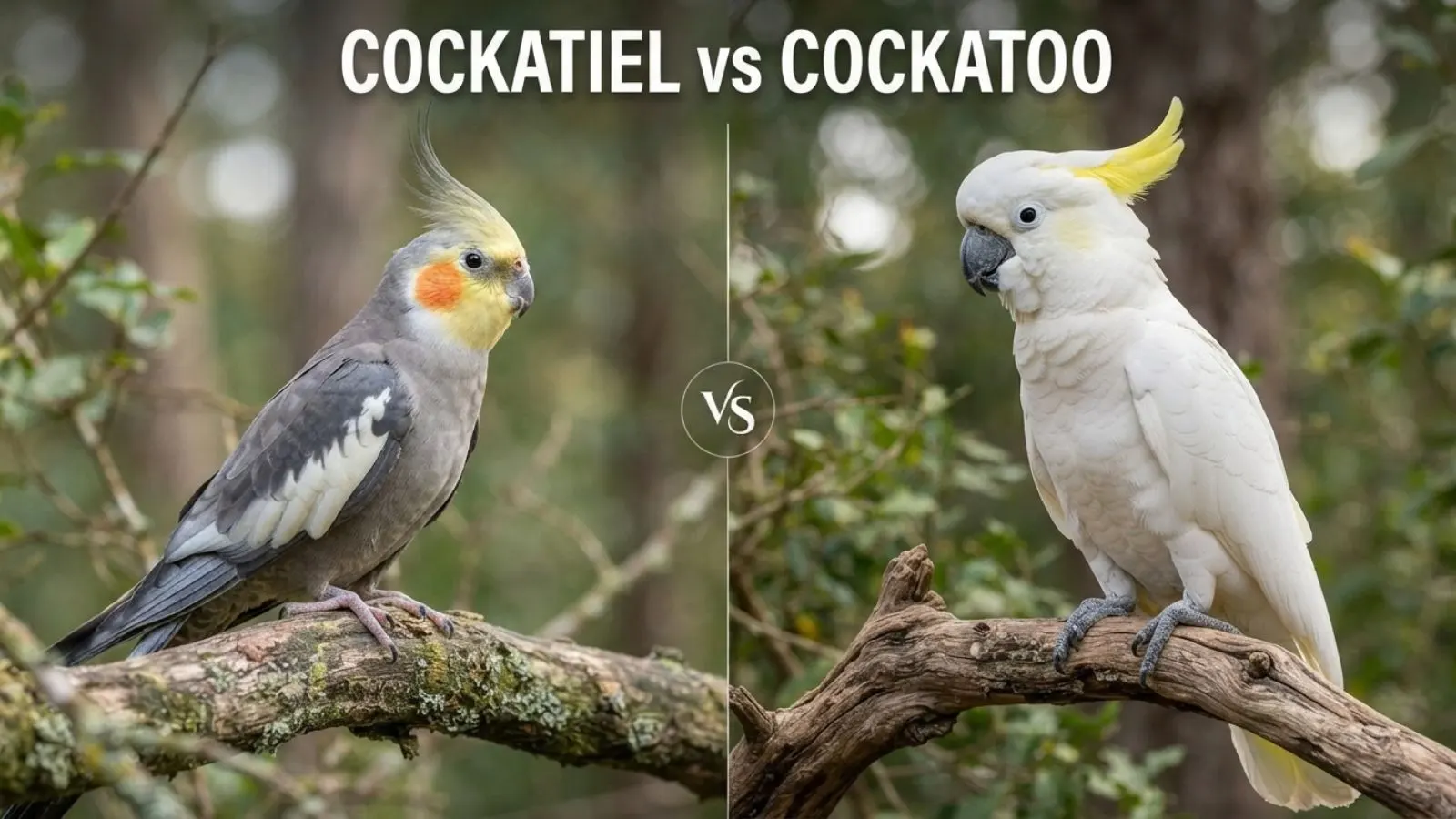
The biggest surprise in the cockatiel vs cockatoo comparison is that a cockatiel is actually a type of cockatoo.
Cockatiels are much smaller than many birds commonly called cockatoos, but both belong to the cockatoo family, Cacatuidae.
They share traits such as crests, strong beaks, social behavior, and a need for regular interaction and enrichment.
Key Takeaways:
- A cockatiel is a genuine member of the cockatoo family.
- Cockatiels are considerably smaller than most commonly kept large cockatoos.
- Large cockatoos generally require more space, enrichment, and intensive daily interaction.
- Both birds are social and need appropriate nutrition, exercise, and veterinary care.
- Neither bird should be chosen solely because of appearance or talking ability.
Is a Cockatiel Actually a Cockatoo?
Yes. This is one of the most important facts to understand before comparing these birds.
The cockatiel, scientifically known as Nymphicus hollandicus, belongs to the family Cacatuidae, the same family that includes larger cockatoos.
The confusion comes from everyday language. When people say “cockatoo,” they often mean a large, conspicuous parrot such as a sulphur-crested, umbrella, or Moluccan cockatoo.
A cockatiel looks quite different because it is much smaller. However, its smaller size does not place it outside the cockatoo family.
The Scientific Connection
Cockatoos are parrots within the family Cacatuidae. Cockatiels are the smallest member of that family.
They have several recognizable cockatoo characteristics, including a movable crest and a strong, curved bill. Their body structure and behavior also reflect their relationship with other cockatoos.
So, technically, “cockatiel vs cockatoo” is not a comparison between two completely separate bird families. It is more accurately a comparison between the cockatiel and the larger cockatoos people commonly keep as companion birds.
Why the Names Cause Confusion
The word “cockatoo” can describe a broad group rather than one specific bird.
That means a cockatoo could weigh only a few ounces or several pounds, depending on the species. A cockatiel, by contrast, is one specific species.
This distinction matters when discussing size, noise, lifespan, personality, and care.
Cockatiel vs Cockatoo: Quick Comparison
| Feature | Cockatiel | Larger Cockatoos |
| Family | Cacatuidae | Cacatuidae |
| Scientific example | Nymphicus hollandicus | Several genera and species |
| Size | Small | Medium to very large |
| Crest | Yes | Yes |
| Social needs | High | High |
| Noise | Usually moderate | Often loud |
| Space needs | Moderate | High to very high |
| Enrichment | Essential | Essential and often intensive |
| Lifespan | Often around 15–25 years | Often several decades, depending on species |
| Care difficulty | Significant but generally more manageable | Often demanding |
Individual birds vary considerably, so these descriptions should not be treated as guarantees for every bird.
Cockatiel vs Cockatoo: Size and Appearance
Size is probably the most obvious difference.
Cockatiels are small parrots with long tails, slim bodies, prominent facial markings, and an upright crest. Their relatively compact size makes their housing requirements different from those of large cockatoos.
Large cockatoos have much heavier bodies and larger bills. Their powerful beaks can also make cage construction, toys, perches, and household safety more important considerations.
Their impressive crests are another shared characteristic. A cockatiel can raise and lower its crest depending on its emotional state, while many larger cockatoos also use their crests as part of their visual communication.
Color varies greatly among both cockatiels and cockatoos because different species and captive color mutations exist.
Personality and Temperament
Both cockatiels and cockatoos are intelligent, social birds. They generally benefit from interaction, mental stimulation, exercise, and opportunities to engage in natural behaviors.
Cockatiels are often described as relatively gentle and approachable companion birds, although individual temperament varies.
Large cockatoos can be extremely affectionate and strongly bonded to their human caregivers. That same social intensity can create challenges when their needs are not met.
A bird that receives too little interaction or enrichment may develop undesirable behaviors. Excessive attention can also create problems if the bird becomes overly dependent on one person.
The important point is that bird personality cannot be predicted by species alone.
Noise, Talking, and Vocalization
Noise is another major consideration.
Cockatiels can whistle, chirp, call, and imitate sounds. Some individuals learn words, although their talking ability varies.
Larger cockatoos are generally capable of producing much louder vocalizations. Their calls can carry through a home and may be difficult for neighbors to tolerate in an apartment or closely connected housing.
Neither bird should be purchased solely because you expect it to talk.
A bird’s vocal behavior depends on its individual personality, environment, social situation, training, and species.
If household noise is an important concern, prospective owners should spend time around the specific species and, ideally, adult birds before making a decision.
Diet, Cage, and Daily Care
Both types of birds need more than a basic seed mix.
A companion parrot generally needs a balanced diet appropriate for its species, along with suitable fresh foods and clean water. Pelleted diets are commonly used as part of companion-parrot nutrition, while vegetables and other appropriate foods can provide variety.
Avoid assuming that a food is safe simply because another pet can eat it.
Food and Nutrition
Cockatiels and larger cockatoos have broadly similar nutritional principles, but individual dietary requirements can differ.
Fresh water should always be available. Food should be kept clean, and owners should understand which foods are unsafe for parrots.
An avian veterinarian can provide species-appropriate dietary guidance, especially for birds with medical conditions or unusual nutritional needs.
Housing and Enrichment
The cage should provide enough room for the bird to move, climb, stretch, and play safely.
Cockatiels need less space than large cockatoos, but “smaller bird” does not mean “tiny cage.”
Larger cockatoos need substantially more durable housing and enrichment. Their powerful beaks can destroy toys and materials that may be perfectly suitable for smaller birds.
Both require regular opportunities outside the cage when the environment is safe.
Toys, foraging activities, climbing opportunities, training, and social interaction can help provide mental stimulation.
Veterinary Care
Birds are skilled at hiding signs of illness, so changes in appetite, droppings, activity, breathing, weight, or behavior deserve attention.
Routine care with an avian veterinarian can help owners monitor health and identify problems early.
Which Bird Requires More Space and Attention?
Generally, a large cockatoo requires considerably more physical space and can demand more intensive daily interaction than a cockatiel.
However, both birds are social animals rather than low-maintenance decorations.
A cockatiel still needs exercise, companionship, enrichment, proper food, safe housing, and veterinary attention.
Large cockatoos can also live for decades. Bringing one into a household may therefore represent a very long-term commitment.
Before getting either bird, consider your available space, daily schedule, noise tolerance, budget, and ability to provide care for many years.
Are Cockatiels Easier for Beginners?
Cockatiels are often considered a more manageable companion-parrot option than large cockatoos because of their smaller size and generally less demanding physical requirements.
That does not make them effortless pets.
A cockatiel still needs daily care and interaction, proper nutrition, exercise, enrichment, and medical attention.
Large cockatoos can be especially challenging because of their size, strength, intelligence, vocalizations, social needs, and potentially very long lifespan.
Rather than asking which bird is universally easier, consider whether your home and lifestyle can meet the specific needs of the bird you are considering.
Can Cockatiels and Cockatoos Live Together?
Not necessarily.
Although they belong to the same family, different parrot species should not automatically share a cage.
A large cockatoo can unintentionally injure a cockatiel because of the major difference in body size and beak strength. Even a playful interaction can become dangerous.
If different birds are kept in the same home, separate housing and careful supervision are important. Any introductions should be gradual and handled with attention to each bird’s behavior.
An avian veterinarian or experienced bird behavior professional can provide guidance when introducing birds.
Frequently Asked Questions
Are cockatiels and cockatoos the same?
They are not the same species, but they are closely related. A cockatiel is actually a member of the cockatoo family, Cacatuidae. The term “cockatoo” commonly refers to several other, usually larger species. Therefore, a cockatiel can correctly be described as a type of cockatoo.
Is a cockatiel a type of cockatoo?
Yes. The cockatiel, Nymphicus hollandicus, belongs to Cacatuidae. It is the smallest member of the cockatoo family. Its smaller body and different appearance can make it seem unrelated to large cockatoos, but its biological classification places it within the same family.
Are cockatoos louder than cockatiels?
Large cockatoos can produce substantially louder vocalizations than cockatiels. However, individual birds differ. A cockatiel can still be vocal, particularly at certain times of day or when seeking attention. Anyone concerned about noise should consider the individual bird and living environment.
Which bird lives longer?
Lifespan varies by species, individual health, diet, veterinary care, and living conditions. Cockatiels commonly live for many years, while some larger cockatoos can live for several decades. A prospective owner should therefore view either bird as a long-term commitment rather than a short-term pet.
Conclusion:
The Cockatiel vs Cockatoo comparison becomes much clearer once you understand their classification.
A cockatiel is itself a member of the cockatoo family, but it is dramatically smaller than many birds commonly called cockatoos.
The practical differences are mainly seen in size, housing requirements, vocalization, physical strength, enrichment needs, and the level of daily commitment required.
Before choosing a companion bird, look beyond appearance.
Consider your space, schedule, noise tolerance, budget, and ability to provide responsible care throughout the bird’s life.