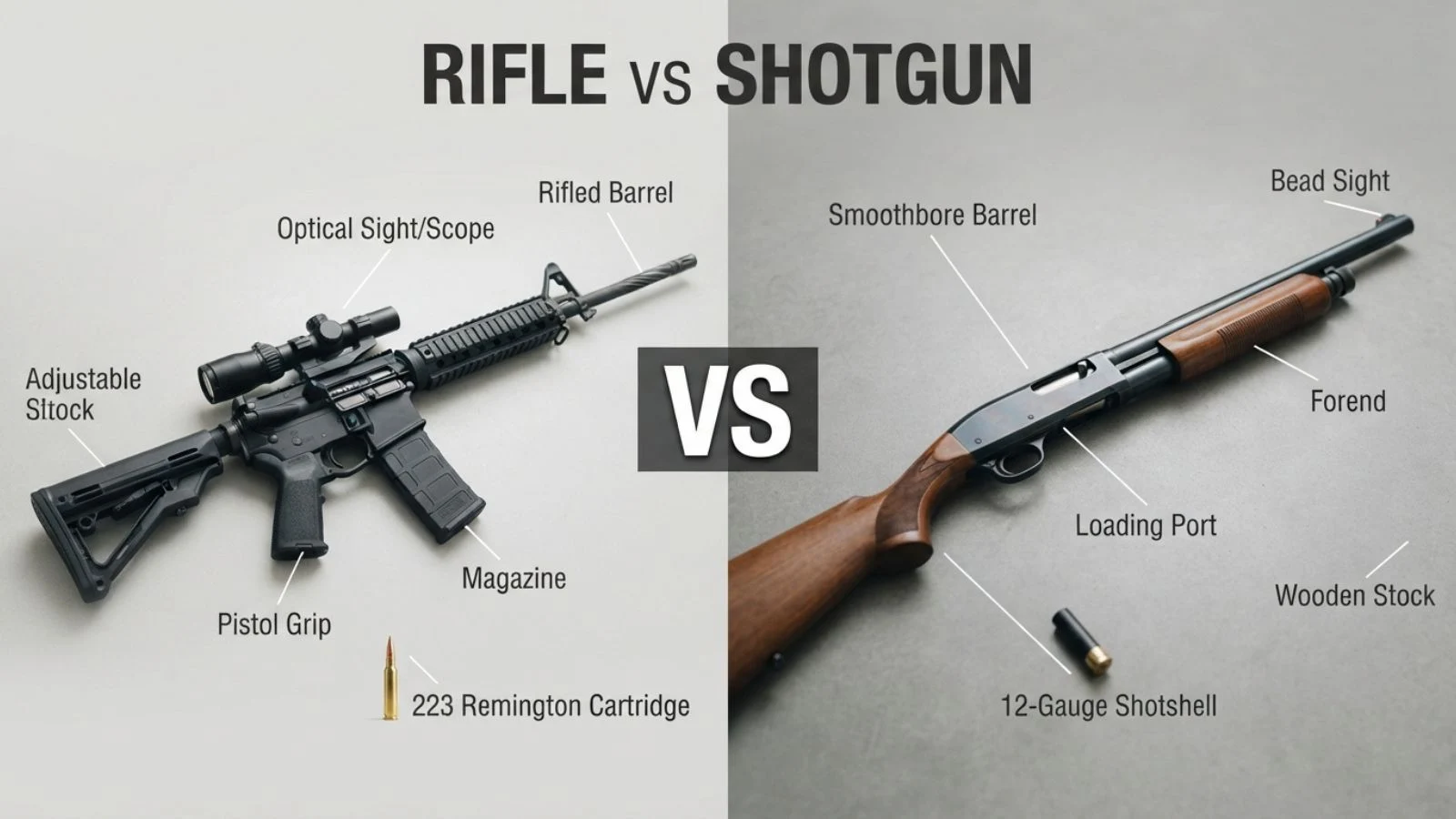
A rifle vs shotgun comparison mainly comes down to barrel design, ammunition, and intended use.
A rifle is generally designed to fire a single projectile through a rifled bore.
While a shotgun is designed to fire either multiple pellets or a single projectile through a smooth bore.
These differences affect accuracy, projectile behavior, and typical applications.
Key Takeaways:
- Rifles use rifled barrels that spin a single projectile for greater stability.
- Shotguns commonly use smooth bores and can fire a shot or a single slug.
- Rifle ammunition is generally described by caliber, while shotgun ammunition commonly uses gauge.
- Rifles are commonly associated with precision shooting and longer-distance applications.
- Shotguns are widely used for hunting birds and other applications where shotshell ammunition is appropriate.
- Neither category is universally better; the appropriate choice depends on the lawful activity, ammunition, firearm design, and local regulations.
What Is the Difference Between a Rifle and a Shotgun?
The simplest way to understand the difference is to look inside the barrel and at the ammunition.
A conventional rifle has rifling spiral grooves inside the barrel. This design imparts spin to a single projectile as it travels through the bore. The spin helps stabilize the projectile in flight and supports precise shooting.
A conventional shotgun generally has a smooth bore. It can fire a shotshell containing multiple pellets, commonly called shot, or a single projectile called a slug. The ATF’s federal definition also recognizes this distinction between a rifle’s rifled bore and a shotgun’s smooth bore.
So, the difference is not simply the overall shape of the firearm. The barrel and ammunition are major parts of what separates the two categories.
Rifle Barrel and Projectile
A rifle’s rifled bore contains spiral grooves and raised areas called lands. When a bullet passes through the barrel, these features cause it to spin.
Rifles are therefore commonly associated with precision shooting, including hunting and target shooting. Hunter education materials describe rifling as a feature that increases projectile stability, accuracy, and distance.
Shotgun Barrel and Projectile
A conventional shotgun uses a smooth bore. Its ammunition is a shotshell, which can contain multiple pellets or, depending on the load and firearm, a single slug.
This makes the shotgun category more varied than the common “scattergun” description suggests. A shotgun does not necessarily fire multiple projectiles every time. A slug is a single projectile.
Rifle vs Shotgun: Side-by-Side Comparison
| Feature | Rifle | Shotgun |
| Typical bore | Rifled | Usually smooth |
| Typical projectile | Single bullet | Shot or single slug |
| Ammunition | Cartridge | Shotshell |
| Common measurement term | Caliber | Gauge |
| Projectile behavior | Stabilized by rifling | Shot can form a spread; slug is a single projectile |
| Common applications | Precision shooting, hunting, target shooting | Bird hunting, hunting, clay sports, and other lawful uses |
| Typical target context | Often stationary or precisely defined targets | Often associated with moving targets and shot patterns |
| Barrel design | Rifled bore | Usually smooth bore |
| Main design emphasis | Projectile stability and precision | Shotshell versatility and projectile pattern |
These are general distinctions rather than absolute rules. Firearm designs vary, and some shotguns have rifled barrels.
How Rifle and Shotgun Ammunition Differs
One of the easiest ways to tell the categories apart is by looking at their ammunition.
Rifle Cartridges
Rifles generally use cartridges containing a single bullet. The rifle and cartridge must be compatible with the firearm’s chambering.
Rifle ammunition is commonly described using caliber, such as a measurement associated with the projectile or bore. The exact meaning and measurement method can vary depending on the cartridge and firearm system.
Shotgun Shells
Shotguns use shotshells rather than conventional rifle cartridges.
A shotshell may contain many small pellets, larger pellets, or a single slug. Birdshot and buckshot are examples of shot loads, while a slug is a single projectile.
This is an important distinction because saying “a shotgun fires many bullets” is inaccurate. A shotgun may fire a shot, which consists of multiple pellets, or a slug, which is one projectile.
Rifling vs Smooth Bore
The barrel is one of the most important technical differences in a rifle vs shotgun comparison.
Rifling consists of spiral grooves inside a barrel. As a projectile travels through a rifled bore, the grooves impart spin. That spin helps stabilize the projectile during flight.
A traditional shotgun’s bore is generally smooth. With shot ammunition, the pellets leave the barrel together and gradually spread into a pattern.
However, this distinction has an important exception: some shotguns have rifled barrels, particularly designs intended for particular slug applications. Hunter education materials specifically note that shotguns designed for slugs may have rifled barrels.
Accuracy and Typical Range
Rifles are generally associated with greater precision at longer distances because their rifled barrels stabilize a single projectile.
Shotguns are commonly associated with shorter-distance applications, especially when firing shots. The individual pellets spread as they travel, creating a pattern rather than one single point of impact.
However, there is no universal distance at which one category suddenly stops working. Ammunition, firearm design, projectile type, barrel characteristics, environmental conditions, and the particular activity all affect performance.
A shotgun firing a slug behaves differently from a shotgun firing birdshot, just as different rifle cartridges can produce very different results.
That is why broad statements such as “rifles are long-range and shotguns are short-range” are useful as general descriptions but should not be treated as precise technical limits.
Rifle vs Shotgun for Hunting
Hunting is one of the most common contexts for comparing these two firearm categories.
Rifles are widely associated with hunting situations where a hunter needs a single projectile and precise shot placement. Shotguns are widely used for hunting birds and other games where shotshell ammunition is appropriate. Hunter education resources describe rifles as commonly used with stationary targets and shotguns as commonly associated with moving targets in the air.
The appropriate firearm also depends on the species, terrain, hunting method, ammunition, and state regulations.
For example, a bird hunter may use a shotgun with a suitable shotshell, while a hunter pursuing certain big-game species may use a rifle where permitted.
There is no universal rifle-or-shotgun answer for every hunting situation. State wildlife regulations can also specify legal firearm types, ammunition, seasons, and other requirements.
Can a Shotgun Fire a Single Projectile?
Yes.
A shotgun can fire a slug, which is a single projectile rather than a collection of pellets.
This is one of the most important details to understand when learning about shotguns. The simplified statement that “rifles fire one projectile and shotguns fire many” is useful for beginners but incomplete.
Federal regulations define a shotgun as capable of firing either a number of projectiles or a single projectile through a smooth bore.
Some shotguns may also have rifled barrels, demonstrating why the firearm’s specific design and ammunition matter more than a simple one-sentence rule.
Caliber vs Gauge: What Do They Mean?
Caliber and gauge are two terms you’ll frequently encounter when comparing rifles and shotguns.
This is commonly used when describing rifle ammunition and bore dimensions. It is often expressed in inches or millimeters.
Shotguns traditionally use gauge to describe bore size. Common shotgun gauges include 12 gauge and 20 gauge.
The terms should not be treated as interchangeable. A rifle is normally identified by its particular cartridge or caliber, while a shotgun is commonly identified by gauge and chambering.
This terminology is another reason why rifle ammunition and shotgun ammunition should never be treated as interchangeable categories.
Important Exceptions to the Basic Rifle vs Shotgun Rule
The basic comparison is useful, but several exceptions are worth remembering.
First, not every shotgun has a smooth barrel. Some shotguns have rifled barrels, particularly certain slug-oriented designs.
Second, shotguns do not always fire multiple projectiles. A slug is a single projectile.
Third, barrel length alone does not define whether a firearm is a rifle or shotgun. Under federal definitions, the intended design, bore, ammunition, and other characteristics matter.
Finally, legal classifications can differ from everyday descriptions. In the United States, federal and state laws can impose different requirements, so current local rules should be checked for any specific firearm or hunting activity.
Frequently Asked Questions
Is a rifle more accurate than a shotgun?
A conventional rifle is generally designed for precision with a single projectile traveling through a rifled bore. A shotgun firing shot is designed around a pattern of multiple pellets. However, shotgun slugs and rifled shotgun designs complicate a simple accuracy comparison, so the firearm and ammunition combination matters.
Can a shotgun fire a slug?
Yes. A slug is a single projectile designed for use in a shotgun. Federal regulations explicitly include a shotgun capable of firing either multiple projectiles or a single projectile.
What is the main difference in ammunition?
Rifles generally use cartridges containing a single bullet. Shotguns use shotshells that can contain multiple pellets or a single slug. Because the ammunition is designed differently, rifle cartridges and shotgun shells are not interchangeable.
Can a shotgun have a rifled barrel?
Yes. Although conventional shotguns commonly have smooth bores, some shotguns are made with rifled barrels. The specific firearm design determines what ammunition it is intended to use.
Final Takeaway:
The key to understanding Rifle vs Shotgun is to focus on barrel design, ammunition, and intended application.
A conventional rifle uses a rifled bore and is designed around a single projectile. A conventional shotgun generally uses a smooth bore and can fire either multiple pellets or a single slug.
Rifles are commonly associated with precision shooting, while shotguns are widely used for hunting birds, clay sports, and other applications suited to shot shell ammunition.
The comparison becomes more nuanced when you consider slugs, rifled shotguns, different ammunition types, and state-specific laws.
For any real-world use, always follow firearm-safety practices, manufacturer instructions, and applicable federal, state, and local laws.

I’m Maya Angelou, the creator behind EmojiAura.com, where I explore emoji meanings, social media trends, and fun digital expressions. I’m passionate about helping people understand the real meaning behind emojis and use them creatively in chats, captions, posts, and everyday online conversations.