If you’re exploring a career in emergency medical services, you’ve likely come across two terms that sound similar but represent very different levels of training and responsibility: EMR and EMT.
Emergency Medical Responder (EMR) and Emergency Medical Technician (EMT) are both foundational certifications in the EMS system, but they differ significantly in scope of practice, training requirements, and career opportunities.
Understanding these differences matters whether you’re a firefighter considering your next certification, a student weighing your first
step into healthcare, or someone simply curious about how emergency responders are trained. Choosing the wrong starting point can mean wasted time, money, or a certification that doesn’t align with your career goals.
In this guide, we’ll break down exactly what separates an EMR from an EMT, covering training hours, skills, work settings, salary expectations, and how each path can lead toward advanced EMS roles like paramedic. By the end, you’ll know which certification fits your goals.
What Is an EMR (Emergency Medical Responder)?
An Emergency Medical Responder (EMR) represents the entry point into the EMS certification ladder. EMRs are trained to provide immediate, basic medical care to patients before more advanced help such as an EMT or paramedic crew arrives on scene. Rather than working as dedicated ambulance personnel, EMRs are typically professionals whose primary job involves something else entirely, with emergency response as a critical secondary function.
The EMR certification was designed to fill a gap: in many emergencies, the first person on scene isn’t a paramedic, but a police officer, firefighter, lifeguard, ski patroller, or industrial safety worker. Having a baseline of medical training among these first-on-scene personnel can make the difference between life and death in the minutes before an ambulance arrives.
EMRs typically operate in settings where quick response matters more than in-depth treatment: roadside accidents, workplace injuries, sporting events, and remote or wilderness locations where professional EMS may be delayed. Their role isn’t to replace ambulance-based care, but to stabilize a patient and “bridge the gap” until that higher level of care shows up.
Because EMR training is shorter and more accessible than EMT training, this certification is often pursued by people whose main career already involves public safety or workplace risk. It’s rarely a standalone career path; instead, it functions as a valuable add-on credential that enhances someone’s core job while giving them the tools to respond confidently when a medical emergency happens on their watch.
What Is an EMT (Emergency Medical Technician)?
An Emergency Medical Technician (EMT) sits one level above the EMR on the EMS certification ladder and represents a more substantial commitment to emergency medical work. Unlike EMRs, who typically treat emergency response as a secondary skill layered onto another job, EMTs are usually trained specifically to work within the EMS system itself most commonly as members of an ambulance crew.
EMTs receive significantly more training than EMRs, equipping them to handle a broader range of medical situations with greater independence. Where an EMR’s role is largely about stabilizing a patient until help arrives, an EMT is often that help. They’re trained not just to assess and stabilize patients, but to actively manage their condition during transport to a hospital or other medical facility.
This makes the EMT certification a genuine career credential rather than just a supplementary skill. Many people pursue EMT certification as their first paid position in the medical field, using it as a foundation for future advancement into paramedic training, nursing, or other healthcare careers.
EMTs typically work in more structured, dedicated emergency response settings: ambulance services, fire departments with EMS divisions, hospital emergency departments, and private medical transport companies. They may also serve as medical staff at large public events, where a higher level of on-site care is required than an EMR alone could provide.
Training & Certification Requirements
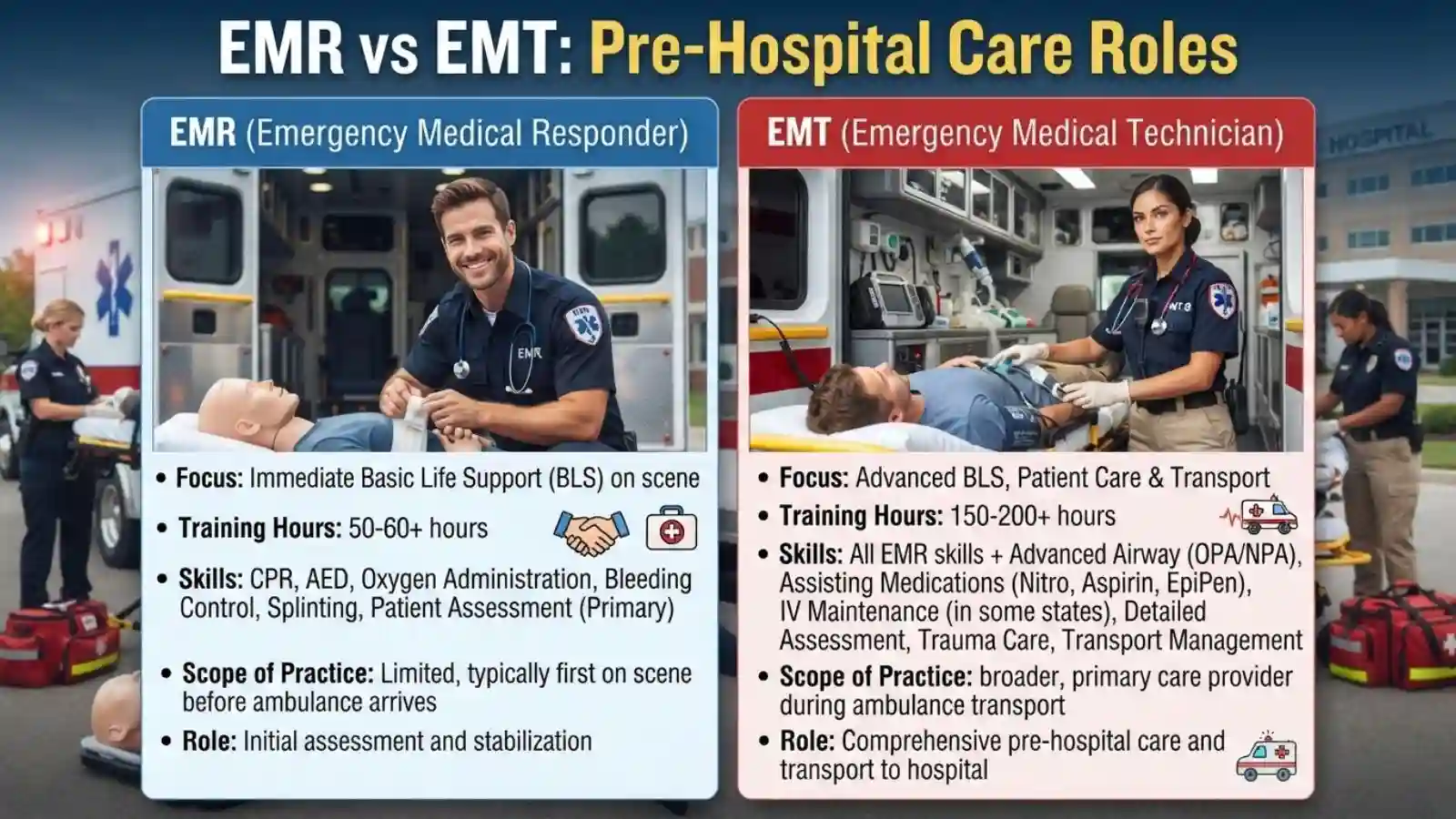
The gap between EMR and EMT becomes most apparent when you look at training requirements. EMR courses typically run 40 to 60 hours, often completed in just a few weeks through community colleges, fire academies, or workplace safety programs. The curriculum focuses on core life-saving skills: CPR, bleeding control, basic airway management, and patient assessment enough to stabilize someone quickly without requiring a long-term educational commitment.
EMT training, by contrast, typically spans 150 to 200+ hours, sometimes more depending on the state and program format. This includes classroom instruction, hands-on skills practice, and clinical or field experience often involving ride-alongs with ambulance crews or time in a hospital setting. The expanded curriculum covers everything EMRs learn, plus more advanced topics like medication administration, trauma management, and patient transport protocols.
Both certifications typically require passing the National Registry of Emergency Medical Technicians (NREMT) exam, though the content and difficulty differ to reflect each role’s scope of practice. It’s worth noting that certification requirements can vary by state, so prospective students should check their local EMS authority for specific hour requirements, approved training providers, and any additional state-level testing.
Recertification is also required for both levels, typically every two years, involving continuing education hours or refresher coursework to keep skills and knowledge current.
The bottom line: EMR is designed for a quick, accessible credential, while EMT requires a more serious time and financial investment, one that pays off with a broader scope of practice and more career options.
Scope of Practice Comparison
Scope of practice is where the practical differences between EMR and EMT become most concrete; it defines exactly what each provider is legally permitted to do for a patient.
EMR scope of practice covers foundational, stabilizing interventions: performing CPR and using an AED, controlling severe bleeding, providing basic airway management (like positioning and simple adjuncts), splinting obvious fractures, assisting with childbirth, and conducting a basic patient assessment. EMRs generally cannot administer medications beyond assisting a patient with their own prescribed emergency drugs, such as helping someone use their own epinephrine auto-injector or inhaler.
EMT scope of practice builds directly on those EMR skills and adds meaningful clinical depth. EMTs can administer a limited set of medications themselves including oxygen, oral glucose, aspirin, and in many states, epinephrine and naloxone. They’re trained to use more advanced airway devices, manage spinal immobilization more comprehensively, and monitor patients more closely during transport, including tracking vital signs over time rather than just at a single point of contact.
Perhaps the most operationally significant difference: EMTs are typically trained and authorized to transport patients in an ambulance, while EMRs generally are not. This single distinction shapes much of how each role functions in the field: EMRs stabilize and hand off, while EMTs stabilize, monitor, and deliver.
It’s worth remembering that scope of practice can vary by state and local medical protocols, so specific allowances (especially around medications) may differ depending on where you’re certified.
Work Settings & Typical Employers
Where EMRs and EMTs actually work reflects the different purposes each certification serves.
EMRs are rarely employed specifically for their EMR certification alone. Instead, this credential tends to layer onto an existing job where medical emergencies are a foreseeable part of the role. Firefighters and police officers frequently hold EMR certification so they can provide care immediately upon arriving at a scene, often minutes before an ambulance shows up. Lifeguards and ski patrollers use EMR training to handle injuries specific to their environments of drowning, hypothermia, or trauma from falls. Industrial and workplace safety personnel, particularly in high-risk settings like construction, manufacturing, or oil and gas, also commonly hold EMR certification to respond to on-site accidents.
EMTs, by contrast, are far more likely to work in dedicated EMS or healthcare roles. Ambulance services whether municipal, private, or hospital-based are the most common employers, with EMTs staffing 911 response units and non-emergency medical transport. Fire departments with integrated EMS divisions frequently employ EMTs directly, blending firefighting and medical response duties. Hospitals also hire EMTs, particularly in emergency departments, where their patient-handling and assessment skills remain valuable even off the ambulance. Event medical services covering concerts, sporting events, and large public gatherings often need EMTs on-site to handle everything from minor injuries to acute emergencies.
There’s also overlap: many volunteer fire departments and rural EMS agencies use a mix of EMR and EMT personnel to cover gaps in staffing and response time.
Salary & Job Outlook
Salary is one of the clearest ways EMR and EMT paths diverge and it starts with the fact that EMR typically isn’t a standalone paid position at all. Because EMR is usually a supplementary certification layered onto another job (firefighter, lifeguard, police officer), there’s no dedicated salary data for it; compensation comes from the primary role, not the EMR credential itself.
EMT, by contrast, is tracked as its own occupation. According to the U.S. Bureau of Labor Statistics, the median annual wage for EMTs and paramedics combined was $46,350 in 2024, or $22.28 per hour. Looking at the two roles separately, the median annual wage for EMTs specifically was $41,340 in May 2024, while paramedics earned a median of $58,410, a meaningful gap that reflects the added training and scope of a paramedic certification.
On job outlook, the BLS projects 5% employment growth for EMTs and paramedics from 2024 to 2034, faster than the average for all occupations, with roughly 14,300 new positions expected over that period. Actual pay varies significantly by state, employer type (hospital-based and private ambulance services generally outpay smaller municipal agencies), and experience level.
Career Pathways & Advancement
One of the most important things to understand about EMR and EMT certifications is that they aren’t dead ends; both serve as stepping stones within a larger EMS career ladder that typically progresses: EMR → EMT → Advanced EMT (AEMT) → Paramedic.
Can an EMR become an EMT? Yes, and it’s a common next step. EMR certification doesn’t automatically count toward EMT training, but the foundational skills and comfort with emergency scenes make the transition smoother. Most EMT programs don’t require prior EMR certification, so an EMR can enroll directly in an EMT course without needing a formal “bridge” program though the EMR background often makes the EMT curriculum easier to grasp.
EMT as a launching pad: For those pursuing EMS as a full career, EMT certification is usually just the beginning. Many EMTs work for a year or more gaining field experience before advancing to Advanced EMT or Paramedic training, which requires significantly more coursework and clinical hours but unlocks a much broader scope of practice and higher earning potential.
Beyond paramedic: Some EMS professionals continue advancing into specialized roles in flight paramedics, tactical EMS (supporting law enforcement units), critical care transport, or EMS supervisory and management positions. Others use their EMT or paramedic experience as a foundation for entirely different healthcare careers, transitioning into nursing, physician assistant programs, or emergency management.
Pros & Cons of Each Path
Choosing between EMR and EMT often comes down to weighing what you gain against what you give up. Here’s how the two compare.
EMR: Pros
- Fast to complete most courses wrap up in a few weeks, not months
- Low cost significantly cheaper than EMT programs, making it accessible
- Low barrier to entry minimal prerequisites, ideal for pairing with another job
- Immediately useful enhances safety and preparedness in fields like firefighting, law enforcement, or lifeguarding
EMR: Cons
- Limited scope of practice can’t administer most medications or transport patients
- Not a standalone career rarely leads to paid employment on its own
- Fewer advancement opportunities doesn’t independently open doors to higher EMS roles without further training
EMT: Pros
- Broader scope of practice medication administration, advanced airway management, and patient transport
- Real career potential a legitimate entry point into paid EMS and healthcare work
- Higher earning potential meaningfully higher wages than roles built solely around EMR certification
- Clear path to advancement serves as the foundation for Advanced EMT, Paramedic, and other healthcare careers
EMT: Cons
- Bigger time commitment 150+ hours of training, often spanning months
- Higher cost tuition, materials, and clinical requirements add up
- More demanding certification exam the NREMT EMT exam covers significantly more material than the EMR exam
- Physically and emotionally demanding work especially once in the field, dealing with high-stress emergencies regularly
Which Certification Is Right for You?
Choosing between EMR and EMT ultimately comes down to your goals, timeline, and how central emergency medicine is to your career plans.
Choose EMR if:
- You already work (or plan to work) in a field where medical emergencies are a foreseeable part of the job firefighting, law enforcement, lifeguarding, ski patrol, or industrial safety
- You want a quick, low-cost credential that enhances your existing role rather than replacing it
- You’re not looking for a standalone paycheck from emergency medicine, just the skills to respond confidently when needed
- You want to “test the waters” of EMS before committing to a longer program
Choose EMT if:
- You’re serious about building a career in emergency medical services or healthcare more broadly
- You want the ability to actually treat and transport patients, not just stabilize and hand off
- You’re willing to invest more time and money upfront for better pay and more job opportunities
- You see EMT as a stepping stone toward paramedic, nursing, or another advanced healthcare role
Ask yourself these questions before deciding:
- Is emergency response my primary career goal, or a complement to another job?
- How much time and money can I realistically invest in training right now?
- Do I want to work on an ambulance, or is scene-level stabilization enough?
- Where do I see myself in five years EMS, healthcare more broadly, or elsewhere?
Frequently Asked Questions
Can EMRs work independently?
Not typically. EMRs generally operate under medical direction and are trained to stabilize patients until EMTs or paramedics arrive not to provide ongoing, independent patient care or make transport decisions on their own.
Is EMT harder than EMR?
Yes, in terms of both training volume and exam difficulty. EMT courses run roughly three to four times longer than EMR courses, and the NREMT EMT exam covers a significantly broader range of medical knowledge and skills.
How long does it take to go from EMR to Paramedic?
There’s no fixed timeline, but a realistic path often looks like: a few weeks for EMR, several months for EMT, another 6–12 months for Advanced EMT (if required), and 1–2 years for Paramedic training. Total time from EMR to Paramedic is often 2–3 years, depending on program pacing and whether you work while studying.
Do EMRs get paid?
Usually not for the EMR certification alone. Most EMRs are paid for their primary job (firefighter, police officer, lifeguard), with EMR skills functioning as an added responsibility rather than a separate income source.
Can I skip EMT and go straight to Paramedic?
No EMT certification (or an equivalent) is a required prerequisite for Paramedic training in virtually all U.S. states, since paramedic programs build directly on EMT-level skills and knowledge.
Do EMR and EMT certifications transfer between states?
Not automatically. While the National Registry (NREMT) provides a baseline standard, each state has its own licensing requirements, so moving states often requires reciprocity applications or additional state-specific testing.
Final Takeaway:
EMR and EMT represent two distinct entry points into emergency medical services, one a quick, supplementary credential for existing first responders, the other a genuine career foundation with real earning potential and room to grow.
If you want fast, low-cost training to support another role, EMR fits. If you’re aiming for a paid EMS career with a path toward paramedic or healthcare beyond, EMT is the stronger investment.
Either way, you’re stepping onto a ladder with clear next rungs. The right starting point simply depends on how far you want to climb.