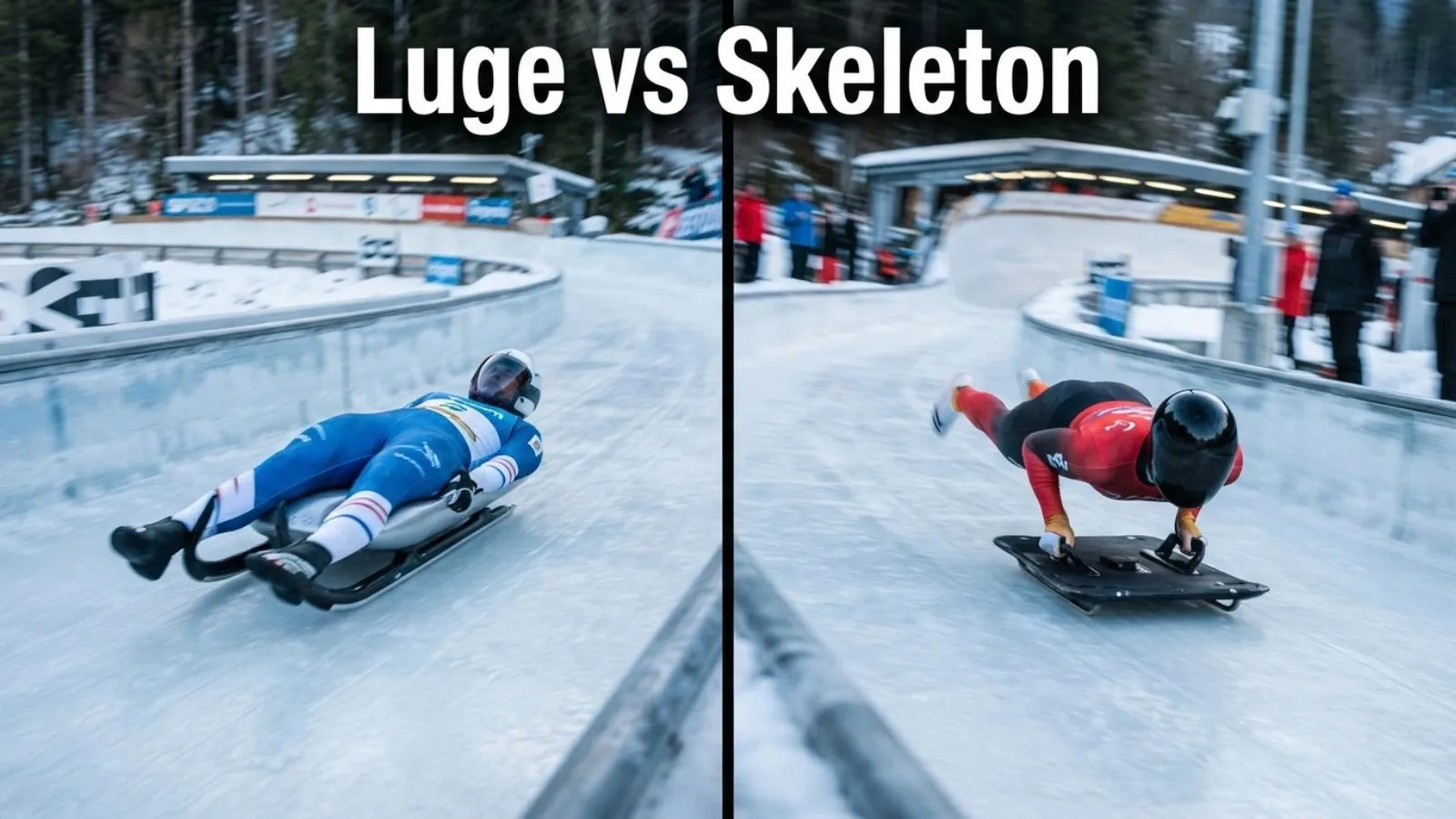
Luge vs skeleton mainly differs in riding position and starting technique. Luge athletes lie on their backs and travel feet-first, while skeleton athletes lie face-down and travel head-first.
This starts from a seated position on the sled, whereas skeleton uses a running push start. Both are timed Olympic sliding sports that rely on precise body movements to steer.
Key Takeaways:
- Luge: athletes lie on their backs with their feet pointing forward.
- Skeleton: athletes lie face-down with their heads pointing forward.
- Luge uses a seated push-off from the starting area, while skeleton begins with a running start.
- Both sports use body movements rather than conventional steering wheels.
- Luge generally has a speed advantage, although both can reach extremely high speeds.
- Both are Olympic sports, but their events and competition formats are different.
What Is the Difference Between Luge and Skeleton?
Luge and skeleton look similar because both involve one athlete racing down an icy track on a small sled. However, the riding position makes them very different experiences.
In luge, the athlete lies face-up on their back with their head toward the rear of the sled and their feet pointing downhill. In the skeleton, the athlete lies face-down with the head toward the front and the chin close to the ice.
The starting methods are also different. A luger begins on the sled and uses their arms and hands to generate initial momentum. A skeleton athlete starts standing, runs while pushing the sled, and then dives onto it.
| Feature | Luge | Skeleton |
| Riding position | On the back | On the stomach |
| Direction | Feet first | Head first |
| Start | Athlete begins on sled | Running push start |
| Riders | Singles and doubles | Individual races |
| Steering | Body, shoulders, calves and runners | Body shifts, shoulders, knees and toes |
| Sled style | Small, low racing sled | Flat, minimalist sled |
| Governing body | FIL | IBSF |
| Olympic status | Yes | Yes |
The basic goal is the same: complete the course in the shortest possible time.
How Luge Works
Luge is a high-speed sliding sport in which an athlete controls a small sled while lying on their back.
Starting a Luge Run
Unlike skeleton, lugers do not sprint down the track before getting onto the sled.
At the start, the athlete sits on the sled and uses handles and specially designed gloves to push against the ice. After generating initial speed, the athlete settles into an aerodynamic position.
That early acceleration matters because the rest of the run is largely about preserving speed while making precise adjustments.
Steering a Luge Sled
A luge sled does not have a steering wheel. Athletes use subtle movements of their body to influence the sled’s runners and direction.
Pressure from the shoulders and calves helps the athlete guide the sled through curves. Because the sled travels at very high speeds, small movements can affect the racing line significantly.
Luge is therefore a sport of precision, balance, reaction, and aerodynamic control. The athlete has to make corrections without creating unnecessary drag or losing momentum.
How Skeleton Works
Skeleton is also a timed race down an icy track, but the athlete’s position is almost the opposite of luge.
The skeleton racer lies on the stomach with the head facing downhill. The athlete’s face and helmet are extremely close to the ice, which gives the sport its distinctive appearance.
The Skeleton Running Start
One of the biggest differences in luge vs skeleton is the start.
A skeleton athlete begins standing beside the sled. They sprint while pushing it forward and then jump onto the sled once enough speed has been developed.
This makes explosive acceleration an important part of skeleton racing. IBSF describes top skeleton athletes reaching more than 40 km/h during the opening 50 meters of a strong push start.
Steering a Skeleton Sled
Skeleton sleds do not use a steering wheel or conventional mechanical steering system.
Instead, athletes make tiny movements with their body. Shoulders, knees, toes and shifts in body weight help influence the sled’s direction.
Because the athlete is traveling head-first, maintaining a stable line through corners requires extremely precise control.
Luge vs Skeleton: Speed and Track
Both sports are exceptionally fast, and the difference in speed is not as simple as saying one always travels at a particular number.
Luge is commonly described as the fastest of the Olympic sliding sports. NBC’s Olympic guide says luge speeds can exceed 145 km/h (90 mph), while IBSF material says skeleton athletes can reach speeds of up to 150 km/h (93 mph).
So why is luge often considered faster?
One factor is aerodynamics. A luger travels feet-first while lying on their back, creating a streamlined position. Skeleton athletes travel head-first and face-down, with a different body position and sled design.
However, actual speeds depend on the track, conditions, athlete, equipment and racing line. It is more accurate to say that both sports reach extreme speeds, with luge generally regarded as the faster discipline overall rather than assigning one universal maximum.
The sports can also use the same general sliding facilities, although different disciplines use different start areas and configurations.
Luge vs Skeleton: Sled and Equipment
The sleds look similar at first glance, but they are designed around completely different riding positions.
A luge sled is built for an athlete lying on their back. The athlete’s body position, runners and steering technique work together to keep the sled stable while moving quickly through the track.
A skeleton sled is a low, flat platform designed for an athlete lying face-down. The rider holds onto the sled during the push and then controls the descent primarily through subtle body movements.
Neither sport uses a conventional steering wheel. Instead, success depends on the athlete’s ability to make extremely small corrections at high speed.
Luge vs Skeleton: Olympic Events and Rules
Both luge and skeleton are part of the Winter Olympic program, but their event structures differ.
Olympic skeleton traditionally includes men’s and women’s individual events. At Milano Cortina 2026, skeleton also introduced a mixed-team event, in which one woman and one man from the same country each complete a run and their times are combined.
Luge includes singles and doubles competition as well as the team relay. At the 2026 Winter Olympics, women’s doubles was added to the Olympic program, giving women a doubles event alongside men’s doubles.
Olympic skeleton individual races consist of four runs, with the combined time determining the result.
Luge singles also use four runs, while doubles use two runs at the Olympic level. The athlete or team with the lowest accumulated time wins.
Which Sport Is More Difficult?
There is no objective answer to whether luge or skeleton is harder because they demand different combinations of athletic skills.
Luge places major demands on precision steering, body control, reaction speed and maintaining an aerodynamic position. The start also requires athletes to generate speed quickly from the sled.
Skeleton places greater emphasis on explosive sprinting at the beginning of the run, followed by precise control while traveling head-first. The athlete must transition smoothly from pushing the sled to lying down without disrupting the run.
Both require excellent balance, strength, coordination and the ability to make tiny corrections while traveling at high speed.
Rather than being simply harder or easier, the two sports emphasize different technical and physical skills.
Luge vs Skeleton vs Bobsleigh
Luge and skeleton are often confused with bobsleigh because all three are Olympic sliding sports.
The easiest way to separate them is by the athlete’s position and sled design.
- Luge: one or two athletes lie on their backs and travel feet-first.
- Skeleton: one athlete lies face-down and travels head-first.
- Bobsleigh: athletes sit inside a larger enclosed sled and use a team-based push start in most events.
Bobsleigh also uses a dedicated steering system, unlike the body-controlled steering used in luge and skeleton.
This makes luge vs skeleton a much closer comparison than either sport is to bobsleigh.
Frequently Asked Questions
Is luge faster than skeleton?
Luge is generally regarded as the faster Olympic sliding discipline, and luge athletes can exceed 145 km/h. However, skeleton athletes can also reach speeds around 150 km/h on suitable tracks. Actual speed varies according to the track, conditions, athlete, equipment and racing line, so there is no single speed that applies to every race.
Which is more dangerous, luge or skeleton?
Both involve very high speeds and significant physical demands. Skeleton places the athlete head-first with the face close to the ice, while luge places the athlete on their back traveling feet-first. That visual difference does not by itself establish that one sport is objectively more dangerous; both require specialized training, equipment and controlled tracks.
Do luge and skeleton use the same track?
They can use the same general sliding facility, but the disciplines have different starting points and race configurations. At the Olympics, bobsleigh, skeleton and luge can all be contested at the same sliding venue while using discipline-specific start areas.
Can you ride a luge or skeleton sled?
Recreational riding opportunities depend on the facility and country, and Olympic competition requires specialized equipment and training. Competitive luge and skeleton are not simply activities where someone can step onto a sled and safely reproduce what athletes do. Both involve high-speed ice tracks and require proper instruction and safety procedures.
Conclusion:
The simplest way to remember Luge vs Skeleton is the direction the athlete faces.
Luge is back-down and feet-first. The skeleton is stomach-down and head-first.
The two sports also differ in their starts, steering techniques, sled designs and Olympic event structures.
Luge begins from the sled, while skeleton uses a powerful running push start. Both then depend on extremely precise body control to navigate an icy track at high speed.
Once you remember feet-first for luge and head-first for skeleton, the rest of the comparison becomes much easier to understand.