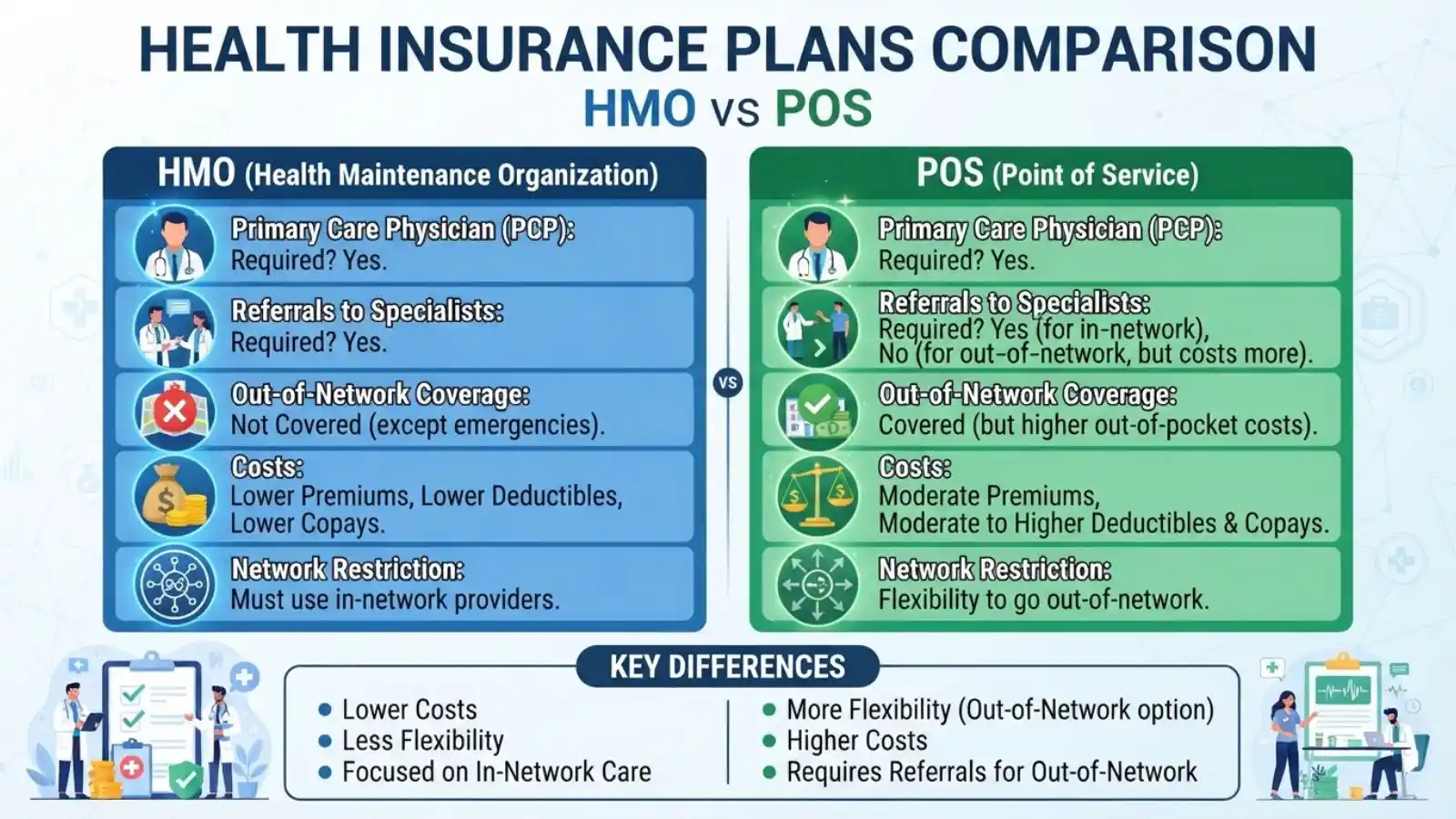
HMO vs POS plans mainly differ in provider choice and out-of-network coverage. An HMO generally limits routine care to its network, while a POS plan typically gives members an option to use out-of-network providers at a higher cost.
Both plan types may use primary care providers and referrals, but exact rules depend on the specific plan.
Key Takeaways:
- HMO plans generally focus on in-network care and coordinated treatment.
- POS plans typically provide some out-of-network coverage, usually at a higher cost.
- Both types may involve a primary care provider (PCP) and specialist referrals.
- The cheapest monthly premium does not necessarily mean the lowest yearly healthcare cost.
- Always check the specific plan’s provider network, referral rules, deductible, copays, and out-of-pocket maximum before enrolling.
What Is the Difference Between HMO and POS?
HMO stands for Health Maintenance Organization, while POS means Point of Service. Both are managed-care approaches that use provider networks, but they handle provider choice differently.
An HMO generally limits covered routine care to doctors, hospitals, and other providers within its network. Out-of-network care is usually not covered except in situations such as emergencies.
A POS plan also encourages members to use in-network providers, but it generally offers an out-of-network option. Going outside the network can result in higher cost sharing. HealthCare.gov also describes POS plans as requiring a referral from a primary care doctor to see a specialist.
The important point is that HMO and POS describe plan structures, not a universal set of prices or benefits. The actual rules can differ between insurers and individual plans.
HMO Explained
An HMO is built around a defined network of healthcare providers. Members generally receive routine care from participating doctors and facilities.
Many HMO designs use a PCP to coordinate care, although referral and PCP requirements vary. For plans that require referrals, the PCP may direct a member to a specialist or certain medical services.
The main trade-off is provider choice. Staying within the network can help members avoid the higher costs or lack of coverage associated with out-of-network care.
POS Explained
A POS plan combines features of managed care with greater provider flexibility.
Members generally pay less when they use in-network providers. A POS plan can also provide benefits for certain out-of-network services, although members usually pay more when they leave the network.
This makes the network rules particularly important when comparing a POS plan with an HMO.
HMO vs POS: Key Differences at a Glance
| Feature | HMO | POS |
| Full name | Health Maintenance Organization | Point of Service |
| In-network care | Generally emphasized | Generally lower cost |
| Out-of-network care | Usually limited, except for specific situations | Generally available for covered services, at higher cost |
| PCP | Often required, depending on plan | Often used, depending on plan |
| Specialist referral | May be required | Commonly required under the traditional POS definition |
| Provider flexibility | More limited | Greater flexibility |
| Cost outside network | Usually not covered except for certain situations | Usually higher cost sharing |
| Network importance | Very high | Very high |
These are general characteristics rather than guarantees. Individual employer, Marketplace, and Medicare plans can have different requirements. For example, some insurers offer HMO designs without specialist referrals, while specific POS products can also differ in referral rules.
HMO vs POS Provider Networks
The provider network is one of the biggest differences to examine when comparing HMO vs POS plans.
In-Network Care
An in-network provider has a contract with the health plan. Using network doctors and facilities generally results in the plan’s preferred cost-sharing structure.
HealthCare.gov recommends checking whether your doctors and facilities are in a plan’s network because out-of-network care may cost more or may not be covered.
For an HMO, staying in the network is usually central to how the plan works.
For a POS plan, staying in the network can still be financially important, but the plan may provide another option when you need or prefer an out-of-network provider.
Out-of-Network Care
Traditional HMOs generally do not cover routine out-of-network care, although emergency care and other specific situations can be exceptions.
POS plans generally offer some out-of-network coverage. However, that flexibility can come with higher deductibles, coinsurance, copayments, or other cost-sharing requirements depending on the plan.
So if you regularly see a doctor who is outside a plan’s network, the POS option may require closer examination of the out-of-network benefits.
Do HMO and POS Plans Require Referrals?
Referral rules are another major part of the HMO vs POS comparison.
A referral is an order from a primary care doctor to see a specialist or receive certain medical services. HealthCare.gov notes that many HMOs require referrals for specialist care, although the exact requirement depends on the plan.
HealthCare.gov’s general definition of a POS plan includes a referral from a primary care doctor before seeing a specialist.
However, don’t assume every plan follows the same rule.
For example, insurers may offer open-access HMO or POS products where referrals are not required for certain services. Cigna currently lists different HMO and HMO-POS designs with different PCP and referral requirements.
Before enrolling, check the plan documents rather than relying only on the HMO or POS label.
HMO vs POS Costs
Cost is more complicated than simply comparing monthly premiums.
Health insurance expenses can include:
- Monthly premiums
- Deductibles
- Copayments
- Coinsurance
- Out-of-pocket maximums
- Out-of-network cost sharing
HealthCare.gov recommends considering estimated total yearly healthcare costs, rather than looking only at the monthly premium.
Premiums and Deductibles
An HMO may have lower overall costs in some markets because its network structure is more restrictive, but this is not a universal rule.
A POS plan may charge more for the flexibility associated with out-of-network care. However, actual premiums and deductibles depend on the insurer, location, employer, plan design, and coverage level.
The same principle applies to Marketplace plans: Bronze, Silver, Gold, and Platinum are cost-sharing categories, while HMO and POS describe plan/network structures. They are not competing labels for the same thing.
Copays, Coinsurance, and Out-of-Pocket Maximums
Suppose two plans have similar monthly premiums.
One might have a lower deductible but higher specialist coinsurance. Another could have a higher deductible but lower copays for routine visits.
The better financial fit depends on how you expect to use healthcare.
HealthCare.gov explains that the out-of-pocket maximum limits what you pay for covered services during a plan year after you reach that limit, subject to the plan’s rules.
Why Out-of-Network Costs Matter
This is particularly important with POS plans.
A POS plan can provide access to out-of-network providers, but that does not mean the care will cost the same as in-network care.
Before choosing a POS plan, check:
- Out-of-network deductible
- Out-of-network coinsurance
- Out-of-network copays
- Out-of-pocket limits
- Whether the provider is actually covered
- Whether referrals or prior authorization are required
HMO vs POS Flexibility and Choice
The simplest way to think about the difference is network flexibility.
An HMO generally puts stronger emphasis on using its network for routine care. This can make the process more structured, particularly when a PCP coordinates treatment.
A POS plan generally gives members another route: they can use the network for lower-cost care while having some ability to seek covered services outside it, depending on the plan.
For example, imagine your preferred specialist is not part of an HMO network. Routine treatment with that specialist may not be covered under the HMO’s normal rules.
With a POS plan, the specialist may be accessible through the plan’s out-of-network benefit, but you could face substantially higher cost sharing.
That difference can be important for people who have established relationships with particular doctors.
HMO vs POS: Which Plan Fits Different Needs?
There isn’t one universally appropriate plan type because the right comparison depends on the actual plan benefits and your healthcare needs.
When an HMO Structure May Fit
An HMO may fit someone who:
- Is comfortable using a defined provider network
- Has preferred doctors within the network
- Values coordinated care
- Does not expect to use out-of-network providers
- Wants to compare plans with a strong focus on network-based care
When POS Flexibility May Matter
A POS plan may be worth examining when:
- You want access to some out-of-network providers
- Your preferred doctor is outside the network
- You want more provider flexibility than a traditional HMO
- You are willing to pay more for out-of-network care
- You understand the plan’s referral and cost-sharing rules
These are comparison factors, not guarantees about premiums or overall costs. The specific plan documents determine the actual benefits.
HMO vs HMO-POS: Are They the Same?
Not necessarily.
HMO-POS commonly refers to an HMO plan that includes a point-of-service benefit allowing out-of-network access for certain covered services.
CMS describes HMO-POS arrangements as allowing specified services outside the plan’s provider network, potentially with increased cost sharing or limits on the out-of-network benefit.
This terminology is particularly important in Medicare Advantage, where insurers offer HMO-POS plans alongside traditional HMO and PPO plans.
For example, current 2026 Aetna Medicare information says HMO-POS plans can provide more choice than traditional HMO plans, while specific network, PCP, referral, and cost rules vary by plan.
Therefore, don’t assume that an HMO-POS plan has identical rules to a traditional POS plan.
How to Compare an HMO and POS Plan Before Enrolling
Instead of looking only at the plan name, compare the actual benefits.
1. Check your doctors.
Confirm that your PCP, specialists, preferred hospitals, and other important providers participate in the network.
2. Review referral rules.
Find out whether you need a PCP referral for specialists and which services require one.
3. Check out-of-network benefits.
If you’re considering a POS plan, find out exactly which services are covered outside the network and how much you could pay.
4. Compare total costs.
Look at premiums, deductibles, copays, coinsurance, and out-of-pocket maximums rather than focusing on one number.
5. Read the Summary of Benefits and Coverage.
HealthCare.gov says individual and job-based plans must provide an easy-to-understand Summary of Benefits and Coverage, which can help consumers make apples-to-apples comparisons.
6. Check the provider directory again.
Provider networks can change, so verify your important doctors and facilities before enrolling and before receiving major care.
Frequently Asked Questions
Is HMO or POS cheaper?
There is no universal answer. An HMO may have lower costs in some plan offerings, while a POS plan can have higher costs associated with its out-of-network option. Compare the actual premium, deductible, copays, coinsurance, and out-of-pocket maximum for the specific plans you’re considering.
Can I see an out-of-network doctor with a POS plan?
Generally, a POS plan provides some out-of-network coverage, but the details vary. You may pay more through a higher deductible or cost-sharing percentage, and certain services may have additional requirements or limits. Check the plan’s benefit documents before receiving out-of-network care.
Do HMOs always require referrals?
No. Referral requirements depend on the specific HMO. Many traditional HMO designs use PCP referrals for specialist care, but insurers can offer open-access HMO plans that do not require referrals for certain services. Always check the plan’s rules.
Is a POS plan better than an HMO?
Neither plan type is universally better. The important differences are provider choice, out-of-network coverage, referral requirements, and cost sharing. Compare those features with your doctors, expected healthcare use, budget, and preferred level of flexibility.
Conclusion:
The key to understanding HMO vs POS is the relationship between provider networks, referrals, flexibility, and cost.
An HMO generally emphasizes in-network care, while a POS plan generally offers some out-of-network access for a higher cost. Both can use PCPs and referral systems, but the exact rules vary by plan.
Before enrolling, check your preferred doctors, specialist access, network rules, out-of-network benefits, and total potential yearly costs.
The specific plan documents, not just the HMO or POS label, should guide your comparison.

I’m Maya Angelou, the creator behind EmojiAura.com, where I explore emoji meanings, social media trends, and fun digital expressions. I’m passionate about helping people understand the real meaning behind emojis and use them creatively in chats, captions, posts, and everyday online conversations.