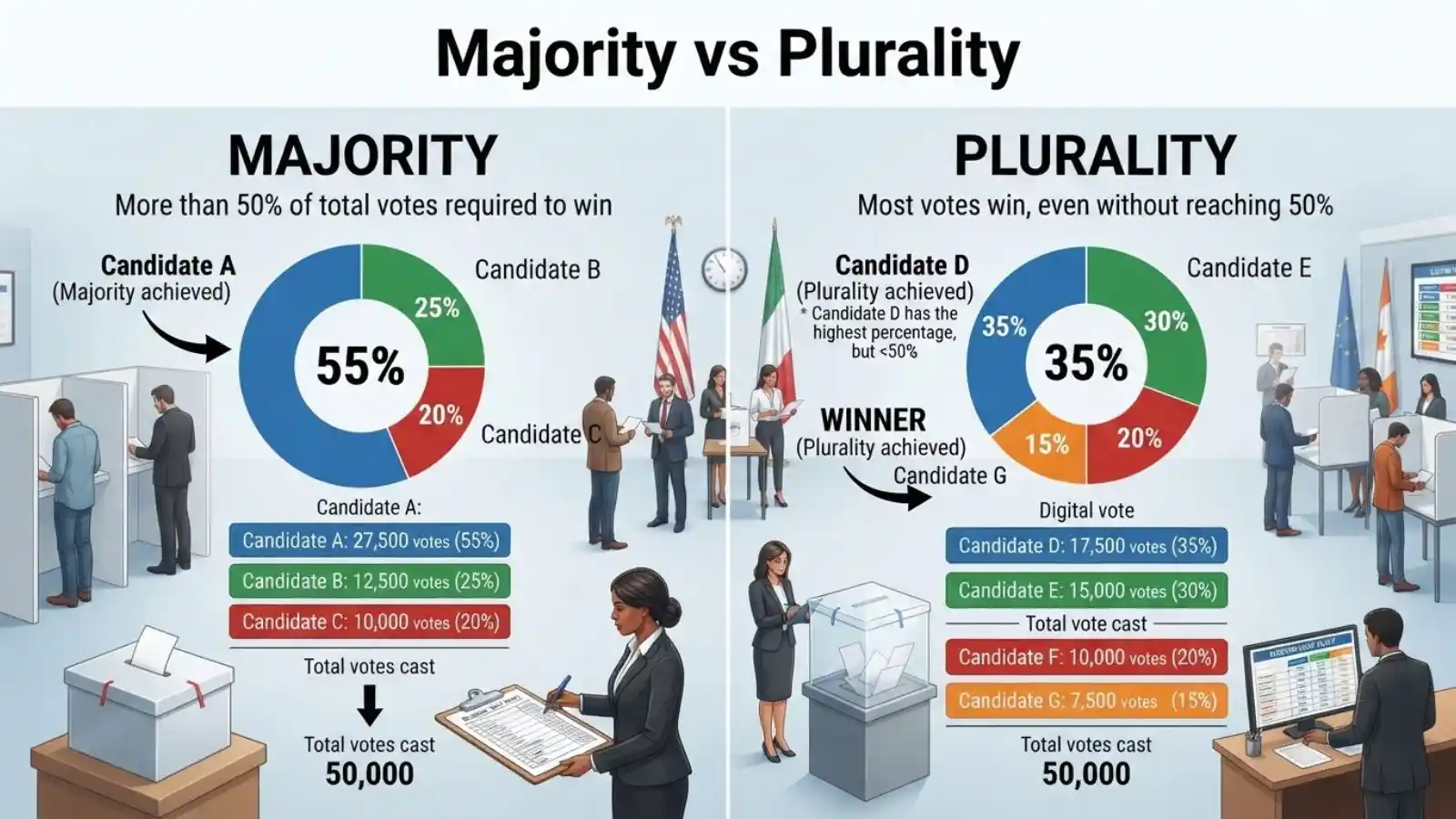
Majority vs plurality refers to two different ways of measuring votes. A majority means more than half of the total votes.
While a plurality means receiving more votes than any other candidate or option, even when that total is below 50%. In a three-candidate election, for example, 45% can be a plurality but not a majority.
Key Takeaways:
- A majority means more than half of the votes.
- A plurality means getting more votes than any other candidate or option.
- A candidate can win by plurality without receiving 50% of the vote.
- If a majority is required and nobody reaches it, some voting systems use a runoff or another round.
- Many U.S. elections use plurality rules, although election procedures vary by office and jurisdiction.
What Is a Majority?
A majority means more than half of the total. In an election with 100 votes, a candidate would need at least 51 votes to have a majority.
The important point is that a majority is based on a threshold. The candidate must cross the halfway mark rather than simply receive more votes than each individual opponent.
For example, imagine three candidates receive these results:
| Candidate | Votes | Percentage |
| Candidate A | 45 | 45% |
| Candidate B | 35 | 35% |
| Candidate C | 20 | 20% |
Candidate A has the largest share, but 45% is not more than half. Therefore, Candidate A has a plurality, not a majority.
A majority would require more than 50% under the usual definition used in elections.
Majority Vote Example
Suppose 200 people vote on a proposal:
- Option A: 110 votes
- Option B: 90 votes
Option A receives 55% of the votes. Because 110 is more than half of 200, Option A has a majority.
This is why the terms “majority” and “most” should not automatically be treated as synonyms. Something can have the most votes without having more than half of all votes.
What Is Plurality?
A plurality means receiving more votes than any other individual candidate or option.
Unlike a majority, a plurality does not require more than 50%.
Consider a race with three candidates:
- Candidate A: 42%
- Candidate B: 34%
- Candidate C: 24%
Candidate A has the largest percentage, so A has the plurality. But A does not have a majority because 42% is below 50%.
This distinction becomes especially important when several candidates divide the vote. The more candidates competing, the more possible it becomes for the leading candidate to have a plurality without receiving a majority.
Plurality Vote Example
Imagine 1,000 people vote:
- Candidate A: 430 votes
- Candidate B: 350 votes
- Candidate C: 220 votes
Candidate A receives the most votes, with 430. That is a plurality.
However, 430 is less than the 501 votes that would be needed for a majority of 1,000.
If the election rules say that the candidate with the most votes wins, A wins by plurality. If the rules require a majority, the election would need another step because nobody crossed the required threshold.
Majority vs Plurality: Key Differences
The easiest way to understand majority vs plurality is to focus on the rule each one uses.
| Feature | Majority | Plurality |
| Basic meaning | More than half | More votes than any other candidate |
| Requires over 50%? | Yes, under the usual definition | No |
| Can occur below 50%? | No | Yes |
| Depends on other candidates? | Not directly | Yes, because the highest total matters |
| Possible in a three-way race? | Yes | Yes |
| Can determine a winner without 50%? | Generally no, if majority is required | Yes |
| May involve a runoff? | Sometimes | Not necessarily |
A simple memory trick is:
Majority = more than half.
Plurality = more than each competitor.
Those two conditions can produce different results.
How Majority and Plurality Work in Elections
Election rules determine whether a plurality or majority is enough to declare a winner.
Under a plurality voting system, the candidate with the most votes wins. The candidate does not have to reach 50%.
This is commonly associated with first-past-the-post voting. OpenStax describes U.S. elections as generally based on plurality voting, where the candidate with the most votes can win even without a majority.
Under a majority system, a candidate must receive more than half of the relevant votes to win under the applicable rule.
If nobody reaches that threshold, the system may require another election round.
What Happens When Nobody Gets a Majority?
Suppose an election has three candidates:
- A: 46%
- B: 32%
- C: 22%
A has a plurality but not a majority.
If the election requires a majority, A may not immediately be declared the winner. Depending on the jurisdiction and voting method, the rules might call for a runoff election, another round of voting, or a different counting procedure.
Two-round systems are one example: if no candidate reaches the required majority in the first round, another round can be held among qualifying candidates.
How Plurality Voting Works
Plurality voting is comparatively straightforward:
- Voters cast their votes.
- The votes are counted.
- The candidate with the highest total wins.
- Reaching 50% is not required unless another rule says it is.
This means a candidate could receive 45% and still win if the other candidates receive smaller shares.
Majority vs Plurality Example
A numerical example makes the difference easier to see.
Three-Candidate Election
Imagine 10,000 votes are cast:
| Candidate | Votes | Result |
| A | 4,600 | Highest total |
| B | 3,100 | Second |
| C | 2,300 | Third |
Candidate A receives 46% of the vote.
A therefore has a plurality, because 4,600 is more than the total received by either B or C.
But A does not have a majority because 4,600 is less than half of 10,000.
For a majority, a candidate would need more than 5,000 votes under the usual “more than half” definition.
Two-Candidate Election
With only two candidates, the distinction usually becomes much smaller.
For example:
- Candidate A: 54%
- Candidate B: 46%
Candidate A has a majority and also has more votes than the opponent.
But if there are three or more candidates, the candidate with the most votes may fall below 50%. That is where the distinction between majority and plurality becomes especially useful.
Majority vs Plurality in U.S. Elections
The United States uses different election rules depending on the office and jurisdiction, so it is important not to treat every American election as identical.
Plurality voting is widely used for U.S. elections. In a plurality system, the candidate who receives the most votes wins, even when that candidate receives less than half of the votes.
State and local rules can differ, however, and some elections use majority requirements or runoff procedures.
The distinction also matters when discussing presidential elections.
First-Past-the-Post Voting
First-past-the-post is a common name for a plurality system in which the candidate with the highest number of votes wins the particular contest.
For example, if three candidates receive 41%, 36%, and 23%, the candidate with 41% is first. In a contest decided by plurality, that candidate wins despite being below 50%.
This is different from a system that requires a candidate to cross a majority threshold.
Presidential Elections and the Electoral College
The U.S. presidential election has another important layer: the Electoral College.
The nationwide popular vote and the Electoral College vote are not the same thing. The National Archives explains that states determine how their electors are allocated, and in most states the candidate receiving the state’s largest popular vote total receives all of that state’s electoral votes under the winner-take-all rule. Maine and Nebraska use different allocation systems.
As a result, saying that a presidential candidate “won by majority” can be misleading if it is unclear whether the statement refers to the popular vote in a particular state, the nationwide popular vote, or Electoral College votes.
The relevant voting rule and level of the election should always be identified.
Common Mistakes About Majority and Plurality
Mistake 1: Thinking plurality means 50% or more.
It does not. A plurality only requires the highest vote total.
Mistake 2: Treating “most votes” and “more than half” as identical.
They can be different. A candidate can receive the most votes while remaining below 50%.
Mistake 3: Assuming every election uses the same rule.
Election laws vary by jurisdiction and office.
Mistake 4: Assuming a plurality automatically means a majority.
A plurality winner may have less than half of the votes.
Mistake 5: Confusing the popular vote with the Electoral College.
For U.S. presidential elections, these are different parts of the electoral process.
Frequently Asked Questions
Does plurality mean more than 50%?
No. A plurality means having more votes than any other candidate or option. It can be below 50%. For example, if candidates receive 45%, 35%, and 20%, the candidate with 45% has a plurality but not a majority.
What percentage is a majority?
A majority is more than 50% of the relevant total. With 100 votes, 51 votes represents a majority. With 1,000 votes, 501 votes represents a majority. The exact counting rule can depend on the election or voting procedure.
Can someone win with a plurality?
Yes. If the applicable election rule says that the candidate with the most votes wins, a candidate can win with a plurality even without receiving more than half of the votes. This is a central feature of plurality or first-past-the-post voting.
What is the difference between majority vote and plurality vote?
A majority vote requires more than half of the relevant votes, while a plurality vote goes to the candidate or option with more votes than any other individual competitor. The difference is most noticeable when three or more candidates split the vote.
Conclusion:
The key difference in Majority vs Plurality is simple: majority means more than half, while plurality means the largest individual share.
A candidate receiving 55% has a majority. A candidate receiving 45% in a three-way race may have only a plurality.
Understanding this distinction makes election results easier to interpret, particularly when several candidates divide the vote.
It also helps explain why some voting systems declare a winner after one round while others require a candidate to reach a majority or proceed to another round.